data-animation-override>
“Published in NZV8 Issue No. 79”
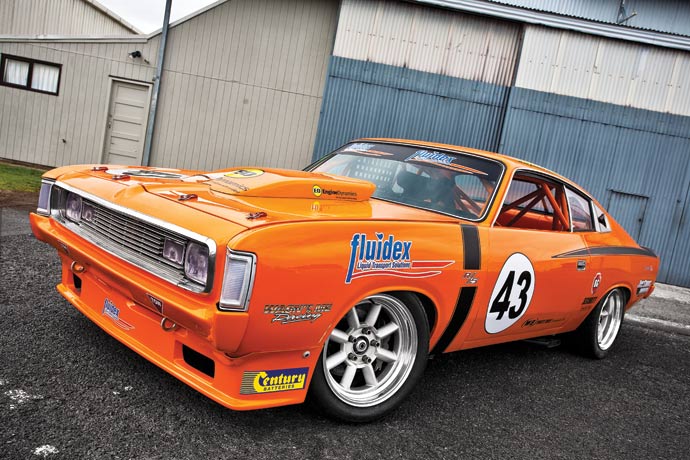
It all started with a few beers,” says Tony Galbraith of his immaculately presented Valiant. “I was talking with the guys about what I should do after retiring from speedway racing, and next thing you know we’re building a race car.”
With Tony’s driving pedigree, it’s not too surprising that CMC was the class the lads talked him into racing in, after all, besides the fact they’re cool cars, many of them spend more time going sideways than they do in a straight line, and that suited Tony’s driving style perfectly.
The more the guys talked, the more the build plan evolved, it’s just lucky that one of the guys doing the talking was Craig Hyland, owner and operator of Engine Dynamics. While the name would indicate the business to be an engine builder, the reality is that it’s really a one-stop car-building workshop, and that’s where the entire build would take place.
The thought of buying an existing car, or building something common, didn’t really appeal. Instead Tony, Craig and the rest of the crew wanted something different, yet competitive, but it also had to be easy to run at the same time. Having access to American-built Mopar race motors, the plan soon headed in the Mopar direction. Rather than expensive Dodges, hard to obtain and heavy Plymouths, the idea of building Valiant Chargers was floated. And by Chargers, we mean two of them, to race as a team and pool costs and resources along the way.
After meeting some interesting Valiant owners Tony finally managed to find a decent vehicle to base the build on. Friend Alan Kemp, aka Kempy, who would run the matching vehicle, struggled – finding rust bucket after rust bucket, so his build has been heavily delayed.
Once Tony’s car was back at Engine Dynamics, the build commenced, starting with stripping the car back to a bare shell, strengthening the chassis and removing any excess weight at the same time. A comprehensive cromoly roll cage was stitched in, which also added to the vehicle’s strength.
Having built many different race cars for a wide range of classes, Craig made sure to stick to the letter of the CMC rulebook, but also make the most of the available rules at the same time.
Although Tony wanted plenty of tail-out fun, a large focus was placed on setting the vehicle’s handling up to be as precise as possible. As part of this, custom A-arms were produced for the front and they are suspended with Afco coilovers. The leaf-sprung rear-end is assisted with a Watt’s linkage, and custom sway bars were also fabricated. With sticky Kumho rubber wrapped around the 17×10.5 and 17×11-inch rims and this suspension package, it should stick to the track as well as any other vehicle in the CMC field.
With the knowledge that a serious engine package would be installed, no compromises were made when it came to selecting brakes. Instead, 6-pot Alcon callipers now slow the front, while 4-pot items do the rear. There’s no brake booster to be seen, just pure leg strength and a floor-mounted pedal box.
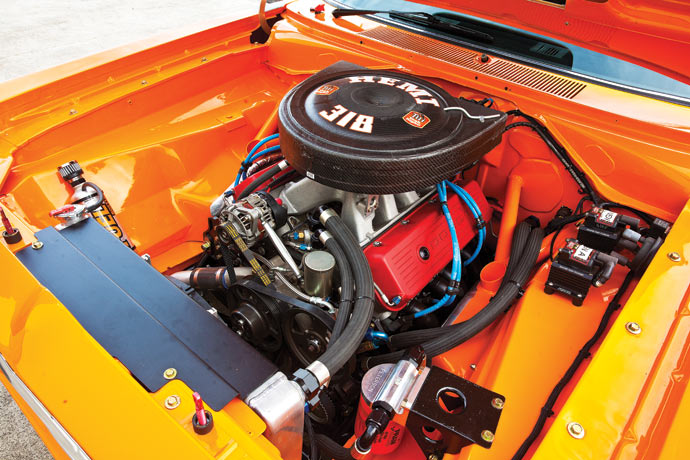
Craig’s always got his finger on the pulse, and when the motors came up for grabs a few years back for a good price, he grabbed what he could. Not knowing the history of the R5 Dodge 358ci version selected to power Tony’s Valiant, it was pulled down and freshened up. Since the Diamond pistons, Callies crank, Callies rods and Bullet cam all looked brand-new, they were all retained. In fact, besides the custom oil pan that was fabricated to fit around the Valiant’s cross-member, the engine is essentially as it was imported. This includes the P7 heads fitted with titanium valves, and the custom carb, which is fitted to the Wilson intake manifold.
For reliability’s sake the team fitted a Johnson’s HTP dry sump kit, for which the oil tank is mounted in the boot. Speaking of which, the boot is an impressive sight, as alongside the dry sump is a massive fuel cell and equally as impressive fuel pump and surge tank arrangement.
Being a new car, rather than a rebuild of an old car, the team had the chance to do things right the first time, without cutting any corners, nor making any compromises. With this in mind, the decision was made to give the option to run in endurance events and potentially GT2 also. This saw the inclusion of twin-ignition systems amongst other items, for complete peace of mind.
An impressive custom dash panel has been created which, besides the usual Auto Meter gauges, has a few handy notes stuck on for Tony’s peace of mind. They’re a good reminder that besides being competitive, the aim is to have a bunch of fun, although in a car like this, we’re not sure how you could forget that, especially when you hear that engine fire into life.
The 700-odd horsepower package is backed up with a Jerico WC4 4-speed gearbox, along with a Quartermaster triple-plate clutch and steel flywheel. To get the power to the track, the team opted for a 9-inch diff with custom housing and fully floating hubs.
Knowing just how hard it is to source rust-free Valiant panels, the guys had A1 Fibreglass construct fibreglass replacements. These include the doors, hood and bootlid, along with a few spares, of course. With the whole lot coated in PPG Citric Orange by White Bros Panel Works in Hamilton, you’d be hard pressed to tell they weren’t steel, till you feel just how light they are.
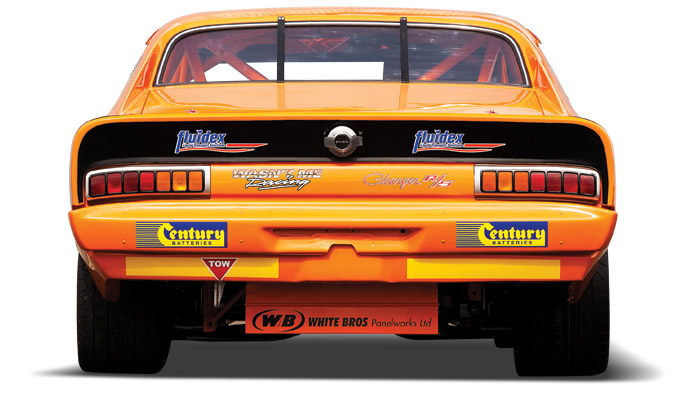
By the time you read this, the car and Tony would have had their first competitive CMC outing. He’s quick to downplay his expectations, rightly stating that most of the competition has had far more seat time than him. Then again, we’ve seen how well he can drive a speedway car, so we’re pretty sure it won’t take him long to get the hang of things. Worst-case scenario, he ends up at the back of the pack. Either way, one thing is for sure, and that is he’ll be having a blast and a cold beer or two with some good mates afterwards.
Specs
Engine: R5 Dodge 358ci V8, R5 Mopar block, Diamond pistons, Callies Ultra rods, Callies Ultra crank, Bullet cam, Jesel belt drive, custom-built oil pan, Johnson’s HTP dry sump oil pump, P7 Dodge heads, titanium intake valves, titanium exhaust valves, Wilson intake manifold, custom carb, 2x MSD 6600 ignitions, 2x HVC coils, Moroso Blue Max leads, custom fabricated headers and exhaust, aluminium radiator with internal oil heat exchanger
Driveline: Jerico WC4 4-speed gearbox, Quartermaster triple-plate clutch, steel flywheel, custom diff housing, fully floating hubs
Suspension: Custom coilover front end, leaf spring with watts linkage rear, Afco coilovers, custom swaybars and mounts
Brakes: Alcon 6-piston front callipers, Alcon rotors, PFC pads, Alcon 4-piston rear callipers
Wheels/Tyres: 17×10.5 and 17×11-inch Vintage Wheel Works rims, 275/40R17 and 315/40R17 Kumho tyres
Exterior: Fibreglass doors, fibreglass hood, fibreglass bootlid, lexan windows, PPG Citric Orange paint
Chassis: Chassis stiffeners, lightened and strengthened
Interior: Racetech seat, Woodward steering column and wheel, Auto Meter gauges, roll cage
Performance: Approx 700hp
Driver Profile
Tony Galbraith
Age: Bloody old
Occupation: Transport Company Director
Previously owned cars: Various speedway cars
Dream car: I think I might have it now
Why the Valiant?: So I could race at different tracks, and Eastern Creek in Australia is looking like a possibility next year. YeeHaa!
Build time: 2 years
Length of ownership: 2 years
Tony thanks: My wife Sheryl, Craig Hyland, David Hogg, Toby and Scott White, Stuart Erye, Kempy
Words: Todd Wylie
Photos: Adam Croy