
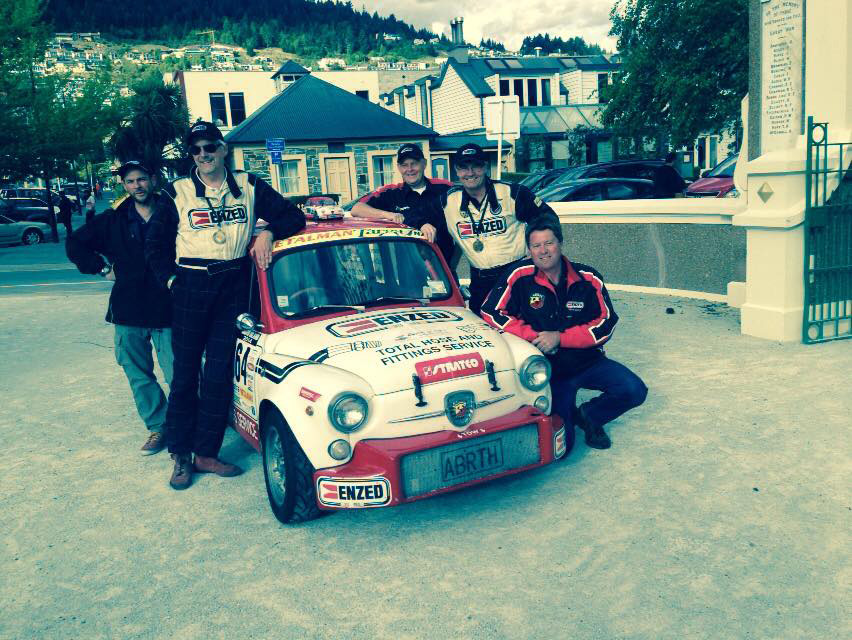
Mike Lowe’s trusty steed heads into retirement

10 November, 2014


After finishing 20 years' of Targa, Mike Lowe's Fiat Abarth will be retired to the New Zealand National Motorsport Museum

After finishing 20 years’ of Targa, Mike Lowe’s Fiat Abarth will be retired to the New Zealand National Motorsport Museum

All racers have to hang their helmets up some day, and Mike Lowe has announced that that day has come for his trusty steed. After participating in, and finishing, every Targa event for the last 20 years in his 1964 Fiat Abarth, Mike has decided to retire the iconic vehicle — it will be relocated to its new home in the New Zealand National Motorsport Museum.

According to Mike, “the time is right … she was telling us something when the clutch failed just three corners from the end of the last stage.”   

Mike kicked off the inaugural 1995 Targa with co-driver Steve Cannon, seeded 22nd following the prologue stage at Pukekohe Park Raceway. As an indication of the little Abarth’s performance, it was clocked at 142kph on the circuit’s back straight — barely any slower than a Dino 246 GT.

The Targa debut would be marked by a high-speed crash after hitting a puddle of oil at around 160kph, putting the Abarth in no condition to continue. However, the car was repaired to drivability, and completed the event. These on-the-fly repairs would become a staple of Mike and his team’s Targa involvement, with every event requiring impromptu repairs of varying intensity, from broken axles, oil leaks, a blown head gasket, through to full-on crashes. As Mike has said, “We came, we broke, we repaired, and we finished!”
 

NZ Classic Car magazine, July/August 2026 issue 406, on sale now

Rebirth of a brilliant Grand Tourer –1973 Datsun 240Z
How often do we long for that ultimate dream sports car, and that dream comes true? This is about one of the most influential Japanese cars of all time, a car that changed the sports car market.
This is about much more than the restoration of an iconic classic sports car, the 240Z. It’s about the culmination of a dream over many years and the friendships made. It’s about the people who helped and the professionals whose approach ensured that the dream became a reality, an attitude typical of the industry we call ‘classic restoration experts’.
It is no surprise that the outcome after a lengthy search by Conrad Van der Geest for the right Datsun 240Z culminated in a trophy for the best Japanese car at this year’s Caroline Bay Beach, Rock N’ Hop at Timaru.
Originally a roadworthy car in running order, it was left-hand-drive and had been driven for several years by its Timaru owner, as Conrad explains.
“A neighbour, Dave Barron, knew I was looking for one and introduced me to the owner. I had seen the car being driven around Timaru. It was unusual for one of these coming originally from California, so it was a really clean car instead of rusty, as they are prone to rust. The story goes that the grandfather passed it onto his grandson, who decided to sell it, and that’s when it came over here.”
Every issue comes with our FREE huge wall poster; this issue, it’s our cover car for this edition, a 1973 Datsun 240Z

The butterfly effect

The man on the mountain bike pedalled over, taking it all in. Gazing in wonderment at this small Japanese coupe with butterfly doors, he said, “Wow, I have never seen one of these before. What is it?” When I told him it was a Toyota, he nearly fell off his bike.
The Toyota Sera is unique amongst ’90s Japanese coupes. The Sera, which is Italian for ‘evening’, can trace its roots back to Toyota’s AXV-II concept car. Launched as part of a trio of Toyota concept cars at the 1987 Tokyo Motor Show, it shared its underpinnings with the P70 Toyota Starlet. The similarities ended there, thanks to the AXV-II’s low-slung and rounded coupe styling with butterfly doors. These doors were held upright by gas struts when fully open. Glass covered the upper section of the doors and the rear hatchback.
These features, much to everyone’s surprise, were carried over to the production Sera in 1990. Toyota marketed the Sera, which means ‘will be’ in Spanish and ‘princess’ in Hebrew, as a funky alternative to the much-loved MR2.