
Aston Martin Ulster to break world record

16 June, 2014


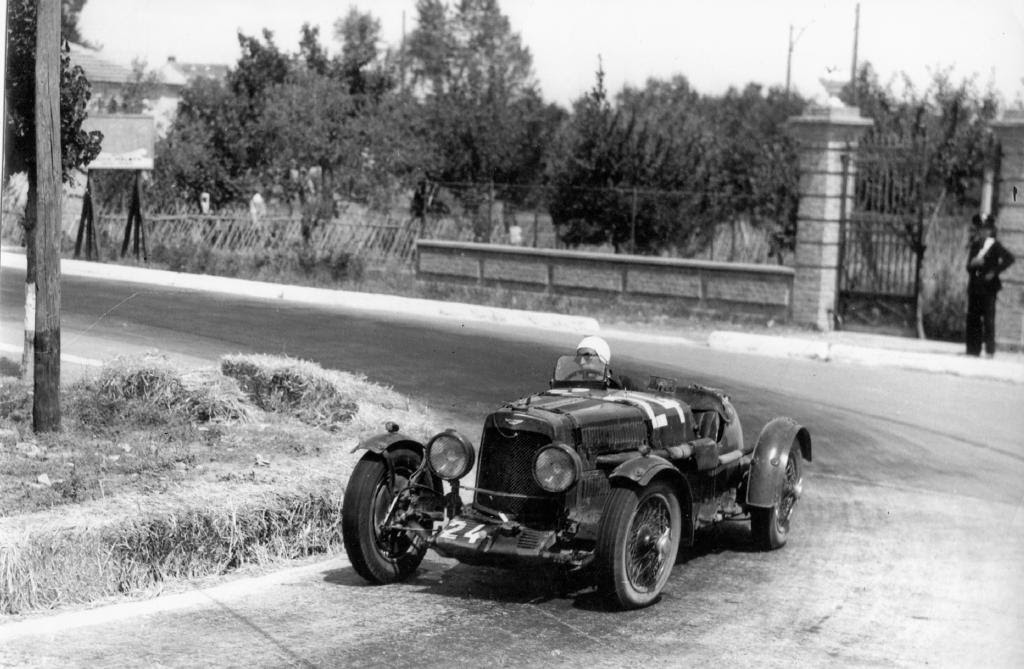
There may be another Aston Martin about to break world records at auction. As seen in yesterday’s articleThe Persuaders! vehicle sold for more than NZD$1 million. However, the upcoming Bonhams Goodwood Festival of Speed Sale may just see another record breaker in the rare Aston Martin Ulster.

The ex-Works Aston Martin Ulster CMC 614 has an incredible racing history  and is one of only 21 production Ulsters ever built. It’s estimated at £1.4 million–1.6 million (approx. NZD$2.8 million–3.2 million) and it is expected to beat the existing world record of £1.3 million set by Bonhams last December for a pre-war Aston Martin at auction.

The Ulster’s racing history dates back nine decades and 100 races. It has raced every year since 1935 — excluding a rest period throughout World War II — and is built for endurance and pace. The two-seater Ulster features a four-cylinder 1496cc engine and is guaranteed to reach speeds of  up to 100mph.

This particular Ulster started its racing career in 1935 at the Mille Miglia. It finished eighth in the 1935 Le Mans 24-hour race and went on to complete the Targa Abruzzo 24-hour sports car event in Italy — finishing third overall and first in class.

As a period entrant in both the Mille Miglia and Le mans races, CMC 614 is not only eligible, but positively welcomed to the great historic motor sport events worldwide. This includes the Mille Retrospective, Le Mans Classic, Goodwood Revival, Monterey Historic, California Mille, and Colorado Grand.

Bonhams Group Head of Motoring James Knight says, “CMC 614 certainly has the potential to exceed the existing Ulster record we established a few months ago. This car has the added benefit of being a Works entry that competed at the very highest international level. It will attract international interest and we are looking forward to an exciting sale.
NZ Classic Car magazine, July/August 2026 issue 406, on sale now

Rebirth of a brilliant Grand Tourer –1973 Datsun 240Z
How often do we long for that ultimate dream sports car, and that dream comes true? This is about one of the most influential Japanese cars of all time, a car that changed the sports car market.
This is about much more than the restoration of an iconic classic sports car, the 240Z. It’s about the culmination of a dream over many years and the friendships made. It’s about the people who helped and the professionals whose approach ensured that the dream became a reality, an attitude typical of the industry we call ‘classic restoration experts’.
It is no surprise that the outcome after a lengthy search by Conrad Van der Geest for the right Datsun 240Z culminated in a trophy for the best Japanese car at this year’s Caroline Bay Beach, Rock N’ Hop at Timaru.
Originally a roadworthy car in running order, it was left-hand-drive and had been driven for several years by its Timaru owner, as Conrad explains.
“A neighbour, Dave Barron, knew I was looking for one and introduced me to the owner. I had seen the car being driven around Timaru. It was unusual for one of these coming originally from California, so it was a really clean car instead of rusty, as they are prone to rust. The story goes that the grandfather passed it onto his grandson, who decided to sell it, and that’s when it came over here.”
Every issue comes with our FREE huge wall poster; this issue, it’s our cover car for this edition, a 1973 Datsun 240Z

The butterfly effect

The man on the mountain bike pedalled over, taking it all in. Gazing in wonderment at this small Japanese coupe with butterfly doors, he said, “Wow, I have never seen one of these before. What is it?” When I told him it was a Toyota, he nearly fell off his bike.
The Toyota Sera is unique amongst ’90s Japanese coupes. The Sera, which is Italian for ‘evening’, can trace its roots back to Toyota’s AXV-II concept car. Launched as part of a trio of Toyota concept cars at the 1987 Tokyo Motor Show, it shared its underpinnings with the P70 Toyota Starlet. The similarities ended there, thanks to the AXV-II’s low-slung and rounded coupe styling with butterfly doors. These doors were held upright by gas struts when fully open. Glass covered the upper section of the doors and the rear hatchback.
These features, much to everyone’s surprise, were carried over to the production Sera in 1990. Toyota marketed the Sera, which means ‘will be’ in Spanish and ‘princess’ in Hebrew, as a funky alternative to the much-loved MR2.