
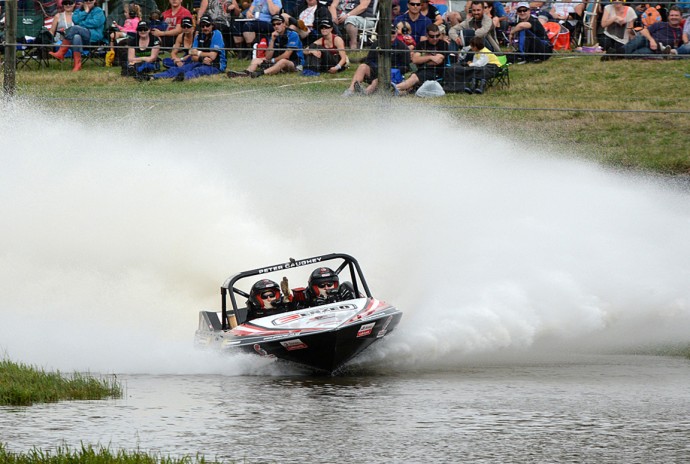
Peter Caughey wins Suzuki SuperBoat Champs round five

16 June, 2014


Photo: Ian Thornton

Photo: Ian Thornton

Peter Caughey and his Enzed team have won the penultimate round of the Suzuki SuperBoat Champs which was held in Whanganui on April 5.

Taking out round four of the SuperBoat Champs sees Caughey defend his four-time world and six-time New Zealand SuperBoat champion title as he also prepares for the World Championships coming up in America in August.

“Up to this point we’ve not only been focusing on the New Zealand champs but in pushing the boat and the team as hard as we dare in pursuit of greater understanding of the team’s capability as the Worlds loom. Is the boat up to it, and is the team up to it.”

Caughey’s Sprintec boat has repeatedly set each event’s fastest time, yet he’s taken the chequered flag less often than his speed might suggest, as chasing ultimate pace can backfire.

“We’ve raced harder than we needed to at times, but for the worlds you need to be on your best game,” the Canterbury racer says. “Racing internationally is a big undertaking, and we want to go there knowing we have a package capable of winning.”
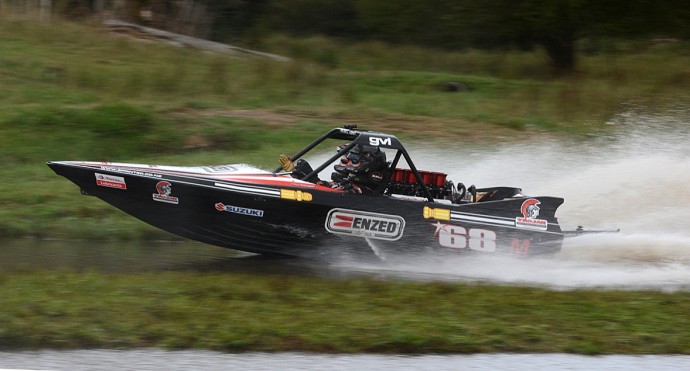

Photo: Ian Thornton

Photo: Ian Thornton

Caughey’s team is aware there are no guarantees, but it takes time – and time spent in the white heat of top-level competition – to fine tune a high-powered lightweight racer like Caughey’s Sprintec-built SuperBoat.

“It’s not easy to find that last two or three per cent of your boat’s ultimate performance, and that is what we have been focused on this season,” Caughey says.

His biggest hurdle will be raising the money to go, Caughey says, but he’s suspended sponsor talks to focus on the last two rounds of this season’s NZ champs, with the points now tight at the top.
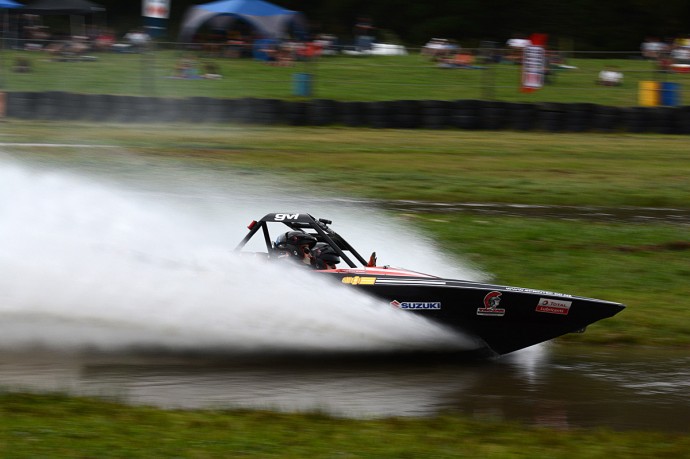

Photo: Ian Thornton

Photo: Ian Thornton

He’s had the boat’s motor out, given the hull a few tweaks after its fast airborne exit from the last round, and fettled the jet unit in pursuit of more speed, which should suit the fast, flowing rotation at Whanganui’s Shelterview track.

“It’s a rotation I expect will deliver a level playing field for the top three. Phonsy will have his twin-turbo back in after trying a new motor at Hastings, Hill has good power too, and we’ll all be looking over our shoulders this weekend,” he says.

“The big variable is night racing, it’s difficult, and the faster you go the trickier it is, but it’s difficult for everyone, and traditionally Wanganui prepares well.”

The final round of the Suzuki SuperBoat class will be held in Wanaka (ending under lights) on April 18.
 

NZ Classic Car magazine, July/August 2026 issue 406, on sale now

Rebirth of a brilliant Grand Tourer –1973 Datsun 240Z
How often do we long for that ultimate dream sports car, and that dream comes true? This is about one of the most influential Japanese cars of all time, a car that changed the sports car market.
This is about much more than the restoration of an iconic classic sports car, the 240Z. It’s about the culmination of a dream over many years and the friendships made. It’s about the people who helped and the professionals whose approach ensured that the dream became a reality, an attitude typical of the industry we call ‘classic restoration experts’.
It is no surprise that the outcome after a lengthy search by Conrad Van der Geest for the right Datsun 240Z culminated in a trophy for the best Japanese car at this year’s Caroline Bay Beach, Rock N’ Hop at Timaru.
Originally a roadworthy car in running order, it was left-hand-drive and had been driven for several years by its Timaru owner, as Conrad explains.
“A neighbour, Dave Barron, knew I was looking for one and introduced me to the owner. I had seen the car being driven around Timaru. It was unusual for one of these coming originally from California, so it was a really clean car instead of rusty, as they are prone to rust. The story goes that the grandfather passed it onto his grandson, who decided to sell it, and that’s when it came over here.”
Every issue comes with our FREE huge wall poster; this issue, it’s our cover car for this edition, a 1973 Datsun 240Z

The butterfly effect

The man on the mountain bike pedalled over, taking it all in. Gazing in wonderment at this small Japanese coupe with butterfly doors, he said, “Wow, I have never seen one of these before. What is it?” When I told him it was a Toyota, he nearly fell off his bike.
The Toyota Sera is unique amongst ’90s Japanese coupes. The Sera, which is Italian for ‘evening’, can trace its roots back to Toyota’s AXV-II concept car. Launched as part of a trio of Toyota concept cars at the 1987 Tokyo Motor Show, it shared its underpinnings with the P70 Toyota Starlet. The similarities ended there, thanks to the AXV-II’s low-slung and rounded coupe styling with butterfly doors. These doors were held upright by gas struts when fully open. Glass covered the upper section of the doors and the rear hatchback.
These features, much to everyone’s surprise, were carried over to the production Sera in 1990. Toyota marketed the Sera, which means ‘will be’ in Spanish and ‘princess’ in Hebrew, as a funky alternative to the much-loved MR2.