Who’s running the numbers? New Zealand’s quickest street and drag cars

12 November, 2015


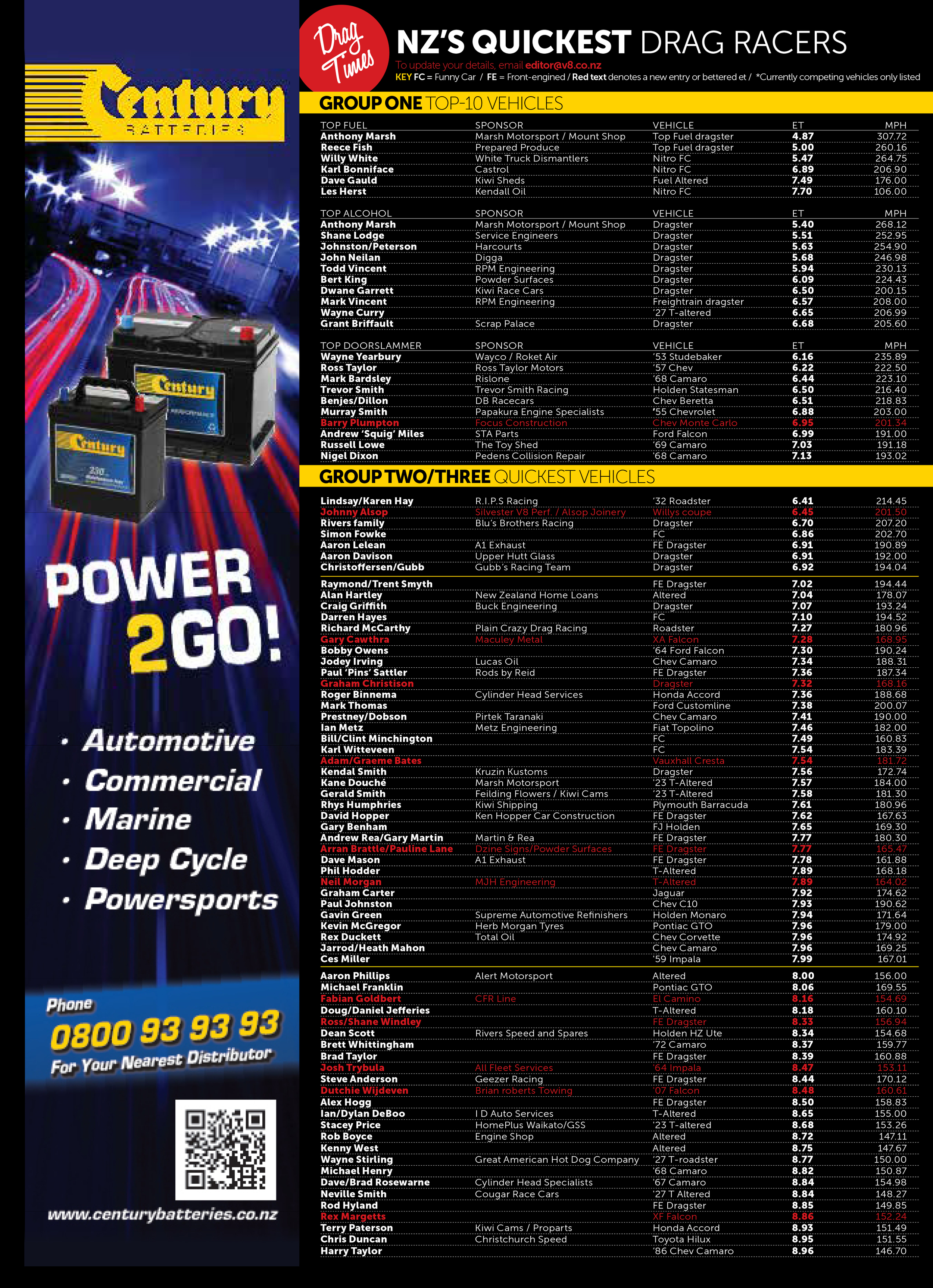
In every issue of NZV8 magazine we feature a list titled New Zealand’s Quickest Drag Racers (as seen below). The list isn’t so much one to celebrate historical achievements, but to give those who are currently competing the credit they deserve. As such, it’s updated on a monthly basis to not only include new entrants, but also to show which drivers have improved their PBs.

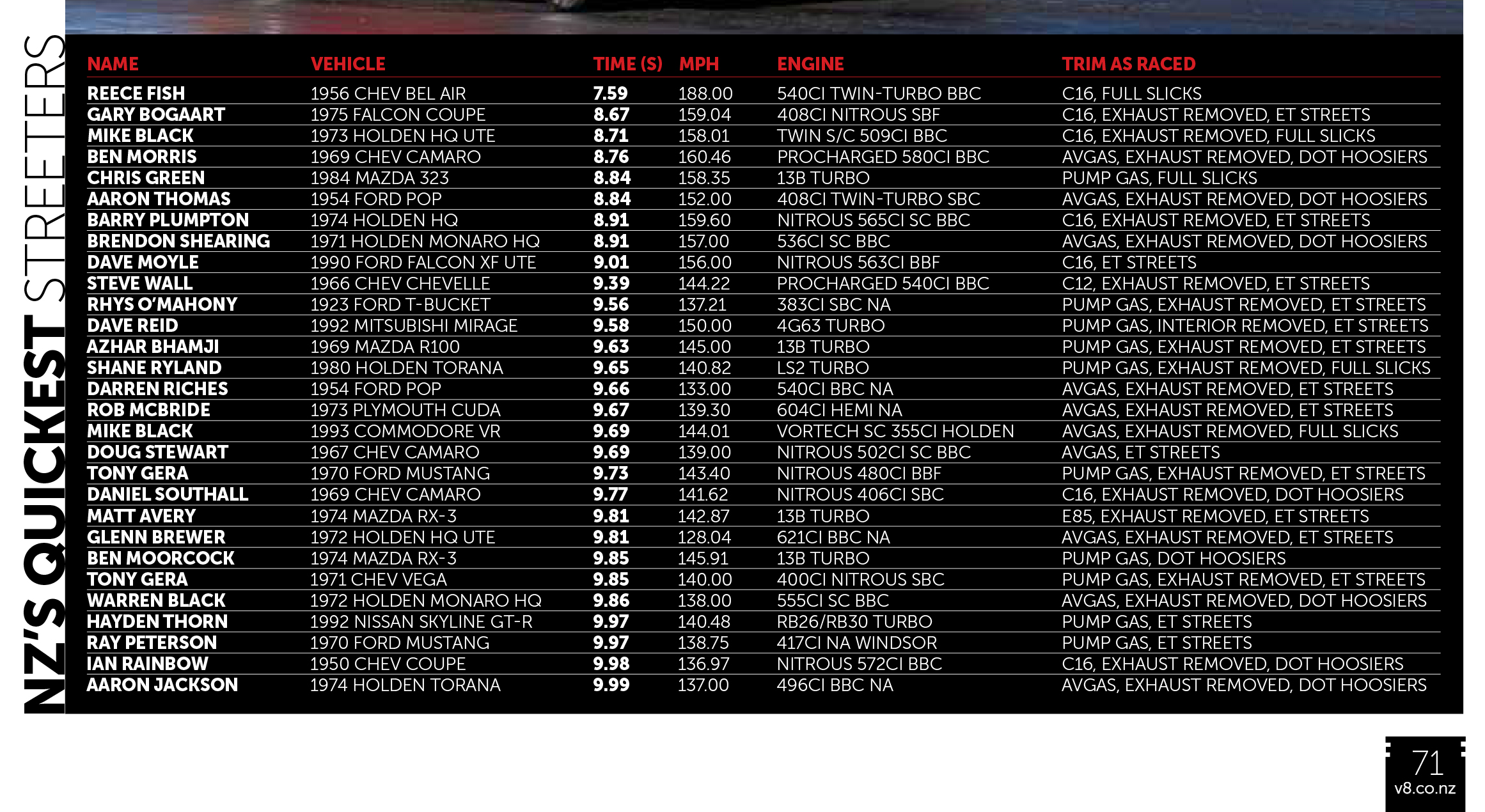
Included on the list is any V8-powered vehicle that runs 8.99 seconds or quicker, regardless of which class they race in. The only exception being streetcars, which fall into our separate Quickest Streetcars List, that we also run, assuming they meet the legal criteria. For the streetcar list, the time cut-off is 9.99 seconds or quicker, since nine seconds seems to be the new benchmark for what quantifies a quick streeter these days. You can see who’s currently on that list here.
As a general rule, we’ve always asked for drivers themselves to keep us informed of their times and progress, but we’ve also made an effort to hunt out the information as much as possible. However, that’s where we now need your help.

With so many new cars running into the eight- or nine-second zones, it’s now more important than ever to remove those no longer competing, to give those that are the room they require.

If you’re on the list, but have parked the car up for a few seasons, or sold it, we’d love to hear from you. Likewise, if you’re not on either list and should be, then please do let us know. The easiest way is by emailing [email protected]. Even if you’re not on the list, but have it on good authority that someone should/shouldn’t be, we’ll take your word for it. 

So get emailing!
Coaching from the bench: Casting plastic knobs and rubber parts

Casting rubber items is simple if you have a good original to work with. The item doesn’t have to be perfect. You can use plasticine to smooth out cracks, and you can even make whole prototypes out of low-fire modelling clay available from craft stores if you need to. Prototypes can also be made of wood or metal.
You will need mould dams to contain the liquid urethane moulding solution until it cures. You can build boxes out of strips of wood, but I have found that small plastic boxes and bowls such as those you would use for leftovers in your fridge work well if you spray them with a mould release agent.
Temperature is important to the chemical processes involved, so work in an area that can be maintained at around 20 degrees. You will also need adequate ventilation because the fumes can be dangerous to breathe. And you will want to wear latex gloves to protect your hands.

Fraser Cars – low flying into the fourth decade

With almost three and a half decades under its belt, Fraser Cars is one of New Zealand’s longest-surviving car manufacturers. The company first opened its doors for business in 1988, during the boom time for kit manufacturers. During the ’80s, around 40 different companies were building kits and turnkey cars for this niche market. Of those, only Fraser and Almac Cars (established 1981) are still in business today.
Most of the new kit car companies were killed off in the cradle by the threat of new legislation that never eventuated and definitively by the sudden availability of high-performance Japanese cars when the floodgates to second-hand imports were opened. The now long-retired founder of the company, Neil Fraser, first came across Lotus Seven replicas while racing Lotus Cortinas in the early ’80s. He regularly found himself racing against a little Caterham, a Lotus Seven–styled car built in England. He was very impressed by its simplicity and handling. In 1986 Fraser built his own Lotus Seven–type car, using the knowledge he had gained from several close looks at the Caterham.