Life is all about connections — or degrees of separation, if you like — and I got a few reminders of just how connected things can get while putting together a recent edition of New Zealand Classic Car.
The first connection was made when we decided to feature a Mazda RX-3 to complement the article in New Zealand Classic Car Issue No. 296 on Japanese performance cars that we’d already slated for inclusion in this issue of the magazine. Talking to the RX-3’s owner reminded me that the very first car I owned in New Zealand (all the way back in 1980) was also rotary powered — a 1975 Mazda RX-2. At the time, having only just started work, the Mazda had attracted me because it offered good performance for very few dollars. You have to bear in mind that following the oil shocks of the late ’70s, Rob Muldoon’s government had instituted the notorious carless days, at the end of July the previous year. In the prevailing environment of the time, nobody wanted to own a gas-guzzling rotor motor. However, I did the sums, and any potentially extra outlay on petrol would be more than compensated by the low purchase price of a rotary-engined Mazda.
The next step was to find a well-priced, low mileage example — up stepped my father: “I know this bloke in Grey Lynn.”
That bloke turned out to be Nick Begovic. Originally from Dalmatia, Nick had been in the second-hand-car-selling business all his life, and was a key member of what has been termed the ‘Dally Mafia’ — New Zealand’s Dalmatian community of car dealers and motor-racing enthusiasts.
I duly visited Nick’s car-sales yard (these days it’s a fruit and veg shop) situated just up the road from one of his favourite haunts, Western Springs Speedway. There I purchased the RX-2 that I ran as my everyday driver for the next few years.
I didn’t catch up with Nick, an active member of the former MotorSport Association of New Zealand (MANZ), until we met at Pukekohe during the running of the 1983 NZ Grand Prix, a race that was eventually won by David Oxton. Later, Nick introduced me to Nigel Roskilly, at that time chief time-keeper at Pukekohe, and I ended up wielding a stop watch for a several races under Nigel’s supervision. Of course, Nigel — in the guise of controversial columnist, Gabriel — would end up working for me when I took over as editor of this magazine.
Like Nigel, Nick Begovic is no longer with us, having passed away in January 2013, but motor-racing enthusiasts who were around back in the day still recall ‘Big Nick’ with fondness.
So many connections — and they all merged together when I received this month’s Motorsport Flashback column, and read Michael Clark’s comments about David Oxton’s son and his brief tribute to the recently deceased Robin Curtis. Coincidentally, yet another connection — I’d only been talking to Robin a few months before about pilfering some of his vintage motor-racing photographs.
Brushing that link aside, I then contacted motor-sport photographer extraordinaire, Terry Marshall, for a few images to illustrate Motorsport Flashback. Terry, following an advance look at the text of Michael’s column, duly made a few connections of his own by providing a photograph that linked Robin Curtis to David Oxton. Clever lad!
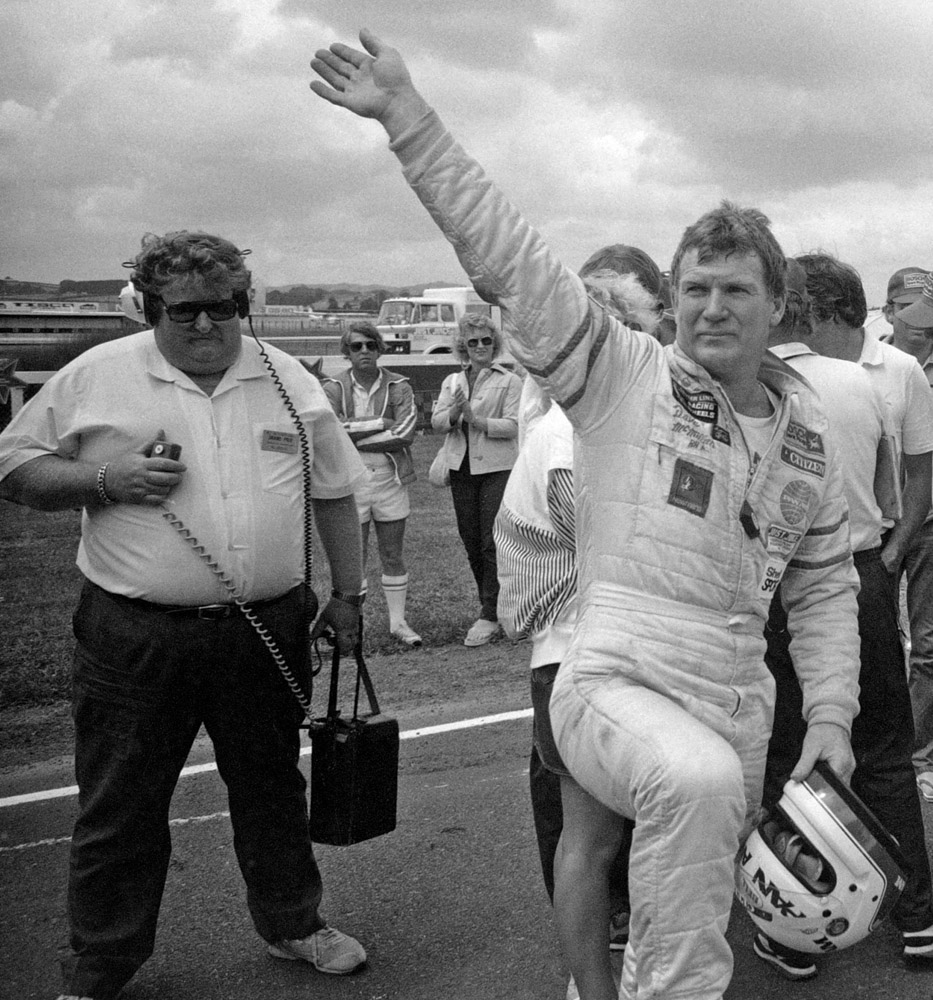
Big Nick watches on as Dave McMillan celebrates his first heat win at the 1983 NZ Grand Prix / Image: Terry Marshall
It all ended there — or at least it would have done until I noticed that the photograph also showed Nick Begovic, Terry thus making the final connection without even knowing that it existed. Talk about a small world!
This article was originally published in New Zealand Classic Car Issue No. 296. You can pick up a print copy or a digital copy of the magazine below: