The annual Auckland All Ford Day, held on Sunday, April 12 at Smales Farm Business Park, Takapuna, had a large turnout of Ford-based vehicles, from vintage cars to hot rods, brand-new Falcons and Mustangs, and everything in-between. The event is organized by five Auckland Ford clubs: Auckland Falcon Owners Club, GT Falcon Club, Auckland Mustang Owners Club, Ford RS Owners Club, and Ford Anglia 105E Enthusiasts Club. The organizing committee also includes representatives from the Auckland Ford dealerships.
What began as a small club event back in 1999, is now one of the largest one-marque-only events in New Zealand, and this year proceeds from the gate and refreshment purchases went towards the Foundation for Youth Development (FYD). FYD supports under 18-year-olds, and works to provide the skills needed to improve the lives of all young Aucklanders, covering the entire spectrum from at-risk youths to others who just need a nudge in the right direction to stay on track. FYD’s programmes teach life skills that are not part of the school curriculum and focuses on building a youth population with a positive outlook.

USA, Australian, and English–origin, Ford-based vehicles were all accounted for in the crowds that filled Smales Farm Business Park to capacity.

John and Robyn Della-Mura’s recently imported ’36 Ford three-window coupe features Mercury hubcaps and red tuck-and-roll interior for the ultimate in ’50s styling.

Tania Foster’s early custom-themed, bare-metal ’36 Ford three-window coupe always draws a crowd wherever she goes. It’s a fitting tribute to her well-known, late-husband Steve.

It was excellent to get up-close and personal with the ex-Craig Pulman Falcon coupe race car of the ’80s. It’s one trick car that’s pushed the boundaries of the rule book.

The Auckland Mustang Owners Club were out in force with a dedicated area for Pony cars, featuring the old and the new.

This 1970 BOSS 302 Mustang was perfect with a 302 and a Hurst-shifted four-speed.

Looking ready for the race track, this 1965 GT350 Mustang exuded the Carrol Shelby influence.

All day this Shelby Super Snake widebody had a crowd around it, boasting its 1000 horsepower under the hood and it is reportedly capable of running 9.2 seconds in the quarter-mile.

This line-up of Cobras was impressive and it showed each owner’s different take on the high-performance sports car.

It’s super rare and impressive, and this 1968 Shelby GT500KR was actually driven to the event in its immaculate form. It featured a 428 Cobrajet under the hood and original Goodyear tyres.

This sleeper 1978 Ford Escort runs a 347ci Windsor and runs 11.7 seconds at 118mph in the quarter-mile.

These three ’34 Fords were just a few of the many hot rods in attendance.

Warren Fairhurst recently purchased Alan Hulse’s ’32 Ford three-window coupe, and he has been making a few changes to it as he drives it.

Sam Ferebend’s ’39 Mercury convertible is immaculate throughout and very rare.

Fast Parts’ Scott Campbell turned up in his street-strip Mk2 Cortina, seen here with his mascot.

Paul McCarthy’s Zakspeed Escort is always impressive to view.

The ex-Rod Harvey ‘PROLOW’ blown Falcon still looks good after all these years.

Athol Anderson has been enjoying this trick ’32 Ford Tudor having recently updated the interior.

Jock Hinton’s heavily modified ‘Chop Suey’ F100 is dwarfed by this Ford Bonus alongside it.

Jon and Marlene Robben ventured up from Cambridge in their cool Model A pickup.

Bert Quinn’s recreation of a Perana V8 Capri sure looked like a lot of fun.
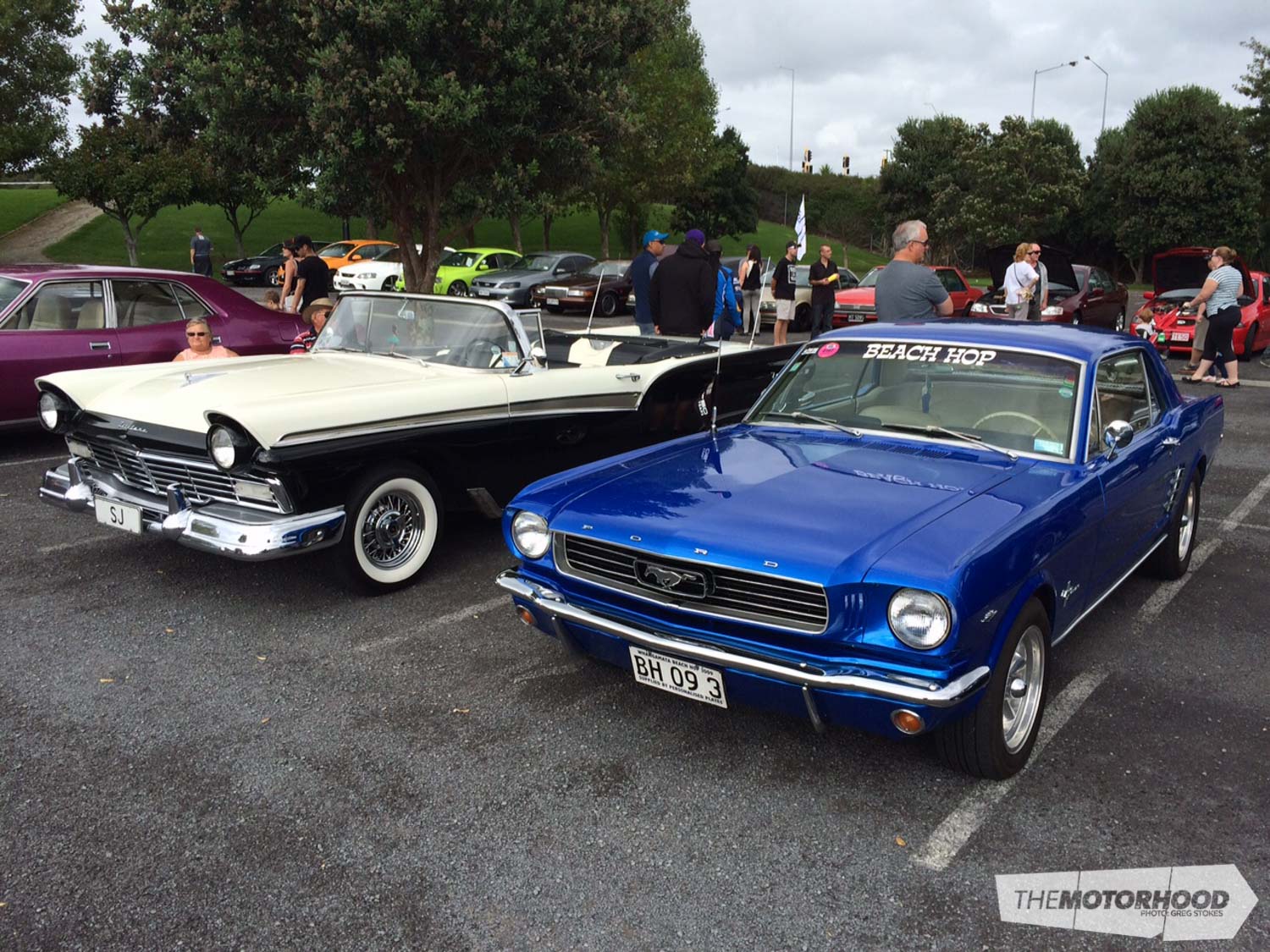
This ’57 Ford retractable looked great alongside one of the previous Beach Hop–giveaway Mustangs.

Dave Brown’s flamed ’40 Ford coupe was originally built in the USA by Chip Foose’s father, Sam Foose.

Ross and Lizzy Maulder’s striking F100 gets used to the max, and is enjoyed by the entire family.

Gary Wright’s ’38 Ford coupe has great stance and colour contrast, with the cream solids against the metallic blue body.

This tough Falcon coupe was one of a few blown street machines in attendance.

Trent Smythe’s ’66 Ford Falcon is one slick ride, shown here with son Couper’s Merc pedal car.

This 1923 Model T was the oldest car in attendance and was actually driven into the event.

Ian Neary’s famous ’59 Ford retractable is the suitable calling card for Mothers.

Zoe Radford’s supercharged Sprint is one tough street car.

Stance is everything, and Ian Taylor’s ‘BILIT’ Model A coupe, built by John Reid in the ’90s, has it all going on.