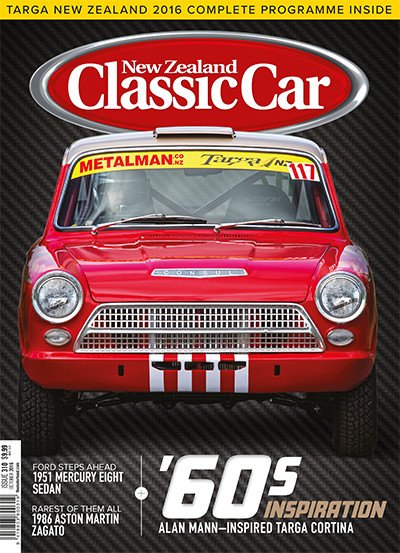
It’s hard to believe it’s that time again. New Zealand Classic Car magazine is once again proud to be associated with the 22nd annual Targa New Zealand event.
This year’s Targa will kick off from Taupo for the first leg then head south to Ohakune for the night. The second leg will head further south, finishing in Palmerston North after six gruelling special stages, and resume the following day to head eastwards to Havelock North on leg three. The final day, leg four, will be confined to the Hawke’s Bay region, with the event finally finishing once again in Havelock North.
This Targa’s 640km of special stages and almost 1100km of touring stages are sure to be hotly contested by the competitors, and will test man and machine alike.
A full and comprehensive official Targa programme, providing all the event details — including a complete driver directory, route maps, and route schedule — is included in the October 2016 issue. This will allow you to pick out a decent vantage point to watch some of the best drivers in the business, such as Clark Proctor, Tony Quinn, Glenn Inkster, and Leigh Hopper — to name a few — as they display their driving prowess on some of the country’s most testing and treacherous tarmac stages.
In addition, we feature Chris Alexander’s stunning Ford Cortina MkI. Chris is definitely no stranger to sitting behind the wheel of a rally car, and he’s competed — rather successfully, I might add — in many gravel and tarmac events. He has also built a number of rally cars, primarily Ford Escorts, and this is his first Ford Cortina, a build that was inspired by Alan Mann, who gained a reputation for building fast Fords wearing striking red and gold livery back in the 1960s.
Looking at this car leaves absolutely no doubt that Chris is a consummate perfectionist in everything he attempts, and it was built especially with this Targa event in mind, but he has been dealt a cruel blow. Chris was recently diagnosed with cancer, and, unfortunately, had to withdraw from competing this time around while he receives treatment and undergoes surgery. His prognosis is positive, thanks to early detection, and he is looking forward to getting back behind the wheel of his beautifully prepared Cortina next year.
On behalf of New Zealand Classic Car magazine and our readers, we wish Chris a speedy recovery.
Want to find out more about the Targa New Zealand drivers, the cars, the events, and the maps? Grab a copy of the October 2016 issue of New Zealand Classic Car (Issue No. 310), which features the 2016 Targa New Zealand programme!