
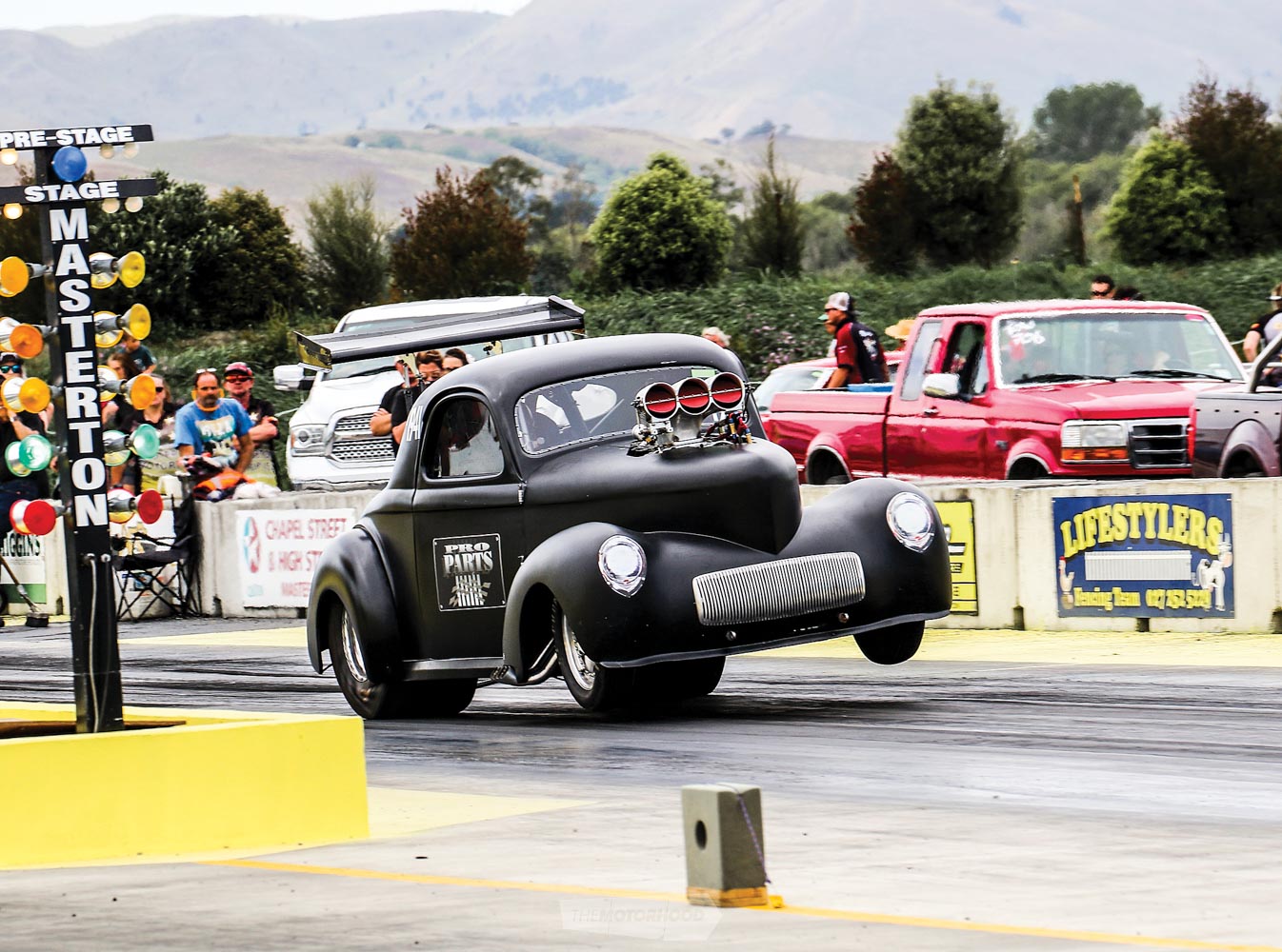
Black Belt Battle: Masterton Motorplex comp season kicking off

27 November, 2018


The weekend of 8–9 December will see round one of the Masterton Motorplex comp season kick off, and regulars to the track will not only be greeted by the welcome sight of absolutely gigantic timing boards, which where installed over winter, but also round one of the newly formed Outlaw 71 class,we mentioned in Issue No. 162. A full field of 16 racers are expected to run the five-round nationwide series, vying for their share of the $15,000 prize pool, which begins and ends at Masterton.

Outlaw 71 is the brain child of Gavin Doughty and Tod Aitken, and as the name suggests, welcomes any type of race car as long as it runs a belt-driven roots or screw blower with a dial-in between 6.5 and 7.9 seconds. Unique to the class is the reaction-time qualification system to ensure that it’s not always the fastest car nabbing the top qualifying spot. Organizer Gavin Doughty explains: “It’s all about putting on a show!” This is why the class has also adopted another unique aspect in its racer-return format, which means that the full field of 16 cars will contest each of the four rounds during a meeting, and a very tight points format will mean that the competition will go down to the wire.

Clearly it has excited racers, with the likes of Brent Whittingham’s Camaro, Mark Gapp’s Willys, Craig Griffith’s rear-engined dragster, Kendal Smith’s Altered, JD Shepherd’s FED, and Murray Hartley’s brand-new Mustang imported from Australia, all signed up to race.

The motor car as an art form

We have certainly come a long way since the exhibition entitled 8 Automobiles, shown at the Museum of Modern Art in New York in the autumn of 1951, the first exhibition concerned with the aesthetics of motor car design.
It was here that the often-used term ‘rolling sculpture’ was coined by curator Philip C Johnson, director of the department of architecture and design, when he said, “An automobile is a familiar 20th century artefact, and is no less worthy of being judged for its visual appeal than a building or a chair. Automobiles are hollow, rolling sculptures, and their design refinements are fascinating. We have selected cars whose details and basic design suggest that automobiles, besides being America’s most useful objects, could be a source of visual experience more enjoyable than they now are.”

More to the point

This Daimler SP252 is so rare, few people know it exists. It’s one of a kind. It’s the only surviving, in fact the only SP252 ever completed; the would-be successor to the SP250 Daimler Dart. It is also the last sports car to have been designed by Jaguar’s legendary founder, Sir William Lyons.
Perhaps one of the original Dart’s biggest problems was it’s somewhat-divisive looks. It certainly went well enough to win fans, although Sir William wasn’t among them. It crushed the opposition in the Bathurst six-hour race, finishing five laps ahead of anyone else, and it was snapped up by police forces in Britain, Australia, and New Zealand, as it was the fastest thing on the road.
So you’d think a stunning new body with the magic Lyons touch would have been a surefire success. Why this car never made it into production is still something of a mystery, as the official explanations barely stack up.