Photo: Earl Edwards
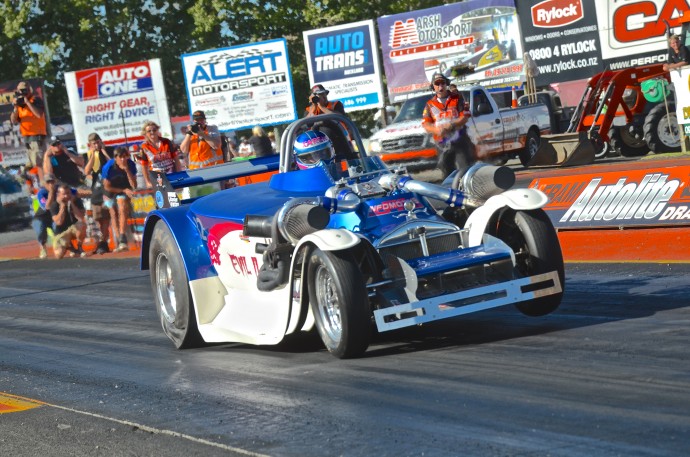
On Sunday, April 6, the record for New Zealand’s quickest, and fastest, female was taken out by Karen Hay in her purpose-built 1927 Ford Model T roadster — powered by a twin-turbocharged 482ci big block Chev engine. The record was previously held by Faye Grant from 1990 with a longer wheelbase rear-engine dragster running a 6.629-second pass over the quarter-mile at 205.52 miles per hour.
Having already run 208 miles per hour in 2012, Karen ran 6.61 seconds at 206 miles per hour over the quarter mile to become both New Zealand’s fastest and quickest female in drag racing history. It’s a goal which Hay has been chasing since 2010 when the Hay Family Racing team purchased the car named ‘Evil II’ from the late Clive Davis. The mother-of-two started racing in 2002 after crewing for her father Lindsay for a couple of years and in 2010 she ran her first 6 second pass. The car was built by the late Warren Brogie in California, USA and has now become the world’s quickest and fastest Brogie-built roadster, adding to the excitement of the New Zealand record.
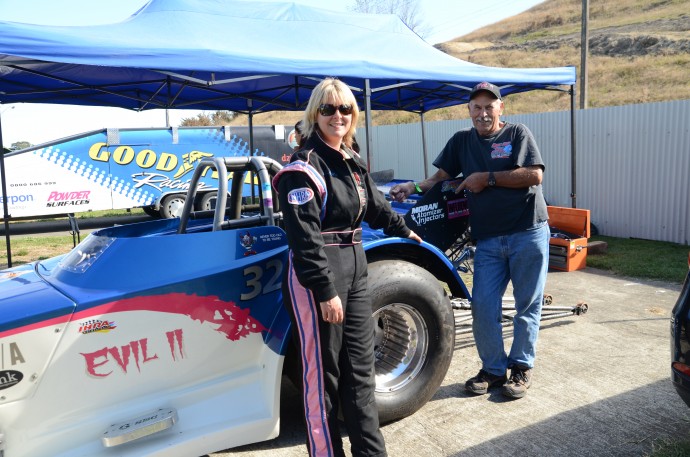
Photo: Earl Edwards
With the event at which Hay rewrote history being the Bay Rodders hosted Nostalgia Days at Fram Autolite Dragway, Meremere, the day meant a lot to Hay for multiple reasons.
Describing the day as the best day of her life, hays says: “I was hoping we were going to do it for many reasons this weekend. This meet is where my racing all started. Fram Autolite Dragway deserved to have me run the record on their track because their support has been unwavering for 12 years! I have lost two crew members along the way of this journey. I asked them in my cockpit just after my final burn out if you can help me out in any way boys, can we do it now just for Dad?”
Hay credits her success in drag racing to her parents, Lindsay and Shona Hay, and their involvement in hot rodding, jetboat racing, and drag racing.
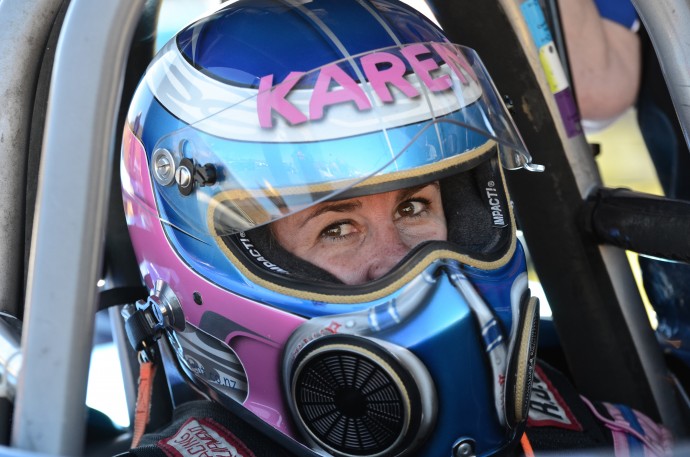
Photo: Earl Edwards
“Hugging Dad on the return road with us both crying with tears of joy and relief is a moment I will never forget. I had always envisaged us doing it one day. What a man my father is. He is the hardest working person I know, who has the utmost integrity. He’d do anything for anyone, he never gives up, he shows kindness to many, and he and Mum have given me the opportunity that people can only dream of. The life I have been given by Mum and Dad, and the support and love I have from my family and friends, truly blows me away.”
This past season was challenging with the new set-up of turbo chargers with electronic fuel injection, but Hay always had faith in her Dad, and both father and daughter worked towards their shared dream and achieved it. With the assistance of Robert Ward of RIPS Racing, and Jason Cutelli of Infomotive (both based in Rotorua) the car consistently ran in the six second at 200 mph hour zone all weekend, getting faster and quicker on each run. It was a dream weekend, which also included running the rain-dated New Zealand Nationals final on the Saturday and winning the competition class, as well as resetting the record for the car classification of AA/Altered. Hay and the team are already talking about getting the car to run even faster and quicker next year.