
Keeping it in the family

21 August, 2019


Some cars inspire so much affection that their value soars way beyond their guide price. ‘Geraldine’ is one of those priceless classics.

After Chris Steele sold his grandmother’s Hillman Super Minx, he couldn’t stop thinking about it. So, after more than a decade, he launched a mission to find it and then restore it. 

Whenever he saw a Hillman Super Minx in red with a white flash, he’d be looking for the plate or other clues to see if it was Nana’s old ‘Geraldine’.


5D2A2613.jpg

Eventually, as Hillman Super Minx sightings dropped away, Chris decided he had to try to find Geraldine. The people he had sold it to had passed it on. He discovered the registration was on hold, but it was already past the time when you could look up owners online from a car’s rego plates. Chris contacted the New Zealand Transport Authority, explaining that he wanted to buy the car back and asking to contact the current owner. He was told the authority couldn’t provide details because of the Privacy Act. Chris was quite persistent and, in the end, spoke to a senior executive, who agreed to send the owner a letter on Chris’s behalf. A few days later, the person who had owned it for the past 11 years contacted Chris.


5D2A2623.jpg

Chris Steele’s grandmother owned the Mark IV Super Minx from 1967 through to 2000, kept it garaged every night, and kept detailed notes of everything done to the car, in tiny writing in tiny notebooks. In one of them, she recorded that she had paid 1165 pounds for it.

“If the car got rained on, it was always dried down,” says Chris.

This attention to the details is clearly in the genes. When restoring the car, Chris sourced, among many other parts, a mint-condition steering wheel. It’s still in its packaging. The one in the car bears the scars of his grandmother’s rings.

“I’ve got a near concours condition wheel but I couldn’t bear to change it,” Chris explains. “It’s a special feeling that comes from knowing that’s the same wheel they held.”


5D2A2651.jpg

The car underwent a bare metal rebuild and the result is a triumph of passion and dedication and the full story is in September’s New Zealand Classic Car, on sale now.
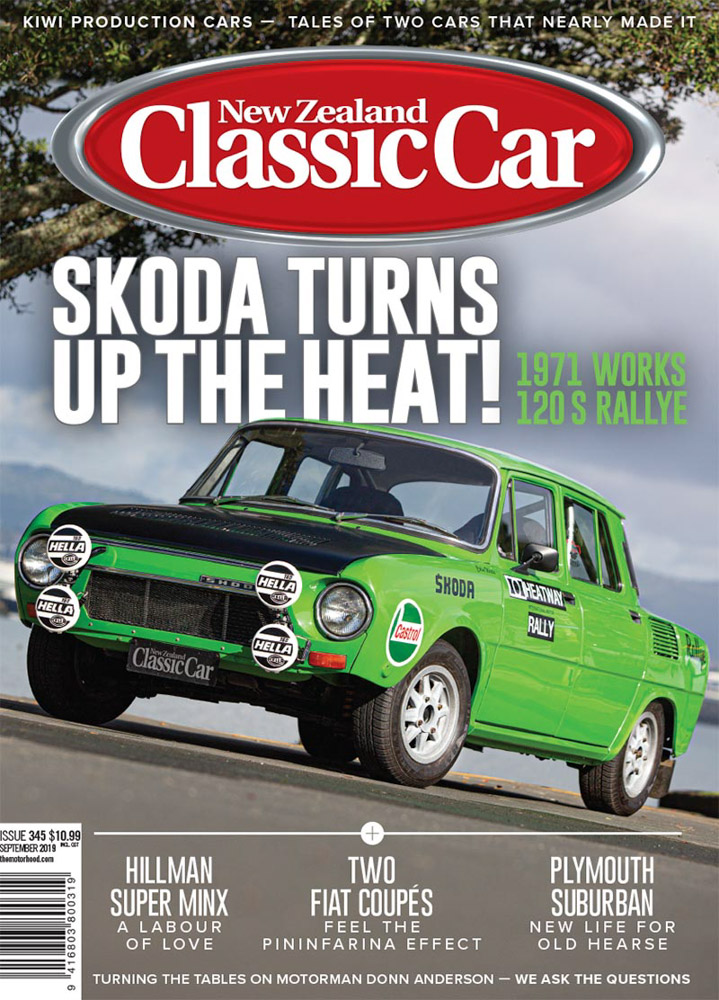
NZCC_345_20190819_Cover.jpg

NZ Classic Car magazine, July/August 2026 issue 406, on sale now

Rebirth of a brilliant Grand Tourer –1973 Datsun 240Z
How often do we long for that ultimate dream sports car, and that dream comes true? This is about one of the most influential Japanese cars of all time, a car that changed the sports car market.
This is about much more than the restoration of an iconic classic sports car, the 240Z. It’s about the culmination of a dream over many years and the friendships made. It’s about the people who helped and the professionals whose approach ensured that the dream became a reality, an attitude typical of the industry we call ‘classic restoration experts’.
It is no surprise that the outcome after a lengthy search by Conrad Van der Geest for the right Datsun 240Z culminated in a trophy for the best Japanese car at this year’s Caroline Bay Beach, Rock N’ Hop at Timaru.
Originally a roadworthy car in running order, it was left-hand-drive and had been driven for several years by its Timaru owner, as Conrad explains.
“A neighbour, Dave Barron, knew I was looking for one and introduced me to the owner. I had seen the car being driven around Timaru. It was unusual for one of these coming originally from California, so it was a really clean car instead of rusty, as they are prone to rust. The story goes that the grandfather passed it onto his grandson, who decided to sell it, and that’s when it came over here.”
Every issue comes with our FREE huge wall poster; this issue, it’s our cover car for this edition, a 1973 Datsun 240Z

The butterfly effect

The man on the mountain bike pedalled over, taking it all in. Gazing in wonderment at this small Japanese coupe with butterfly doors, he said, “Wow, I have never seen one of these before. What is it?” When I told him it was a Toyota, he nearly fell off his bike.
The Toyota Sera is unique amongst ’90s Japanese coupes. The Sera, which is Italian for ‘evening’, can trace its roots back to Toyota’s AXV-II concept car. Launched as part of a trio of Toyota concept cars at the 1987 Tokyo Motor Show, it shared its underpinnings with the P70 Toyota Starlet. The similarities ended there, thanks to the AXV-II’s low-slung and rounded coupe styling with butterfly doors. These doors were held upright by gas struts when fully open. Glass covered the upper section of the doors and the rear hatchback.
These features, much to everyone’s surprise, were carried over to the production Sera in 1990. Toyota marketed the Sera, which means ‘will be’ in Spanish and ‘princess’ in Hebrew, as a funky alternative to the much-loved MR2.