data-animation-override>
“Recreating a Kiwi Le Mans legend is no minor feat and Grant Aitken explains the reasoning behind why he took on the challenge”
Some five years ago, in a discussion with a significant New Zealand motorsport personality, the topic of the original 1966 Le Mans-winning Ford GT40, as driven to victory by Chris Amon and Bruce McLaren came up. The person involved in the discussion was adamant that the original car was stored in a garage in Tauranga although, personally, I had my doubts as I believed that the value of the original vehicle would be beyond the resources of most Kiwis.
A fruitless search resulted in me making contact with a known previous owner of the original car, a certain George Stauffer — a globally recognized race car restorer. I tracked him down and boldly rang him. He told me that he had in fact owned the original car (chassis 1046), and restored it to its original 1966 livery.
Further to confirming his ownership, he also advised me that he’d recently sold it to a New York collector for a modest US$16 million. However, he told me that if the notion of building a clone of the original interested me, I should talk to Lee Holman, as he still had some of the original parts that made up the MKII GT40.
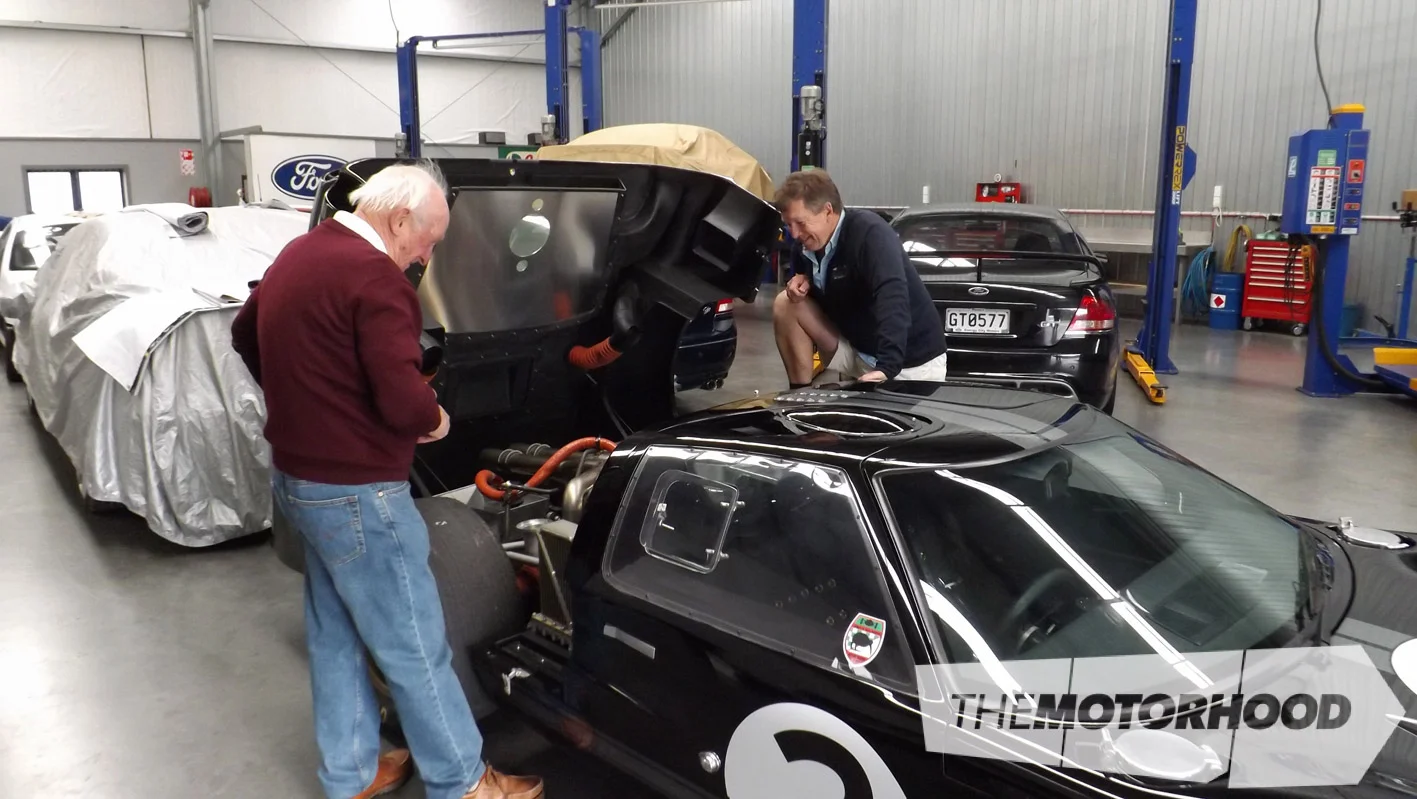
I commissioned manufacturer Holman Moody to build a replica of #1046. The body shell was sourced from a recognized current replica builder in South Africa and shipped to Holman Moody in Charlotte, North Carolina in the US.
Eighteen months went by and the car was completed with a dry-sump 427 FE engine, built but the original engine builder, Jimmy Tucker. The car features the correct T44 transmission, period-correct gauges, seats, interior, and luggage compartments. It is believe to be the closest reproduction of the original car in existence.
During the build, Chris Amon’s assistance was invaluable, with his supplying of pictures of the original car, including dashboard layout among other things.

The car was completed in 2012 and shipped to New Zealand, where on December 10, 2014 Chris Amon was introduced to the car. We drove several laps of the Taupo Motorsport Park circuit and Chris was quite emotional about the visit to the past, speaking very highly of the car.
I am delighted to have reconstructed a car to commemorate one of New Zealand’s greatest sporting victories — one that has gone largely unnoticed in New Zealand. However, I want to ensure that the upcoming 50th anniversary of Bruce McLaren and Chris Amon’s win — the first ever for a Ford at Le Mans — is celebrated and given the recognition it deserves.
The gallery below has been captured by Graham Sword.