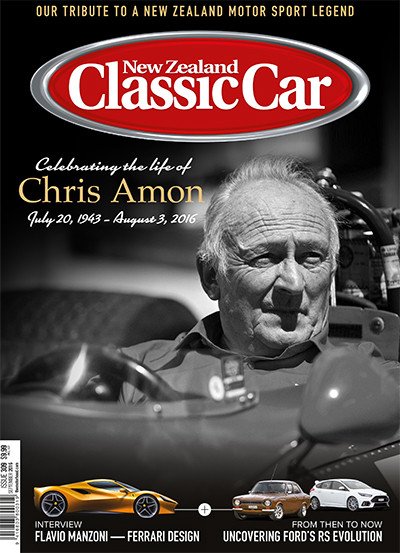
At about 5.30pm on Wednesday, August 3, we received the news that Chris Amon had passed away earlier that day. As the news was being relayed to me, it took me several seconds to register what I’d just heard. Just to make sure, I had to read the notice a couple of times, hoping that, somehow, the news had been misinterpreted.
Sadly, it was true — one of our greatest motor-racing legends had gone, and as a few of us stood around the editorial office in utter shock, I still found it hard to believe.
The following morning — the day before the September 2016 issue of New Zealand Classic Car went to print — we decided to rehash the entire magazine, and put together a fitting tribute to celebrate the life of Chris Amon.
It seemed like only yesterday that I was sitting in his lounge, interviewing him about his career, and at the same time he was reunited with the BMW 3.0CSL — dubbed the ‘Batmobile’ — after 38 years. This was the very car that he shared with Hans-Joachim Stuck during the European Touring Car Championship (ETCC) series back in 1973.
After a close examination of the car in which he and Stuck had won the 1973 Nürburgring Six Hour, I sat down with Chris, and was transported back to a time when drivers such as Jackie Stewart, Niki Lauda, Jochen Mass, and James Hunt all vied for touring-car honours.
It was the very first time I’d met Chris, and he treated me like I was a long-lost friend. Warm, kind, and generous with his time, he sat with me for a few hours reminiscing about his wonderful career, while remaining humble at the same time. Alas, the few hours I spent with Chris went by in a flash, leaving me with many questions that I wanted to ask. I could have easily sat listening to him for hours as he reminisced about his career, but as the old cliché goes — all good things must come to an end.
As part of our tribute to Chris, we’ve rerun the full interview, along with special tributes from Donn Anderson and Michael Clark, who have kindly shared their own personal experiences with Chris over the years.
Chris Amon was a man much respected and admired in New Zealand and around the world — a Kiwi legend, and one of the world’s greatest ever race drivers. Rest peacefully.
To read the latest from Ashley Webb and the New Zealand Classic Car team, pick up a print copy of the September 2016 issue here: