MG make their mark on the road and the track

17 August, 2015

It’s not every day that a customer’s new car is handed over by a racing driver, but for lifeguard Ryan Sykes that’s how he received his brand-new MG3 when British Touring Car Championship (BTCC) star Jack Goff handed over the keys to the enthusiastic teenager, fresh from his maiden BTCC victory in Snetterton. 

Ryan is the son of the owner of Norfolk-based company 5 Star Cases, one of Jack’s sponsors, and from the start of the partnership between MG and Jack, Ryan has been hoping to own an MG of his very own.
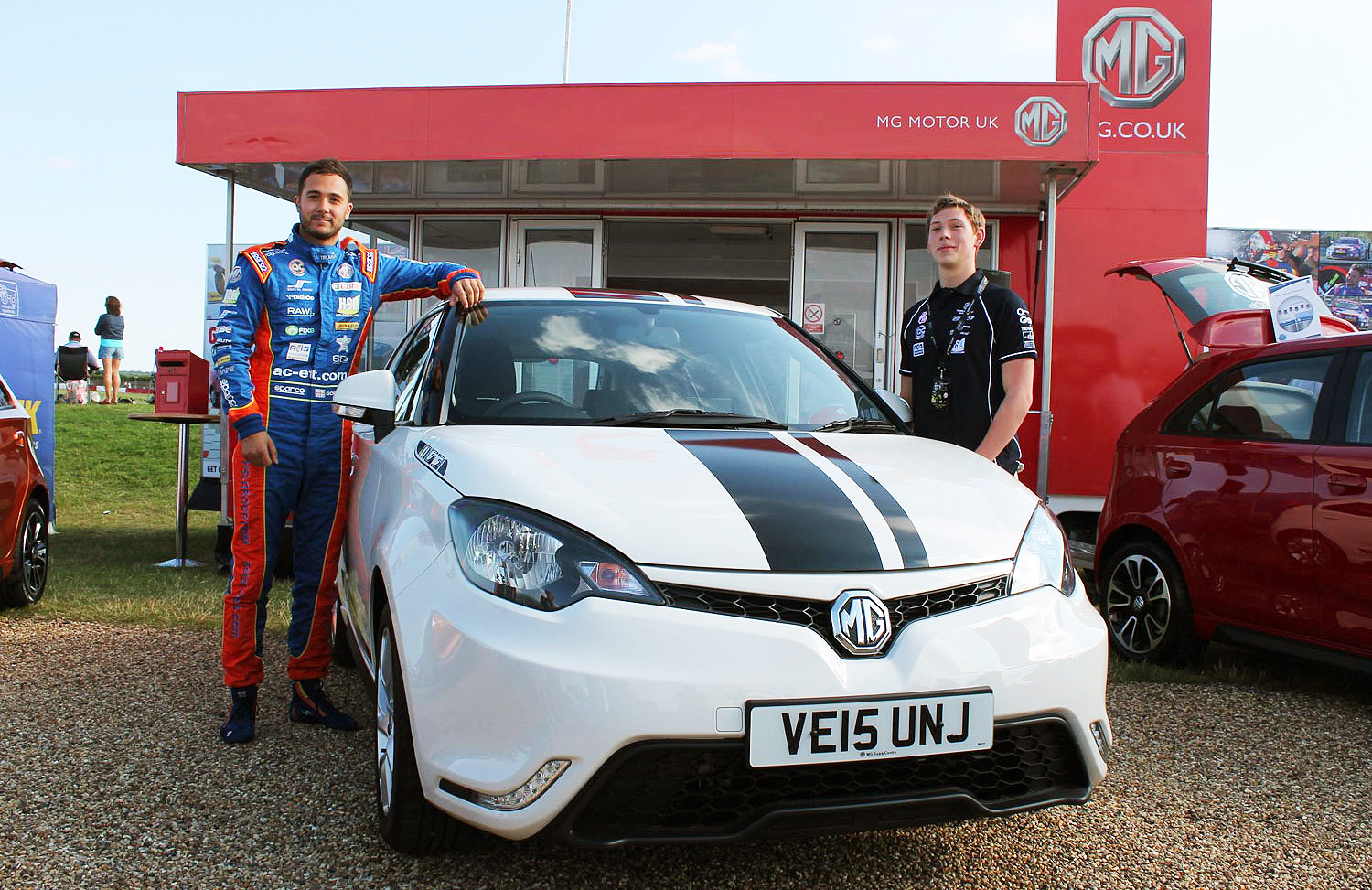
“My dad started working with Jack in 2013, but it wasn’t until Jack started racing for MG Triple Eight that I started looking at MGs and saw what they had to offer,” says Ryan. “I thought the MG3 was great, so when my old car packed up I knew I wanted one. I got the chance to personalize my car and make it how I wanted it to look, which was pretty cool. I’m glad I did though, because my sister wants one now!”

The MG3, alongside the MG6, is designed and engineered at the MG site in Longbridge, Birmingham, where final assembly also takes place. The MG3 is a new-generation supermini, which brings fun and style to this sector of the market at very affordable prices. The 1.5-litre petrol-powered car can also be personalized, so owners have the option of giving their car their own style statement.

MG was voted the fourth-best manufacturer in the UK in the Auto Express Driver Power Awards in 2015, and they’re the fastest-growing brand in Britain in 2014 as shown by official figures issued by the Society of Motor Manufacturers and Traders.

No sign, as yet, of an official MG distributor in New Zealand.
NZ Classic Car magazine, July/August 2026 issue 406, on sale now

Rebirth of a brilliant Grand Tourer –1973 Datsun 240Z
How often do we long for that ultimate dream sports car, and that dream comes true? This is about one of the most influential Japanese cars of all time, a car that changed the sports car market.
This is about much more than the restoration of an iconic classic sports car, the 240Z. It’s about the culmination of a dream over many years and the friendships made. It’s about the people who helped and the professionals whose approach ensured that the dream became a reality, an attitude typical of the industry we call ‘classic restoration experts’.
It is no surprise that the outcome after a lengthy search by Conrad Van der Geest for the right Datsun 240Z culminated in a trophy for the best Japanese car at this year’s Caroline Bay Beach, Rock N’ Hop at Timaru.
Originally a roadworthy car in running order, it was left-hand-drive and had been driven for several years by its Timaru owner, as Conrad explains.
“A neighbour, Dave Barron, knew I was looking for one and introduced me to the owner. I had seen the car being driven around Timaru. It was unusual for one of these coming originally from California, so it was a really clean car instead of rusty, as they are prone to rust. The story goes that the grandfather passed it onto his grandson, who decided to sell it, and that’s when it came over here.”
Every issue comes with our FREE huge wall poster; this issue, it’s our cover car for this edition, a 1973 Datsun 240Z

The butterfly effect

The man on the mountain bike pedalled over, taking it all in. Gazing in wonderment at this small Japanese coupe with butterfly doors, he said, “Wow, I have never seen one of these before. What is it?” When I told him it was a Toyota, he nearly fell off his bike.
The Toyota Sera is unique amongst ’90s Japanese coupes. The Sera, which is Italian for ‘evening’, can trace its roots back to Toyota’s AXV-II concept car. Launched as part of a trio of Toyota concept cars at the 1987 Tokyo Motor Show, it shared its underpinnings with the P70 Toyota Starlet. The similarities ended there, thanks to the AXV-II’s low-slung and rounded coupe styling with butterfly doors. These doors were held upright by gas struts when fully open. Glass covered the upper section of the doors and the rear hatchback.
These features, much to everyone’s surprise, were carried over to the production Sera in 1990. Toyota marketed the Sera, which means ‘will be’ in Spanish and ‘princess’ in Hebrew, as a funky alternative to the much-loved MR2.