Among the famous and colourful entries for the sixth New Zealand Grand Prix at Ardmore were two Maserati 250Fs entered by a wealthy American. Donn Anderson delves into the intrigue behind the cars and their owners
By Donn Anderson
Swiss-born Hans Tanner and American Temple Buell were apparently among the many overseas visitors who arrived in New Zealand for the Ardmore Grand Prix and Lady Wigram trophy in January 1959. Unlike Stirling Moss, Jack Brabham, Ron Flockhart, Harry Schell and Carroll Shelby who lined up for the sixth New Zealand Grand Prix that year, Tanner and Buell were not racing drivers but they were key players in international motor sport.
Neither the rotund and cheery Buell nor the multi-faceted Tanner were keen on being photographed, and the word ‘apparently’ is used in the absence of hard evidence that Buell actually arrived in this country 64 years ago.
As a 13-year-old school lad struggling to produce a fledgling cyclostyled motoring magazine, I was fortunate enough to meet Carroll Shelby in the Ardmore pits that year but was unaware that either Buell or Tanner were in Auckland. However, one source says the pair made quite an impression in the conservative New Zealand motorsport circles.
A few months before, in late summer 1958, Frank ‘Buzz’ Perkins, the extrovert and livewire secretary of the New Zealand Grand Prix Association, had arrived in Italy on his mission to secure name drivers for the upcoming Ardmore airfield circuit race. In Modena he began negotiations with Tanner to secure a Maserati entry after discussions with Enzo Ferrari to bring one of his cars proved fruitless.
Hans, a broker and wheeler-dealer, suggested two Maserati 250F open wheelers for Frenchman Jean Behra and American Harry Schell, but at the last minute, Behra signed with the Ferrari Formula 1 team for 1959, and Enzo refused to allow him to drive a rival car.
Shelby was his last-minute replacement driver for Ardmore, proving a good teammate for Schell, although their race down under was eventful and not altogether successful.
Some confusion
In July 1973, Los Angeles-based Tanner, concerned about the confusion around the history of the famous Maserati 250F, contacted motoring journalist Eoin Young in England to set the record straight, insights I have relied on to fill out the bare known facts.
Tanner’s association with American Temple Buell Junior began when the wealthy oilman from Denver, Colorado, was still involved with Ferrari. Buell’s famous father, Temple Hoyne Buell, designed almost every prominent building in and around Denver. Buell junior’s mother owned Household Finance which was the largest personal finance company in the USA in the 1920s and was still going strong in the 1960s with 1200 offices across the States.
In a remarkable coincidence, London-born Spanish racing driver Alfonso de Portago was a distant cousin of the younger Buell. In 1957, the Spanish aristocrat was 70 kilometres from the Brescia finish in the Mille Miglia when a tyre blew out on his Ferrari 335S sports car at high speed. The resulting crash killed 28-year-old Alfonso, his American navigator Edmund Nelson, and nine spectators, including five children. Buell’s mother was disappointed her son did not give up motor racing following de Portago’s death.
The portly younger Buell owned two streamlined, two-seater Abarth 207A Spyders and raced a 2-litre Ferrari Testa Rossa without success and it was this that persuaded him to hire fellow American Masten Gregory to drive for him. The pair had won the Argentine 1000 km race in 1957, but the overweight Buell, who could not fit into a grand prix car, figured his days in a racing driver’s seat were over.
Enzo Ferrari had a great deal of respect for Masten’s driving ability, and a deal was consummated whereby Buell would finance a sort of addition to the Ferrari sports car team using factory mechanics and with Gregory as driver. Later Tanner became involved and suggested to Buell he take charge of the team that had two racing Ferraris and a 4.5-litre Maserati.


Down but not out
Maserati ruled supreme at the non-championship Reims Grand Prix in 1957, where 15 of the 26 cars entered were 250Fs, the winning example driven by Juan Manuel Fangio. He also won the French GP at Rouen the same year for the Italian marque. There was even talk of Fangio coming to New Zealand for the Ardmore race, and Buzz Perkins said Temple Buell had been talking to him about bringing a 600-horsepower car “specially built on the off-chance that Fangio would drive it”. These plans, of course, never came to fruition.
Financial difficulties saw Maserati placed under controlled administration in 1958, but it had built a new lightweight version of the 250F, known as the 250F3, for Fangio to make one more attempt at a world championship before he retired.
“Fangio tried his best with the 250F3 at Rheims (for the French GP) but could do no better than fourth and decided to retire,” said Tanner.
At that stage, Tanner said his ‘rental system with Maserati went into effect, and the first Formula 1 race entry for Buell was the 1958 Portuguese Grand Prix. Shelby started on the fourth row of the grid in the Buell car. He was running in seventh place, but was dogged by persistent brake troubles that eventually resulted in him crashing just three laps from the end.
Buell, in the finest Playboy tradition, lost interest and went off tiger hunting in India before returning to Modena to take delivery of a Maserati touring car. He also ordered one of the then-new 250F open wheelers for Gregory to drive, and would also hire and eventually own the works 250F raced by Fangio.
Tanner claimed he suggested the two Buell 250F T3 single seaters should be rebodied by Fantuzzi at Maserati. “I designed the twin nostril modifications for the first Piccolo and decided to go whole hog on the second, designing a completely new body with twin nostrils and a high tail with a fin for the other,” said Tanner.
While similar to the earlier T2 250F, the so-called Piccolo T3 had a lighter spaceframe chassis and was slightly smaller. The driveshaft from the 6-cylinder engine was angled to help give this updated Maserati 250F better weight distribution and handling, but the car never showered itself with glory, unlike the earlier 250Fs.


Different valve systems
The Buell Maseratis lacked the desmodromic valve system of some other 250Fs. Another cam closes the valves, allowing the engine to rev higher safely without the curse of spring failure. However, they are expensive to both make and maintain. These days, much-improved spring metallurgy means they are no longer necessary.
Rewinding to the previous year, to take in another Hans Tanner/250F tale, Aucklander Ross Jensen piloted the ex-Stirling Moss 250F to a superb second place behind Jack Brabham’s 2-litre Cooper Climax in the 1958 New Zealand Grand Prix, going on to victory in the New Zealand Gold Star championship.
Following that season, Jensen sent his 250F back to Italy to be rebuilt for the New Zealand races, consigning the car to Tanner, which, it turned out, was not a good idea. Ross became concerned after losing contact with his car and, on an Italian trip, he was appalled to see it had undergone a complete rebuild and modification that changed it into the Corvette V8-engined TecMec.
A revised deal was completed for Jensen to purchase another 250F that Swiss driver Jo Bonnier had been driving. When this Maserati arrived back in New Zealand it was eventually sold to Brian Prescott who campaigned it in the 1961 series, without success.
Fantuzzi left Maserati to make bodies for Ferrari, where that well-known twin nostril nose configuration was later adopted on the successful rear-engined Ferrari F1 machines. It was labelled the Chiti nose. “It may seem that I am trying to take credit for the Chiti nose but it is not so — as I had cribbed it from the earlier Sacha-Gordina Formula 1 car that never raced,” said Tanner.
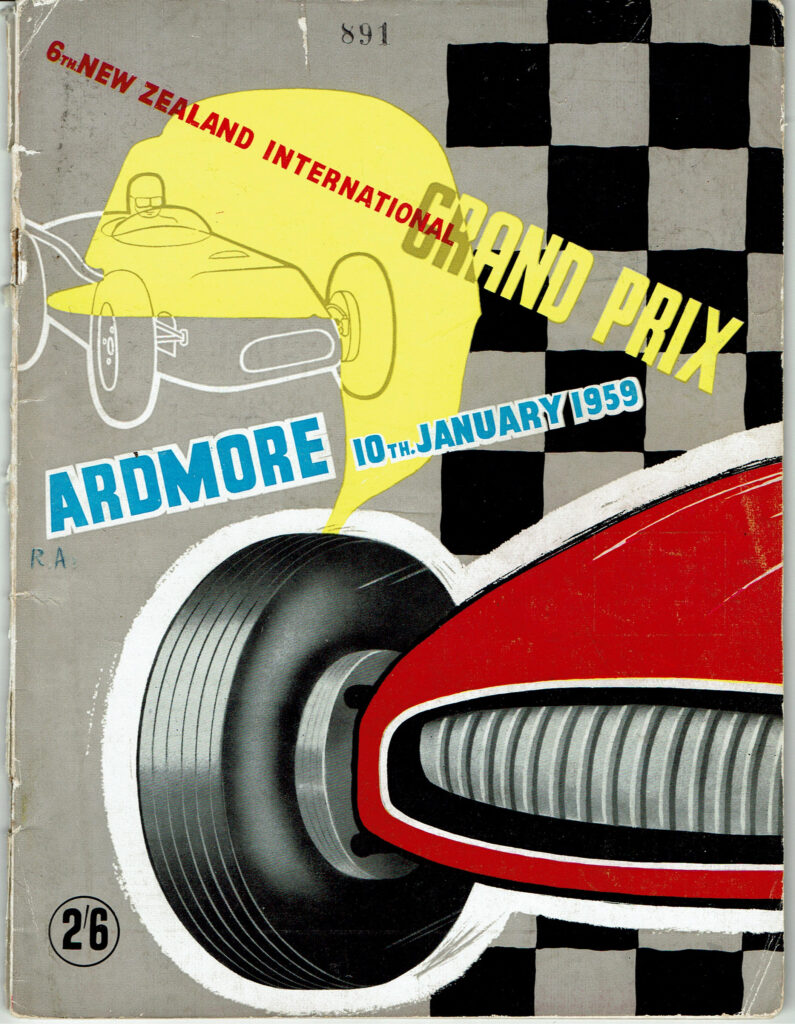
The 16-page January 1959 edition of Motorman magazine was a six-penny souvenir for the Grand Prix and included an article on the 1958 Driver to Europe award, kindly written by Bruce McLaren. My idea was to hand every driver in the big race a complimentary copy yet somehow as a somewhat cautious young editor I don’t think I managed to find most of them before the start.
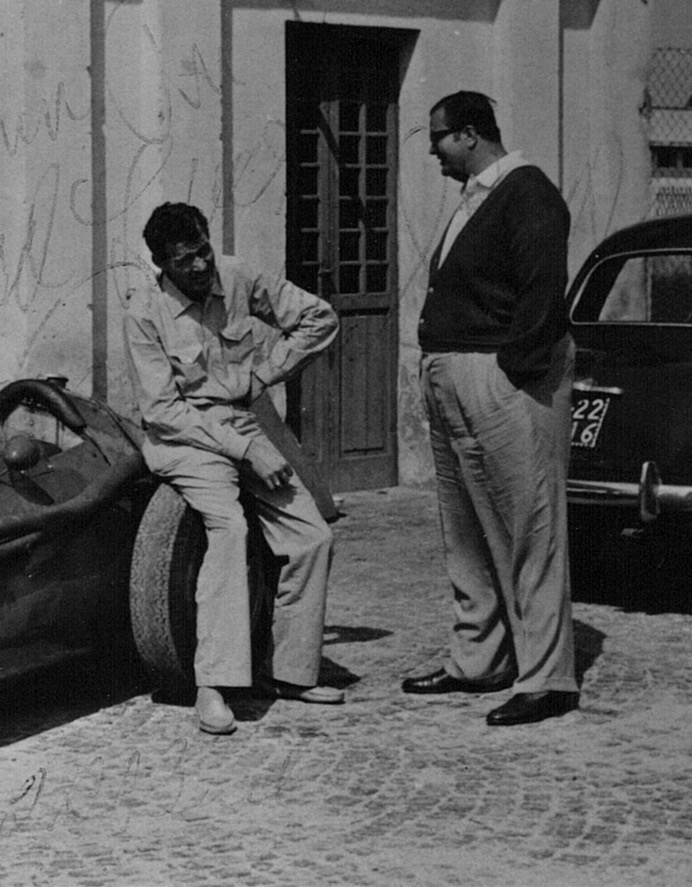
Tanner and Buell in New Zealand
So Tanner and Buell apparently found themselves at Ardmore in south Auckland, where the new generation rear-engined Cooper Climaxes were timed on the back straight at more than 245 km/h – a pace the front-engined Maseratis were hard put to match. Travelling in company with the Buell stable but running as an independent was Bonnier with a lightweight Maserati 250F that had been driven by Fangio.
Guerrino Bertocchi, Maserati’s chief tester who had been an early racing driver, was also at Ardmore overseeing the Italian machines, only to return to Europe disappointed with the New Zealand campaign. Aged 75, he died in 1981 as a passenger in a road accident.
Tanner was commissioned by Perkins and the NZIGP to write an article on Shelby for the official Grand Prix programme, describing the likeable 36-year-old Texan as America’s most experienced and successful driver. Hans wrote most of the editorial in the 1959 NZGP programme, also penning biographies on Stirling Moss, Schell, and Jo Bonnier.
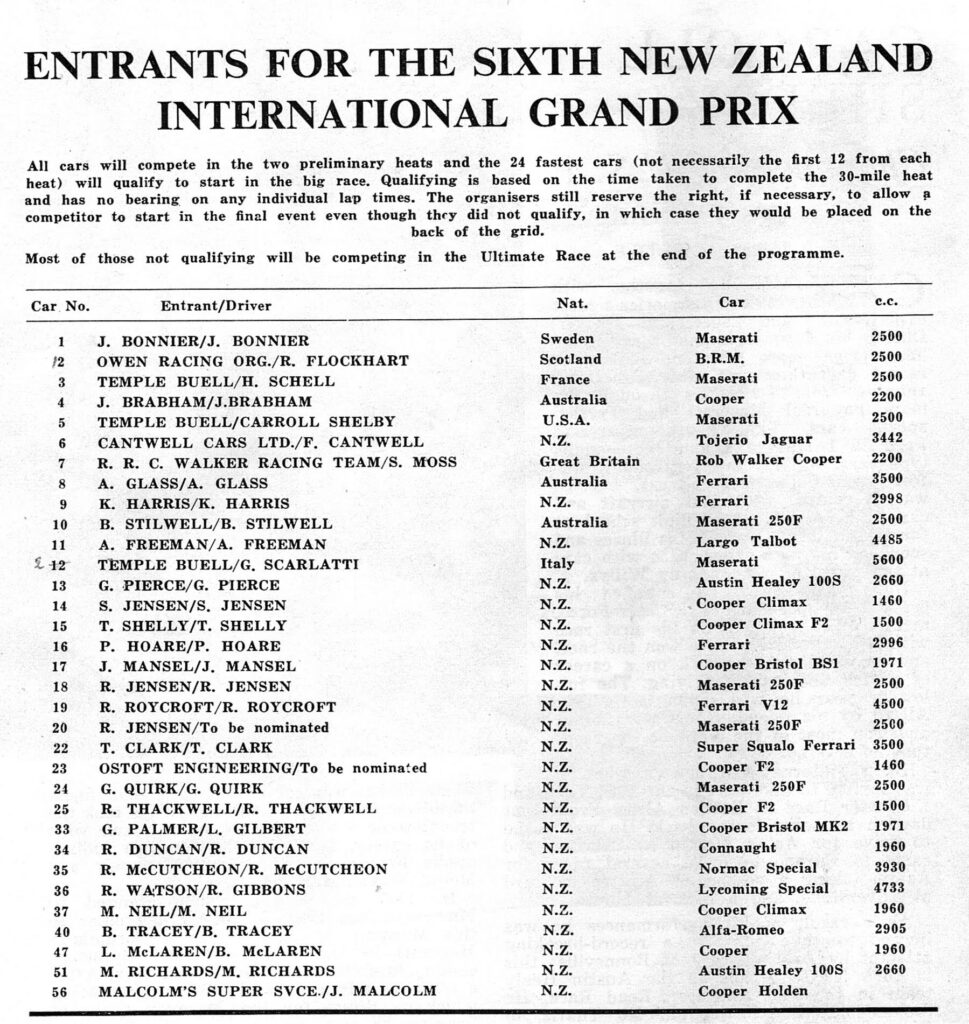
Buell was working on the proposal to bring Fangio to Ardmore, but the great Argentinian was not about to change his mind about retirement. Instead, Buell opted for Italian Giorgio Scarlatti, who had been a Maserati works driver in 1957. Scarlatti was to drive the third 250F owned by the American. He appeared as an entrant in the meeting’s 1959 programme but he failed to appear in New Zealand. Unlike the other 250F Maseratis, Scarlatti’s machine was listed with a 5.6-litre engine. He had achieved good class wins in the Mille Miglia and Targa Florio and shared a 250F with Harry Schell in the 1957 Italian GP, finishing fifth.
Practical joker Schell, born of American parents in Paris, was the first American to start in a Formula 1 Grand Prix race and, like Shelby, a first-time visitor to New Zealand. Harry had opened l’Action Automobile, a sports bar in Paris, and came with a colourful reputation, including an accident at the Monaco harbour chicane where he took out several other competitors.
Tanner recalled how Schell was born into Grand Prix racing. His father was Laury Schell, a noted racing driver and patron of the pre-war Ecurie Bleu, which raced Talbots, Delahayes and Maseratis.
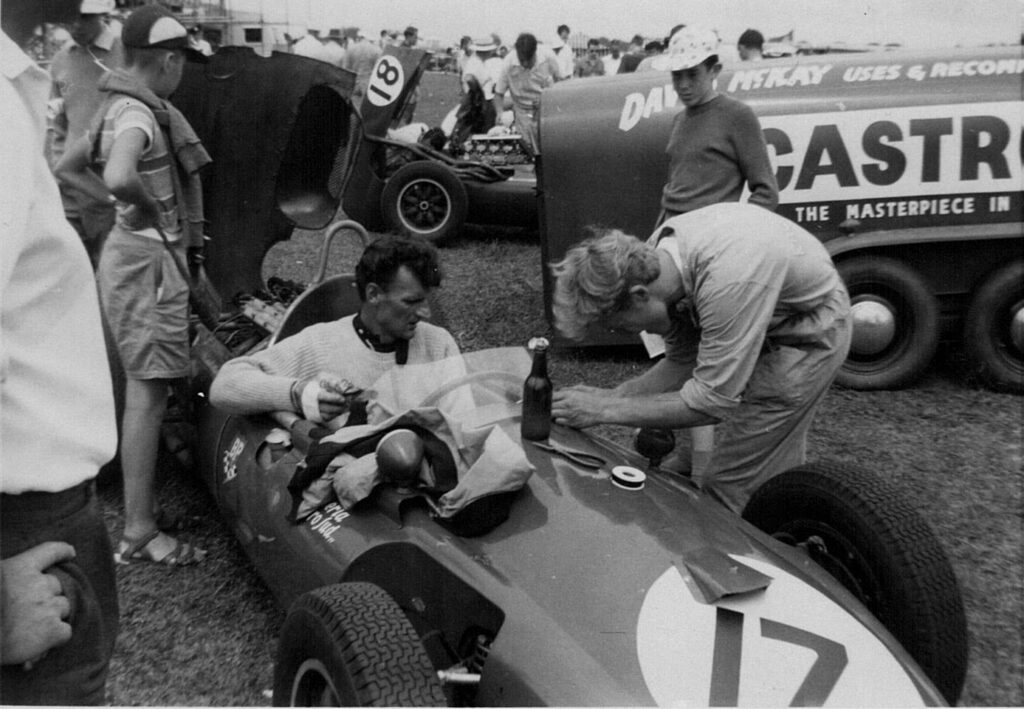
Mum takes over the team
When Schell’s father died in a road accident, his mother took over management of the team, sending two eight-cylinder supercharged Maseratis to Indianapolis.
All this seemed a long way from a summery weekend in Auckland, and as practice got underway on the 3.2 kilometre Ardmore airfield circuit, the drum-braked Maseratis were struggling. Favourite Stirling Moss had broken down in the heat and his Cooper was forced to start from the back of the grid. The three international driver Maseratis led from the grid after Ron Flockhart’s works BRM stalled on the line. Schell made a lightning start to lead Bonnier and Shelby with the Coopers of Jack Brabham and Bruce McLaren next ahead of Jensen in the fourth 250F.
Shelby became involved in a lengthy dice with the young McLaren while a fifth lap fuel leak put Bonnier out of contention.
Harry Schell’s Maserati began to misfire, engine maladies forcing his retirement. A groggy Schell came into the pits, overcome by fumes from oil leaking through a loosened cylinder head onto the exhaust manifold. While Moss roared on to victory Shelby got the better of Jensen and McLaren to hold third place behind Brabham.
But not only was Shelby troubled by grabbing brakes, but he was also suffering from agonising cramps in one leg. He stopped on lap 41 and handed his car over to Schell who would eventually finish fourth. Jensen’s Maserati was in trouble with an engine down on power and a deteriorating clutch so it came as no surprise when Schell overtook the New Zealander on lap 63. Schell would have to be content with fourth when the ailing drum brakes on his Maserati became almost useless in the closing stages.
Australian Bib Stilwell’s 250F finished behind Jensen, so, despite the problems with the Italian cars, there were no fewer than three Maseratis in the top six placings. Jensen had a dismal season with his 250F until shipping the car to Australia for the Bathurst 100 at Easter where he scored a brilliant victory.
In the 1960 New Zealand Grand Prix, Kiwi Johnny Mansel drove the ex-Prince Bira 250F into fifth place, making it the first of the front-engined cars home. Bira had won the Ardmore race in the same car five years earlier. Stirling Moss had notched up another 250F victory in New Zealand’s premier motor race in 1956.

Rear engines to the fore
Stirling Moss had led a 1-2-3 for Cooper in what had been a glamorous, star-studded field for the nation’s premier motor race. Yet Ardmore had left Buell with a bitter taste, and he decided to give up racing altogether, realising that front-engined cars could no longer compete with rear-engined machines. Tanner left his employ at this stage, although not before visiting Christchurch for the Lady Wigram trophy.
Christchurch driver Frank Shuter had two beefy Maserati 8CLTs and the ex-Tazio Nuvolari Maserati 8CM that Tanner figured would be best returned to Europe – but more likely he sensed a fat commission. Tanner secured an agreement with Shuter to exchange the three cars for a newer Maserati 250F, promising one of the 8CLTs to the Montagu Museum in England but the deal fell over.
During the shuffling of race cars back in Italy, Tanner enlisted the help of a young man, an Aucklander who had been hanging around the garage for several days. “His name was Bob Wallace, later to become chief tester for Lamborghini,” said Hans. Wallace, who passed away in 2013 aged 75, had moved to Italy in 1958 and was a highly respected driver for the high-performance brand.
In addition to his racing car deals, Hans Tanner was a motoring journalist with a difference: due to a problem with one eye, he did not actually drive. He would sit beside a driver while assessing a new car and monitor his impressions from the passenger’s seat. Tanner was also the author of several books, including The Ferrari, Ferrari Owners Handbook, Great Racing Drivers of the World and a Maserati Owners handbook. Not only did he like exotic cars he also had a passion for exotic firearms and a collection of guns that led him to writing the book Guns of the World.
A polarising figure who could sell sand to the Arabs or snow to Eskimos, this colourful character could clearly talk the talk if not always walk the walk. Some questioned his frequent inaccuracy and characteristically grandiose claims of personal endeavour.
Associates claimed he might invite you to dinner, but then expect you to pay. The manager at a favourite Modena hotel grew concerned about a ballooning bill after Tanner had resided there for an extended period. Hans solved his financial difficulty by escaping into the night.
By the 1970s, Tanner had settled in California and was struck with a malignant blood condition and was convinced he could not be cured. In March 1975, at the age of 48, he shot his Cuban girlfriend dead and then killed himself.

Racer roundup
And what of the others in this story?
Little more than a year after his appearance at Ardmore 64 years ago, 40-year-old Harry Schell was practising for the non-championship Silverstone International Trophy when he lost control of his Cooper T51 and was fatally injured. Schell’s race record is not inspiring but he did have pace. At Goodwood, only a few weeks before his death, he was second fastest in practice, equalling the time set by Stirling Moss, but the engine in his Cooper failed in the race.
Aged 33, Johnny Mansel crashed his Scuderia Centro Sud Cooper T51 Maserati in the wet 1962 Dunedin road race and was fatally injured. Apparently the wreckage was shipped back to Italy which is understandable given New Zealand’s tough import and tax regulations of the day. Wealthy Jo Bonnier was just 42 when he died in a high speed crash at Le Mans in 1972 in a tragedy that left his friend Masten Gregory devastated. As a result, Gregory retired from racing and moved to Amsterdam, where he worked as a diamond merchant. At the age of just 53, he died of a heart attack in his sleep in 1985.
That same year, Prince Bira died of a heart attack at a London tube station, aged 71. He had retired from racing soon after the 1955 NZ Grand Prix, his last victory. When Buzz Perkins left the NZIGP he returned to his homeland in England only to die in a road accident. Temple Buell junior retired to California and died in 1990 at the age of 67, only a few days after the passing of his father. Seventy-eight-year-old Ross Jensen passed away in his hometown of Auckland in 2003, while Carroll Shelby was 89 when he died in May 2012. And the brilliant Sir Stirling Moss, who had won the NZGP 64 years earlier in a Maserati 250F, passed away, aged 90, in 2020.