Exhibitions of motor cars are now quite common, but this wasn’t always the case
James Nicholls
Photographs: Supplied

We have certainly come a long way since the exhibition entitled 8 Automobiles, shown at the Museum of Modern Art in New York in the autumn of 1951, the first exhibition concerned with the aesthetics of motor car design.
It was here that the often-used term ‘rolling sculpture’ was coined by curator Philip C Johnson, director of the department of architecture and design, when he said, “An automobile is a familiar 20th century artefact, and is no less worthy of being judged for its visual appeal than a building or a chair. Automobiles are hollow, rolling sculptures, and their design refinements are fascinating. We have selected cars whose details and basic design suggest that automobiles, besides being America’s most useful objects, could be a source of visual experience more enjoyable than they now are.”
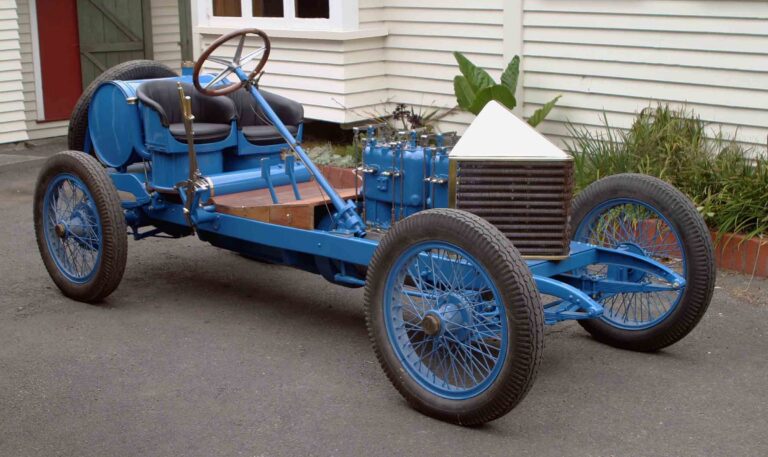
Design sophistication was illustrated by the journey from a 1936 Mercedes’ four enormous wheels carrying a box’ to the sculptural unity of Pinin Farina’s 1949 Sisitalia. It struck a chord. Two years later, in the autumn of 1953 Moma followed up the exhibition 10 Automobiles of postwar cars. Nine of them featured Italian design, and the exhibition celebrated their fitness for purpose beyond simply the provision of lounge-like comfort and “the absence of all sensation”. The rest, as they say, is history – exhibitions of motor cars are now very common.
A tale of two cities
The V&A in London, the self-styled “world’s leading museum of art and design”, is showing Cars: Accelerating the Modern World. Apparently, this is a missed opportunity, despite some of the exceptional vehicles and accompanying items on display. Stephen Bayley, once described by an influential design magazine as the “second most intelligent man in Britain”, creator of the Boilerhouse Project in the V&A, and the Design Museum with Sir Terence Conran; and once the creative director of the Millenium Dome, delivered this verdict in The Spectator: “This exhibition is a rare attempt to explain the car, perhaps the most dramatic since the Museum of Modern Art’s 1951 New York show … This exhibition contains marvels of supportive material, as if a mastermind on the automobile were illustrated by a picture researcher on speed. But ultimately, cars lack logic and coherence. It is a museum-quality car-boot sale. The story of car design, one of the defining activities of the modern age, remains to be told.”
Perhaps it is being told on the outskirts of Paris. The French seem to have a knack for ‘artifying’ the mundane, just look at Marcel Duchamp’s Fountain of 1917, for instance. It was the French philosopher Roland Barthes who, in his definitive essay on the original Citroën DS, said, “Cars are our cathedrals”.
At the Château de Compiègne, 40 minutes from Paris-Gare du Nord, built in 1751, where Napoleon III and Empress Eugenie would host and entertain 100 guests every autumn from 1856 until 1869, and which became a museum in 1927, there is an outstanding exhibition entitled Concept-Car. Beauté Pure.
Beauté pure at the château
The exhibition Concept-Car. Beauté Pure (pure beauty), co-organised by the Château de Compiègne and the Réunion des Musées Nationaux, Grand Palais, heralds the revival of the Musée National de la Voiture, the world’s first museum dedicated to locomotion, which was opened at Compiègne in 1927 and is now to embrace the motoring heritage of the twentieth century.
Bringing together some thirty automobiles, motorcycles, and record-breaking vehicles as well as around one hundred photographs, documents, preparatory drawings, and models, this exhibition retraces the origins of the motor vehicle in the form closest to a work of art: the concept car. Having first appeared in the 1930s, these vehicles were generally made in just one example, constructed as part of a study on aerodynamism or style or, later, for commercial promotion.
All the leading manufacturers, designers, and master coachbuilders produced this type of vehicle, sometimes called the dream car in the United States. Although they were often destroyed after a temporary display, the effervescent curator Rodolphe Rapetti, who seems the sophisticated personification and embodiment of a good Champagne, has been able to procure some of the surviving models.
This exhibition, which is the first to focus on this theme, presents the genealogy of these unique objects. The vehicles are displayed in the rooms of the Château built for Louis XV, and thus establishes a dialogue between its 18th century architecture and 20th century design: the architecture of the motor car.
Just think of The Jetsons
Rapetti and his team in Beauté Pure have perhaps come the closest to defining what the motor car means in socio-historic terms and how the automobile, in the past, present, and future, affects our everyday lives.
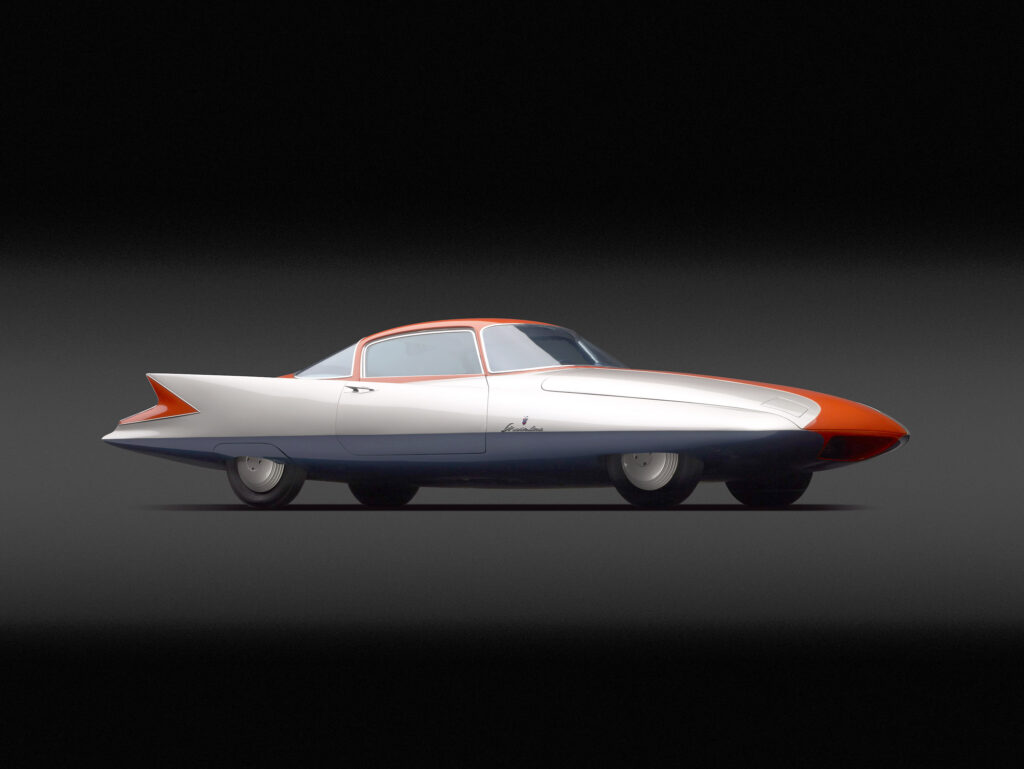
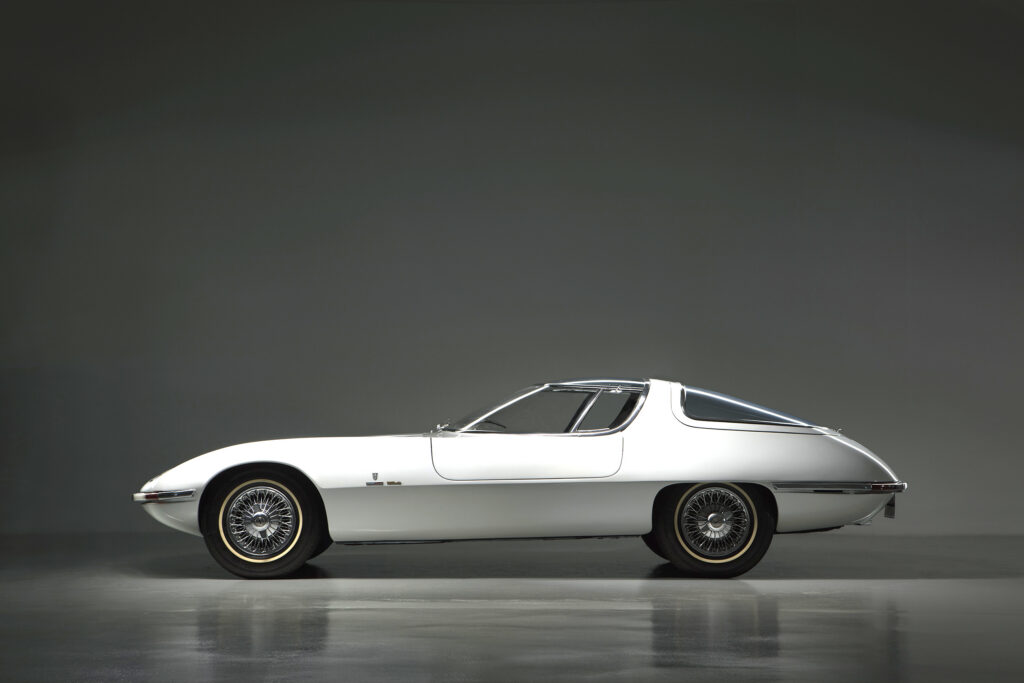
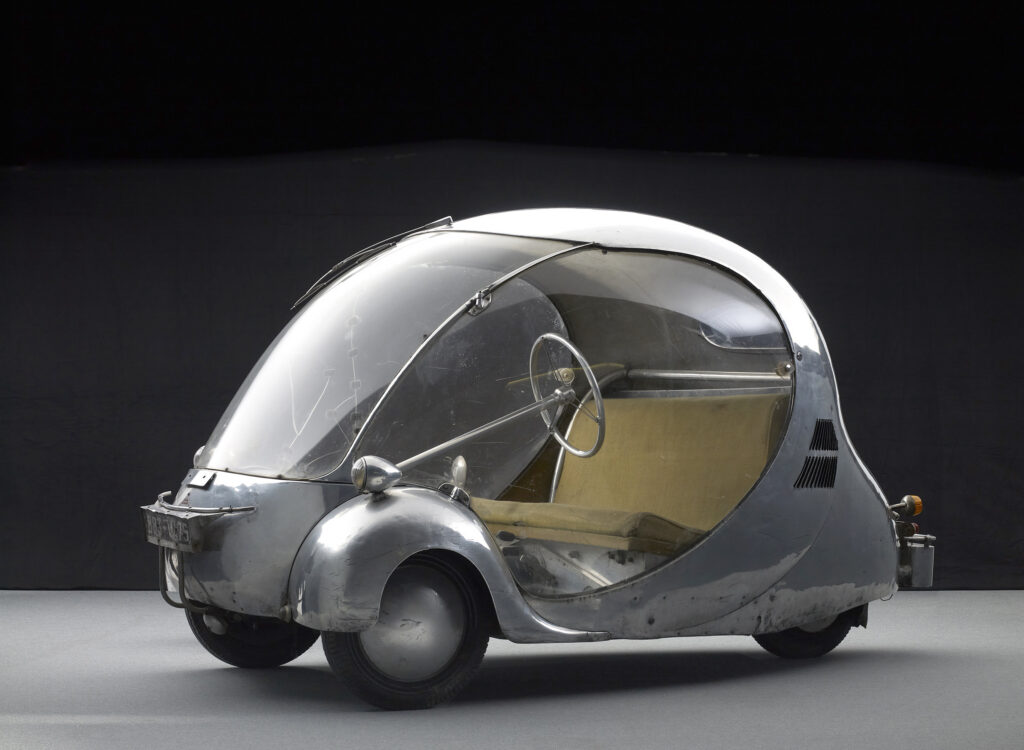
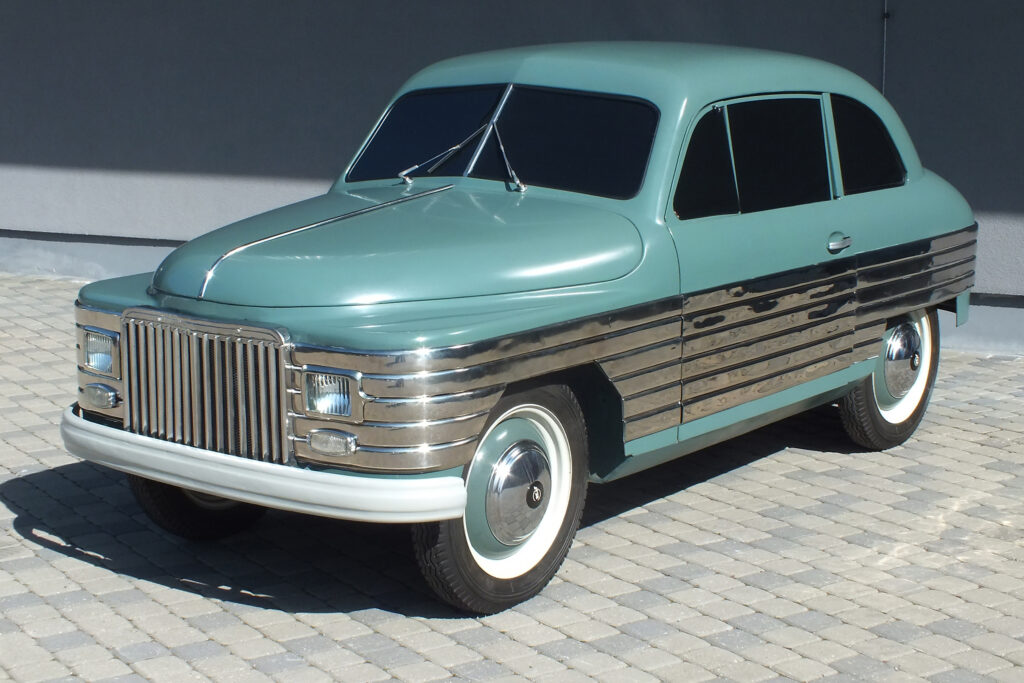
Foremost among those exhibited in France is Giovanni Savonuzzi’s 1955 masterpiece Gilda, Streamline X for Chrysler-Ghia — just think of The Jetsons. Others include the incredibly contemporary-looking L’Oeuf, dating back to 1942 by Paul Arzens; Vsevolod Bahchivandzhi’s REAF 50 family car; and the drop-dead gorgeous 1963 Chevrolet Corvair Testudo Bertone, by Giorgetto Giugiaro for General Motors.
This is no car-boot sale, it’s a coherent and interesting search for our understanding of the object that we call the motor car. It is commonplace today to recognize cars as valid works of art which can be driven, or mounted on a wall, or displayed in a gallery, but in the 50s — even as American car designers were sculpting the optimism of age in curves, wings, and chrome, and customizing became a form of everyman self-expression — seeing cars, essentially utilitarian objects, as art was a relatively radical concept.
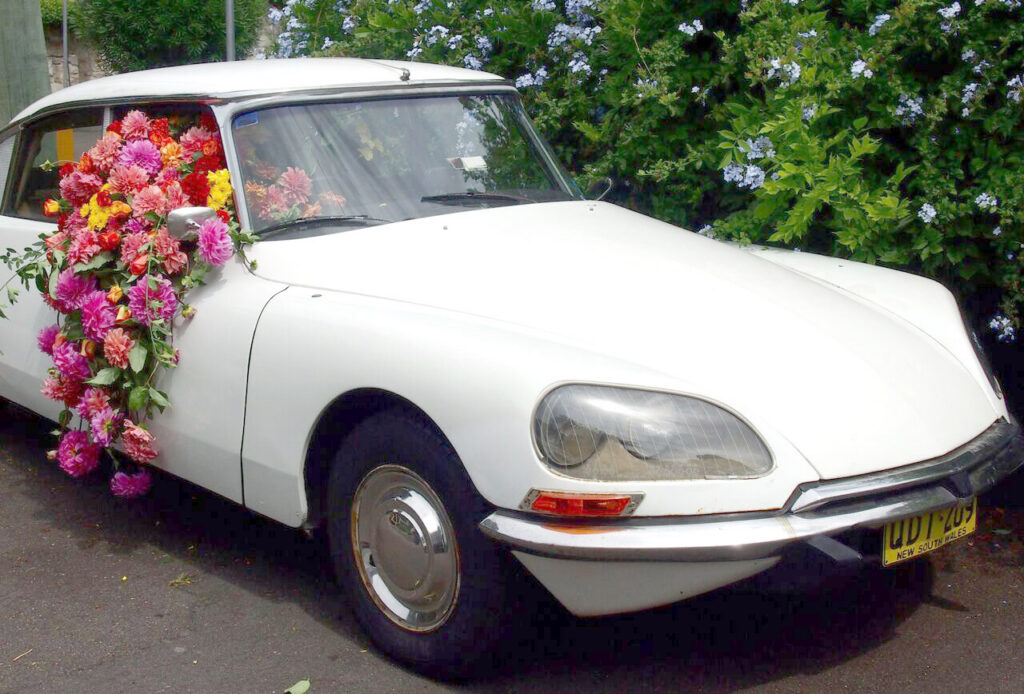
As Barthes said in 1957 in Mythologies, “The object here is totally prostituted, appropriated: originating from the heaven of Metropolis, the Goddess is in a quarter of an hour mediatised, actualising through this exorcism the very essence of petit-bourgeois advancement.” And if that’s not an empathic validation of the artistry inherent in this particular automobile’s design, I don’t know what is. It celebrates the Citroën DS, which in 2018 became just the ninth vehicle, among some 200,000 pieces overall, to go on permanent display at the Museum of Modern Art in New York.