

The actual Formula One

18 September, 2026

Jim Richardson profiles one of the giants of motorsport history, which fell out of the limelight when it came to New Zealand but which greatly enriches the pool of significant cars that now reside here 
By Jim Richardson, photography: David Gooley, Jon Dunstan 

This 1906 Darracq shows us what the first Grand Prix cars looked like

Seeing, in a shed in Hamilton, New Zealand, the Darracq 120 racer that Louis Wagner, also a pioneer aviator, drove to victory in the 1906 Vanderbilt Cup race felt a little like finding a Rembrandt at a garage sale.
For historical significance, I’d say this car ranks with Ray Harroun’s Marmon Wasp, the first Indianapolis 500 winner. Unlike Harroun’s Wasp, which has been lovingly cared for at the Indianapolis Motor Speedway Hall of Fame Museum over the years, this historically pivotal machine wound up half a world away from its home in France and, to most of the motoring world, largely forgotten. Sadly, so is the story of how the car got to Aotearoa in the first place.
More often than not, a racing car that is a few years old is regarded as obsolete and relegated to a shed somewhere. As far as racing drivers and team owners at the cutting edge of the sport are concerned, the cars are virtually worthless at that point. They can’t be driven on the street; at best they can be reconfigured for lower levels of the sport, so few people care about them until their historical significance becomes more apparent.
If they are lucky, and not immediately broken up or cannibalised for parts, most outmoded race cars endure the whims of different owners until they are largely forgotten, ending up in the back of sheds. A typically tortuous fate befell this race-winning Darracq, currently owned by none other than Rod Millen, Kiwi rally driving legend.

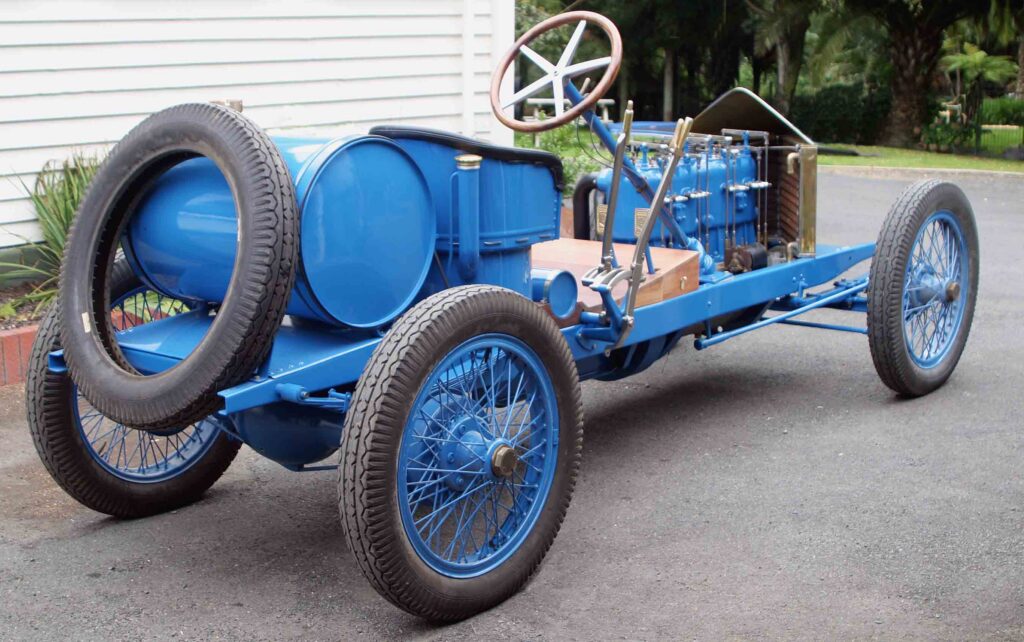
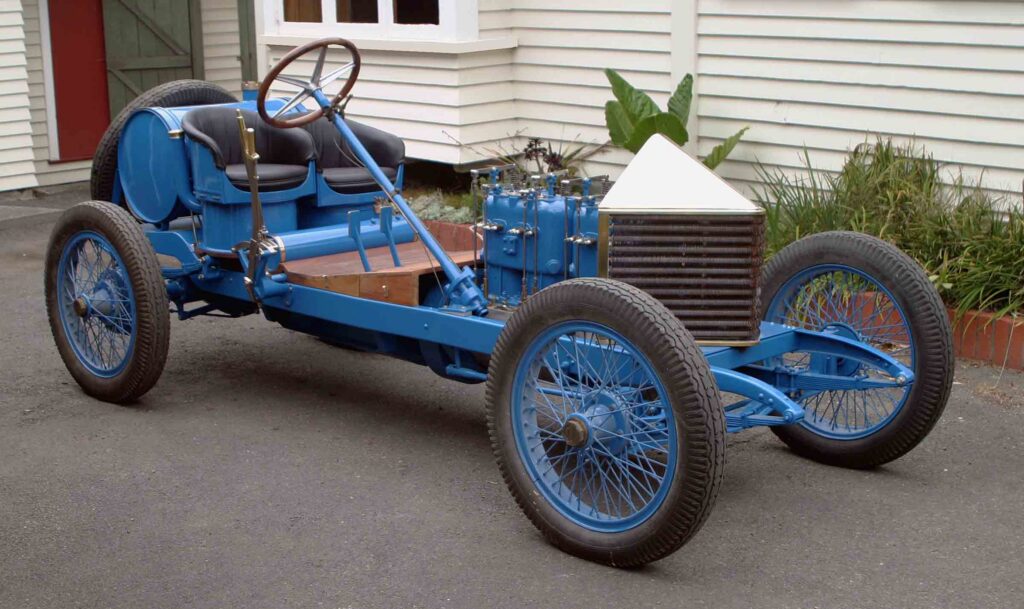
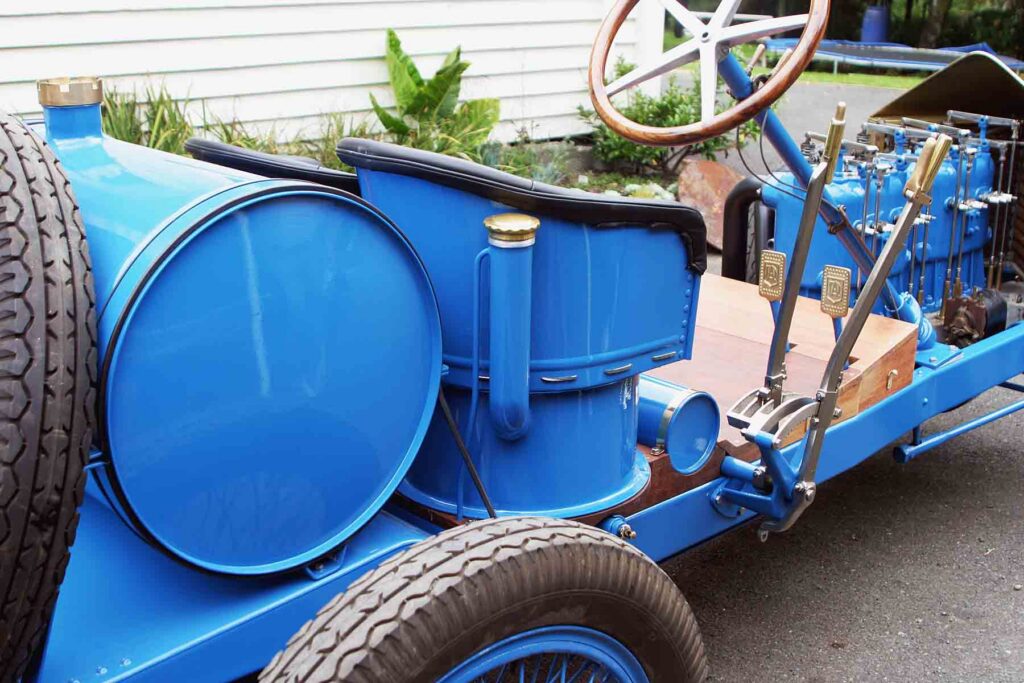
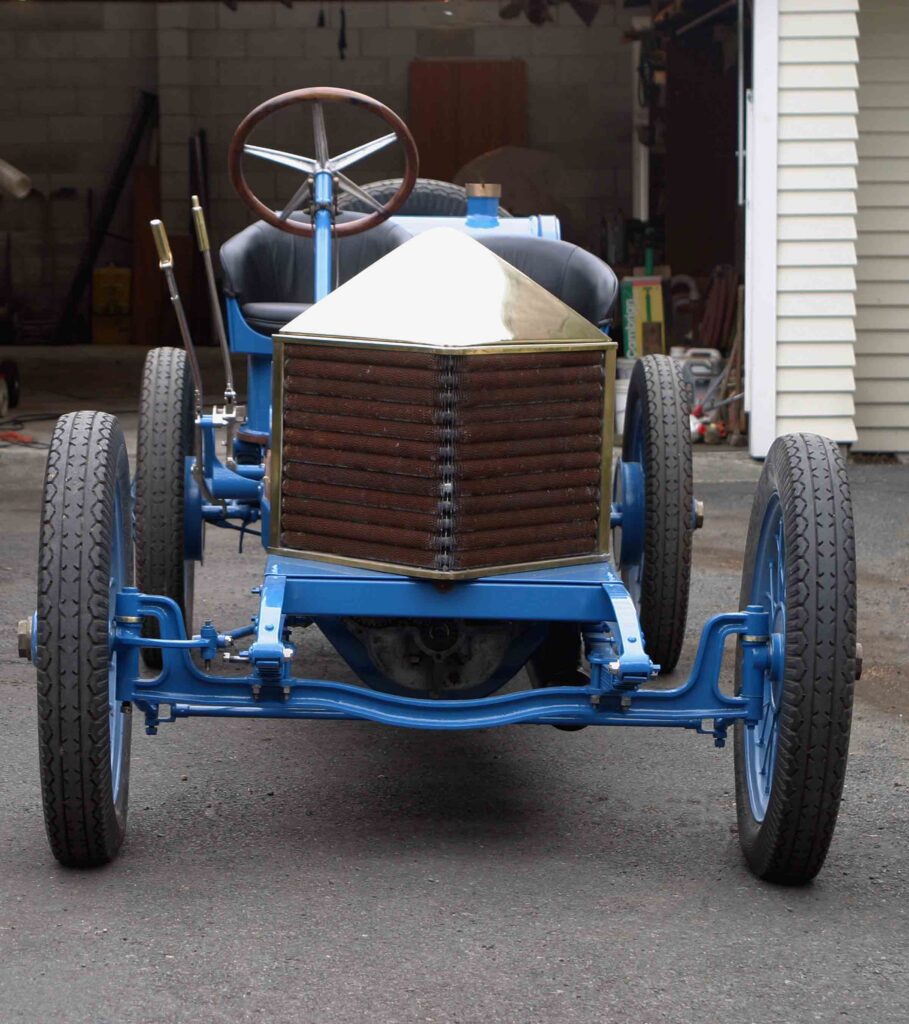
No fripperies such as bonnet, cowl, or mudguards
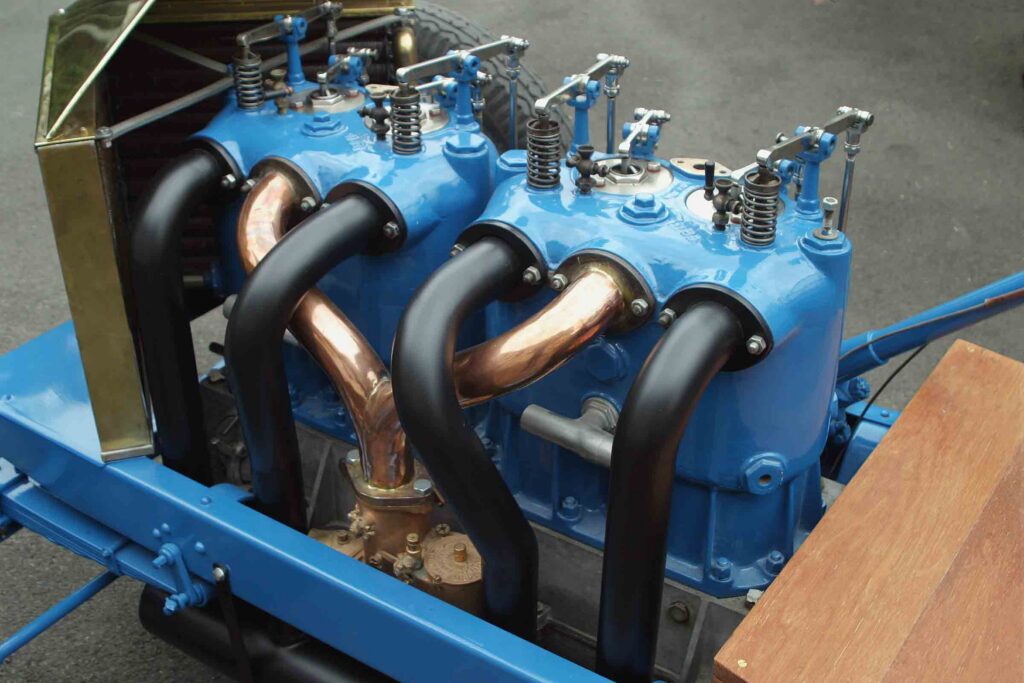
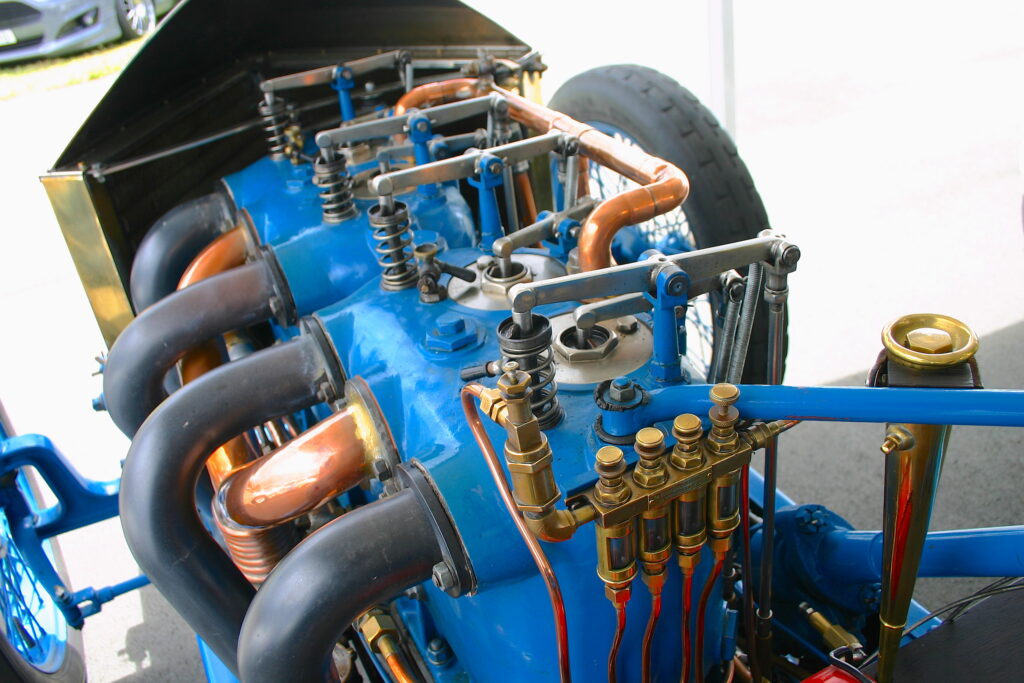
Artfully designed manifolding on the gigantic four-banger
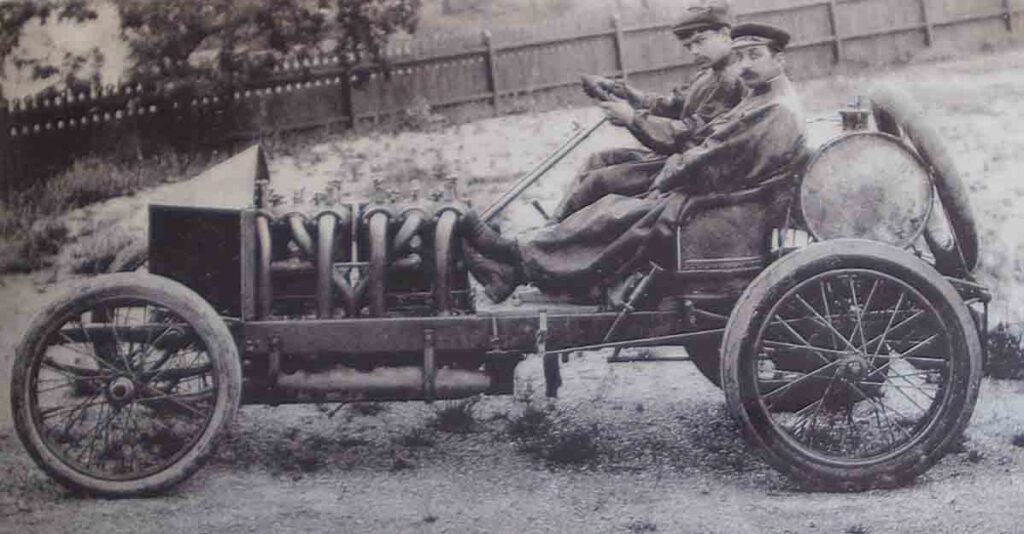
Louis Wagner and co-driver at Vanderbilt Cup Race, 1906

Thunderbird One
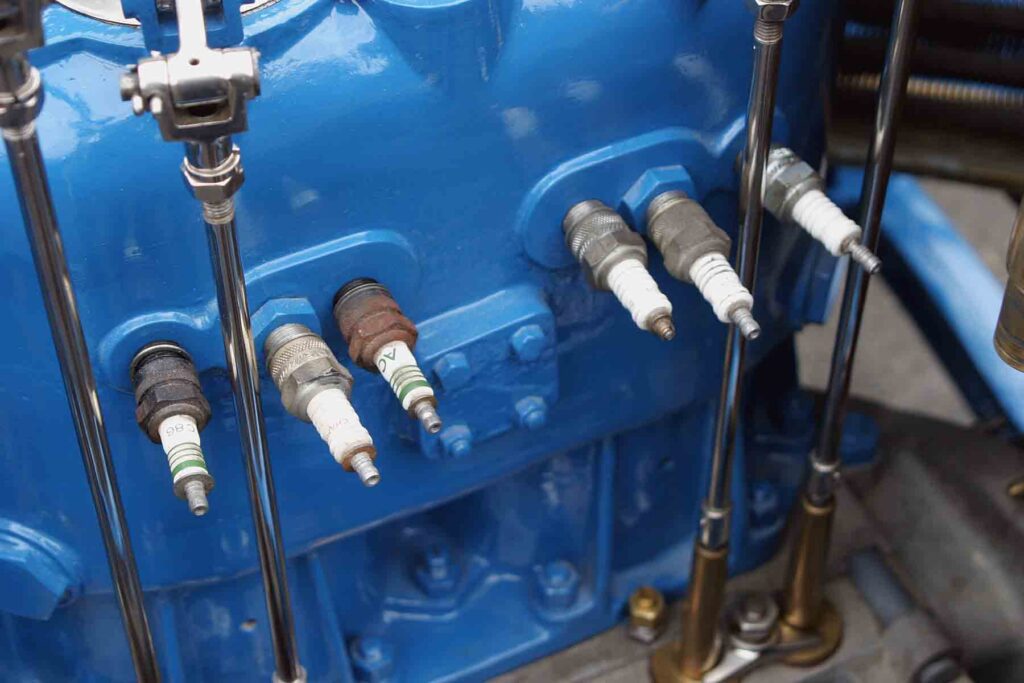
If winning the 1906 Vanderbilt Cup isn’t enough to make the car important, another well-documented tidbit of information makes this racer legendary; it was also the original Blue Bird of land-speed record-setter, Sir Malcolm Campbell, who named the machine after a play he had seen. Of course, the car’s French racing blue paintwork may have been an inspiration, too. It was Campbell who added the third spark plug at each cylinder, no doubt to try to get a more complete burn across the huge pistons of the machine with the low-octane fuel then available.
I saw the car in the aforementioned shed in 2004 when it was owned by the late Wallace McNair. You can see the third spark plugs at each cylinder in some of the photos I took then, but later Wallace, who restored the car, removed the third plugs, as you see in more current pictures. The car has been modified in other minor ways, too, such as the addition of a sump under the engine to collect the oil from its total-loss system in order to make it usable on modern tracks; but in all but the most minor details it is as it came from the Darracq works originally.

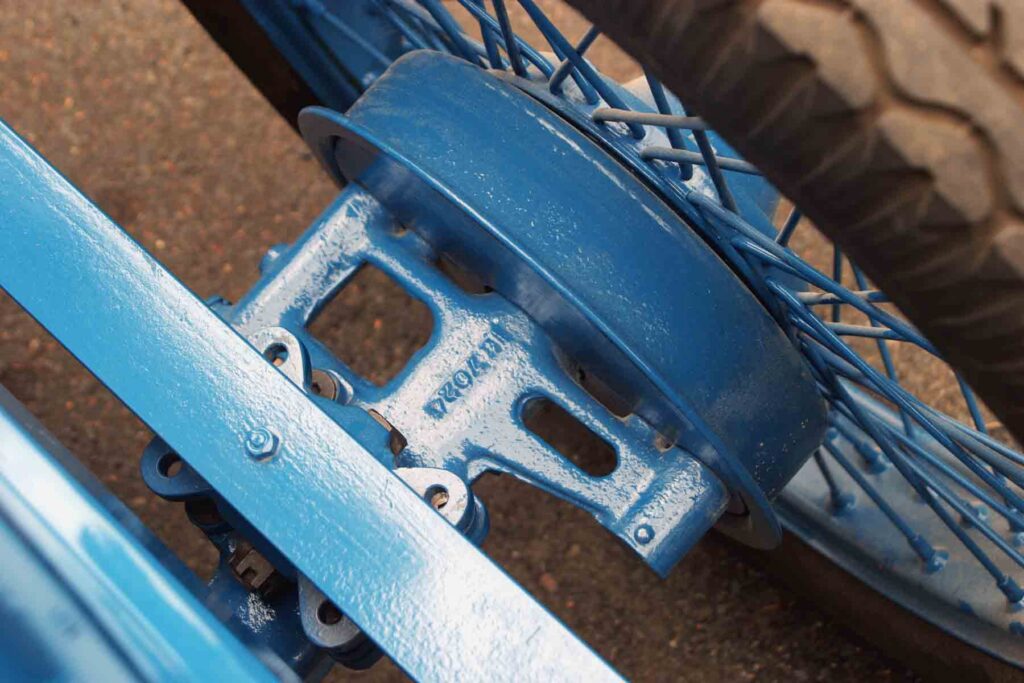
Brakes were internal expanding types but were small, and rear wheel only
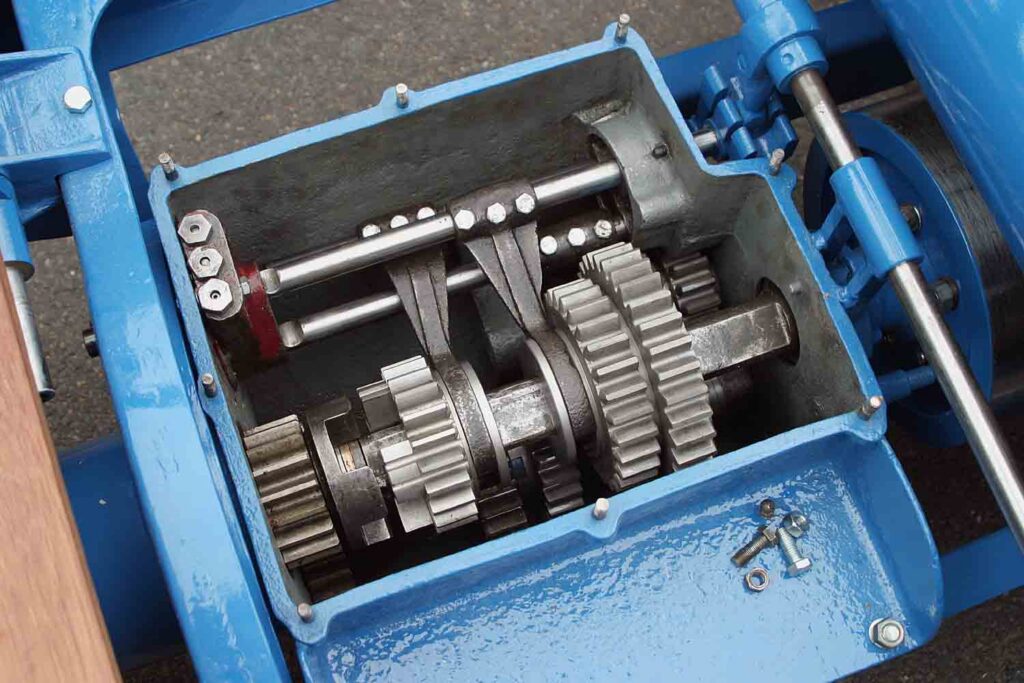
Enclosed four-speed gearbox was years ahead of those in contemporary cars
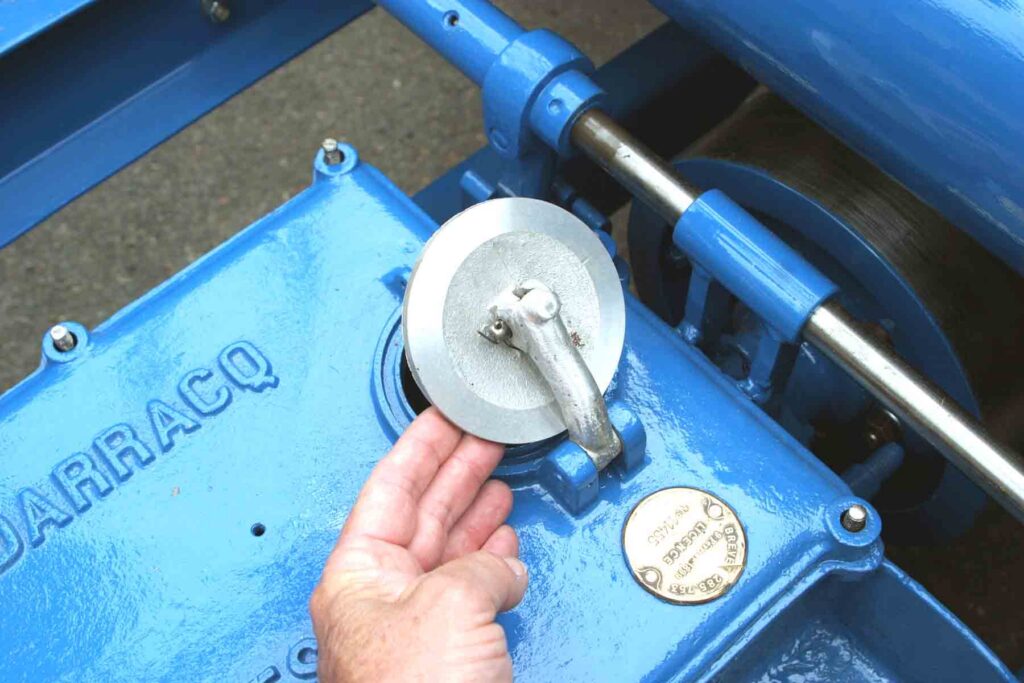
Big filler cap for gearbox makes replenishing the transmission easy

First race
This unique Darracq also competed in the very first French Grand Prix at Le Mans on 26–27 June 1906. The rules stipulated that the car could weigh no more than 1000 kilograms, plus a seven-kilogram allowance for magneto and dynamo. The event was run on a 64-mile circuit and consisted of six laps on each of two days. The Darracq was up against the likes of Fiat, Clement Bayard, Mercedes, and Locomobile, but had to retire with engine problems after only two laps. That race was won by Ferenc Szisz in a Renault AK 90CV at an average speed of 62.88 miles per hour. 
Two years before that first French Grand Prix, WK Vanderbilt II had established the Vanderbilt Cup race to promote the sport of automobile racing in America. This, after Vanderbilt set a land-speed record of 92.30 miles per hour in 1904 in a Mercedes on the beach at Daytona. 
The Vanderbilt Cup race was run on Long Island over mostly unpaved public roads, so all the dust — combined with the oil expelled from the primitive engines with their total-loss oiling systems — soon made for a slick, toxic gumbo in which the drivers had to compete.
If that weren’t dangerous enough, crowds lined the raceway circuit without the benefit of safety barriers, creating hair-raising hazards as the racers thundered by. 
In the 1906 event, a spectator stumbled onto the course and was killed by a competing car. This tragic accident caused such a stir that the event was not held again until 1908, and it inspired Vanderbilt to devote himself to road safety in New York in later years.
The rules for the Vanderbilt Cup race were that drivers had to begin at timed intervals, the car doing the fastest time from start to finish being declared the winner. An astounding 250,000 fans attended the 1906 event, which was America’s most prestigious automobile race at that time. The Indianapolis Motor Speedway didn’t hold its first race until 1908, and the first of the famous 500-mile races wasn’t held until 1911.

The original car came with two plugs per cylinder, but Sir Malcolm Campbell added a third to make it the first Blue Bird
Radiator water tank under the driver’s seat
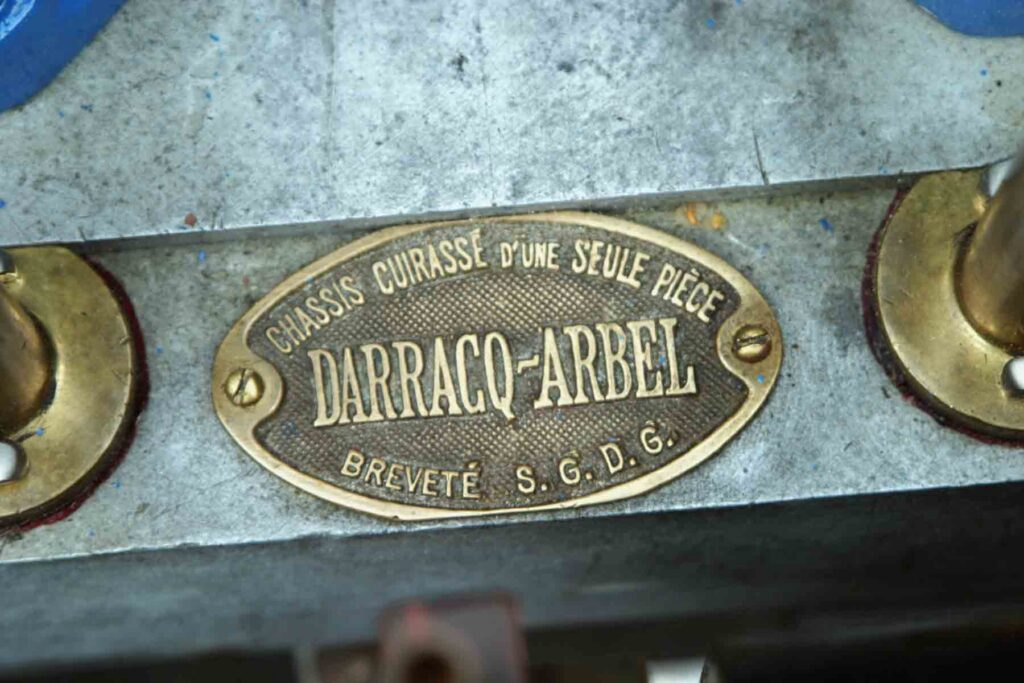
Original nameplates attest to this car’s pedigree

Louis Wagner’s account
Here, in the words of the Darracq’s pilot for the event, Louis Wagner, is how the Vanderbilt progressed: 
“Starting in tenth place, my time for the first lap, 28:36, enabled me to overtake and pass Nazzaro and Luttgen, then Heath and Le Blon, on the initial circuit, and Shepard at the tape. The leading cars were behaving with wonderful consistency. But the crowd! On rounding the hairpin turn for the second time, directly in the road were at least fifty persons as we approached the turn. They swiftly made their way, but my car must have brushed at least a dozen coats while taking the turn. I actually shut my eyes and piloted the machine by blind instinct — expecting any moment to mow down several lives. That no one was slain was nothing less than a miracle. 
“For the oil-sodden roadstead to one travelling faster than a mile a minute was nothing but a very narrow ribbon fringed at brief intervals with blotches of humanity. As for the eleven sharp bends in the course, it was impossible for me to know from my own vision just when and where they may be met. For this knowledge I depended entirely upon my companion who directed the way with his hand. 
“As we swung into the stretch leading to the treacherous Bull’s Head Turn, and while going fully eighty miles an hour, one of the rear tyres struck a broken glass bottle which had been thrown into the road and collapsed with a terrific detonation. My hopes collapsed with the tyre. Some two miles farther on was our emergency station and, without slackening speed, though at the imminent risk of disaster, we got there. Every second was a century. Without realising what I was doing, I took a glass of champagne and two raw eggs, while the emergency crew wrestled in a frenzy with the tyres.
“It seemed but a fraction of a moment before a vague speck appeared two miles away on the course. It swiftly became a cloud, then a dreaded outline, and with a sudden rush and roar, a Lancia thundered by and was gone. There was no more stopping or slackening at turns, no further fear or concern over the reckless crowd. A mile from the finish it became evident that the dense mass of spectators was beyond control. Lancia had finished. But how long ago? As in a trance, a bugle sounded, and the next moment, with a flash and volley, the Darracq was over the tape — the winner.”* 
After 1906, all that is known for sure is that Sir Malcolm Campbell purchased the car in 1910 and raced it at Brooklands; but exactly how, when, and why it came to the Antipodes is lost to history. It is said that in 1914 an Irish immigrant New Zealander purchased the car, imported it, and took its engine out to use in a speedboat, but nobody knows for sure. 
Sadly, the Great War intervened before he could complete his project. After World War I, the fellow’s widow offered the car and motor for sale, and a fellow who intended to use the engine in a speedboat purchased them in 1919. However, in the end, the motor out of the old race car wound up powering a stand-by generator at a Christchurch newspaper while the chassis languished in a barn.
Though some of this car’s history is now lost, its pedigree is indisputable. A casual inspection would be enough to convince most of us of that. There is no mistaking that technologically advanced intake and exhaust system, that huge 14-litre overhead valve four-cylinder engine with its cylinders cast in pairs, the swept-back V-shaped radiator, and that remarkably advanced slider gear transmission. 
When we first photographed the car in 2004, Wallace McNair had just restored it and had a few more details to attend to, such as hooking up the spark plug wires, before he was ready to light it off and experience the bark of this famous old racer. He completed the car and did a few test runs, and soon after his wife Anne began demonstrating it in historic races at Pukekohe and, later, Hampton Downs.

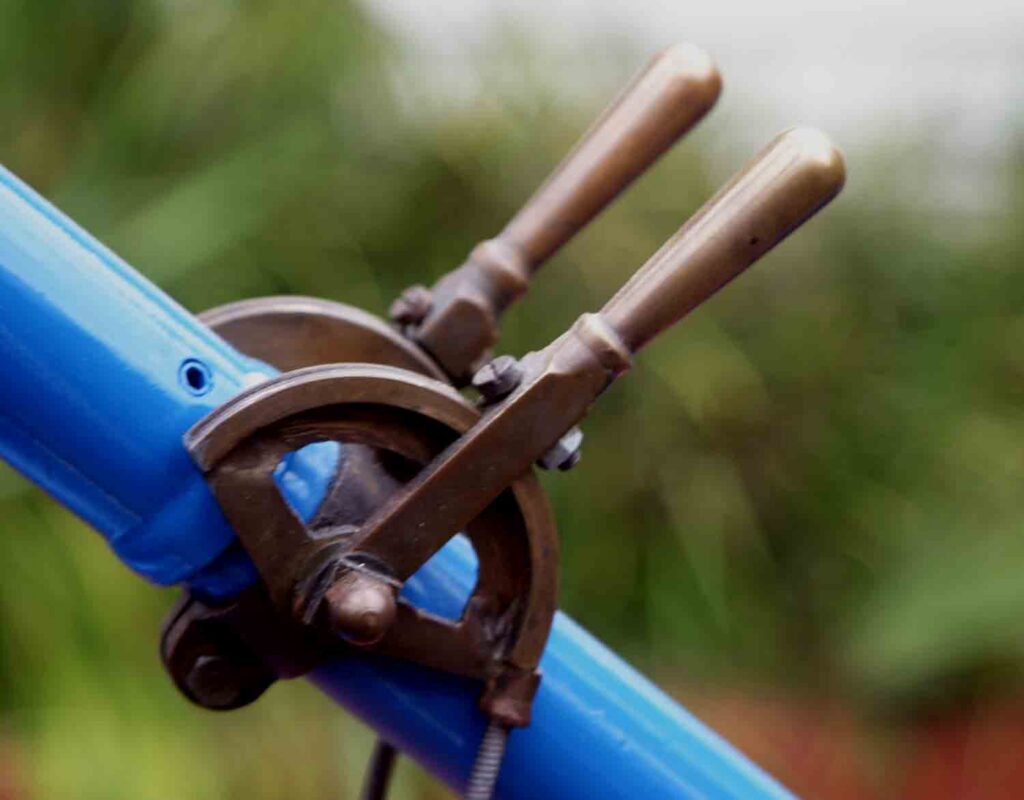
Steering, column-mounted throttle, and spark advance
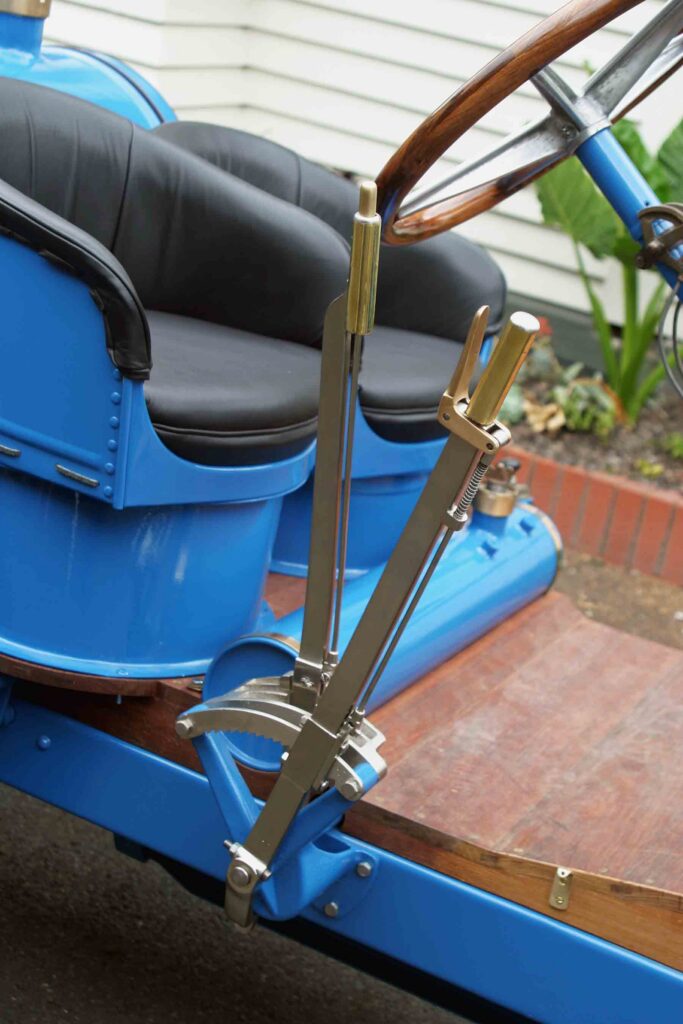
The gearshift and handbrake are made to last
No roll bar, no safety belts, and no fire suit

The remarkable Alexandre Darracq
The car’s builder, Alexandre Darracq, originally made sewing machines in France. He then founded the Gladiator Cycle Company in 1891 and began making Millet motorcycles. These ventures paid off so handsomely that he went into the manufacture of automobiles in the 1890s. His first cars were electric, but, as the internal combustion engine proved itself more versatile, he switched to that new form of propulsion. 
Remarkably, Darracq himself never learned to drive, but he founded one of the first schools for racing drivers. In 1908 Darracq retired to the French Riviera, where he invested in the Hotel Negresco in Nice. He died a wealthy man in 1931, some20 years after his foray into auto manufacturing.
The company is all but forgotten now, but Darracq was the most successful manufacturer of automobiles in 1904, producing 1600 cars under the Darracq, Talbot-Darracq, and Talbot trademarks, using mass-production techniques well before Henry Ford’s merry-go-round got started. 
An early Darracq also set the world land-speed record in 1904, at 104.52 miles per hour, eclipsing Vanderbilt’s brief brush with glory. Then, in 1905, Victor Hémery upped the ante by doing 109.65 miles per hour in another Darracq. In 1906, Louis Chevrolet built a Darracq 25-litre V8-powered car in which Victor Demogeot, his mechanic, set a world land-speed record of 122mph. 
Also, in 1906 — the same year as our feature car — Società Anonima Italiana Darracq began building automobiles in Italy under licence. The original factory was in Naples, but the operation was later moved to Milan, and its name was changed to Società Anonima Lombarda Fabbrica Automobili, or ALFA for short. This Italian branch of Darracq also built several race-winning cars in the early years. Then, in 1915, Nicola Romeo took over the company and dubbed it Alfa Romeo. 
This 1906 Darracq Vanderbilt Cup winner weighs less than the 2200-pound limit for Grand Prix racers at the time, but produces 120 horsepower, so it is quite capable of speeds of over 100mph. Wagner won the 1906 Vanderbilt Cup race averaging 61.43 miles an hour — an incredible feat when you consider the conditions. 
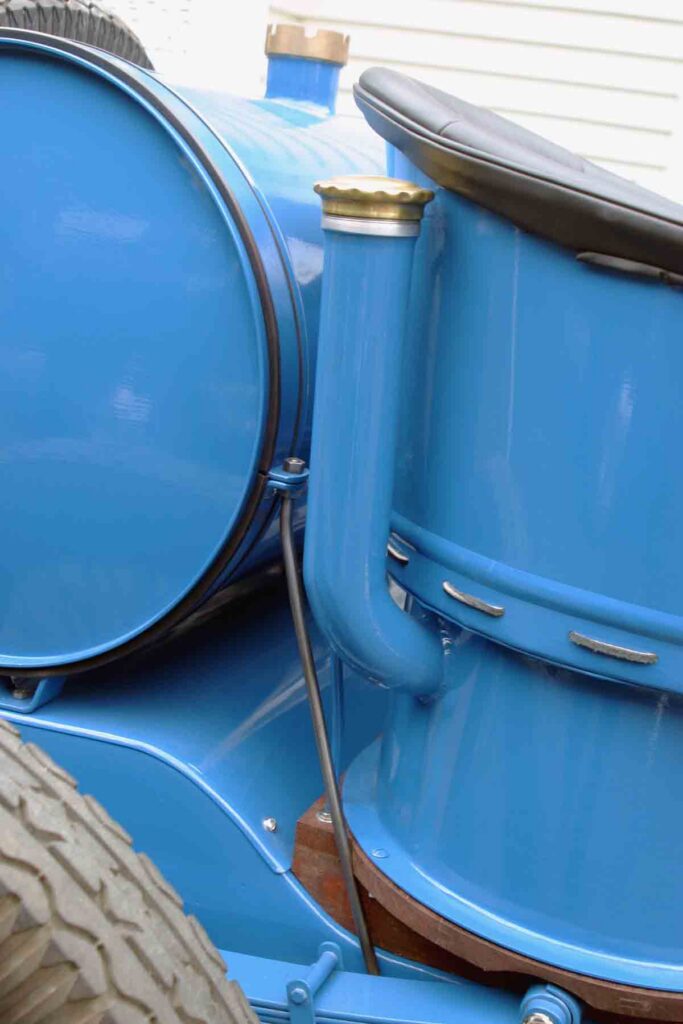
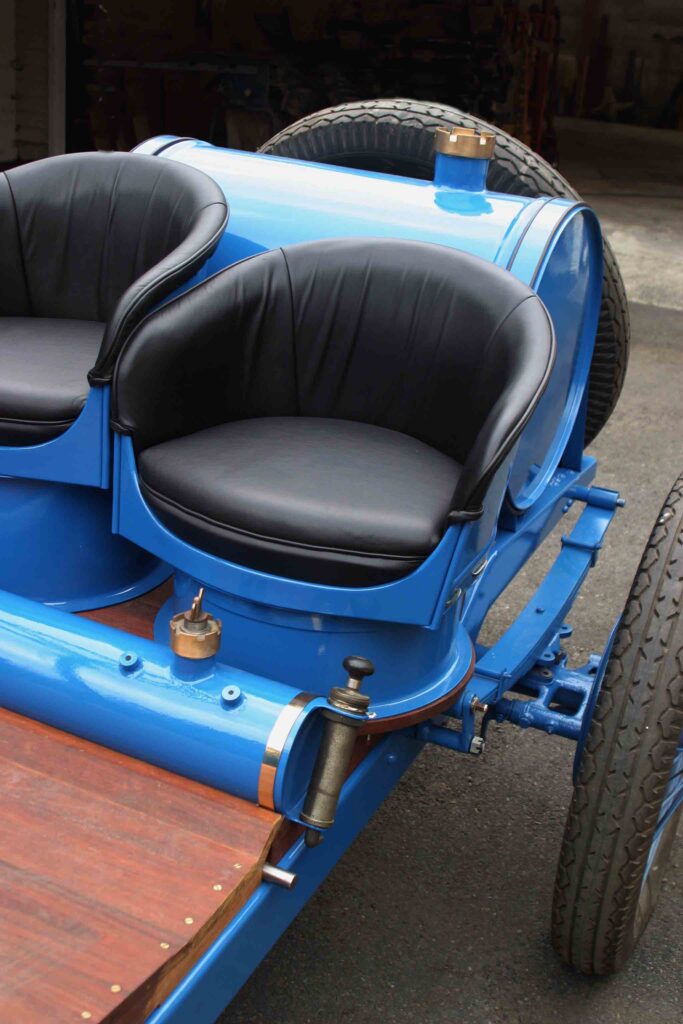
At the time we first photographed the ancient Darracq in McNair’s shed, it was undergoing restoration. Because of that, I assumed the cowl and bonnet were off the car temporarily, but I was wrong. The original machine actually had no cowl or bonnet. It was just as you see it in the photographs. There were a few details yet to be dealt with back then, but the Darracq was about as Spartan as any race car ever built. Even the driver’s seat does double duty, because it is perched on top of the water reservoir for the cooling system.
Driving such a car without so much as a toe-board on which to brace yourself under braking must have been absolutely harrowing. But perhaps the brakes didn’t matter much because all you had was a handbrake working on the driveshaft plus tiny rear wheel mechanical binders that — along with the combined footprint of the narrow tyres — look as if they could barely slow the machine, much less stop it in less than a fortnight. 
The Darracq Grand Prix car has a leather-faced cone clutch that is either engaged or disengaged. There is no feathering it. On the floorboard are just the conventional brake and clutch pedals. Tiny, bicycle-like levers attached to the steering column control the throttle and spark.

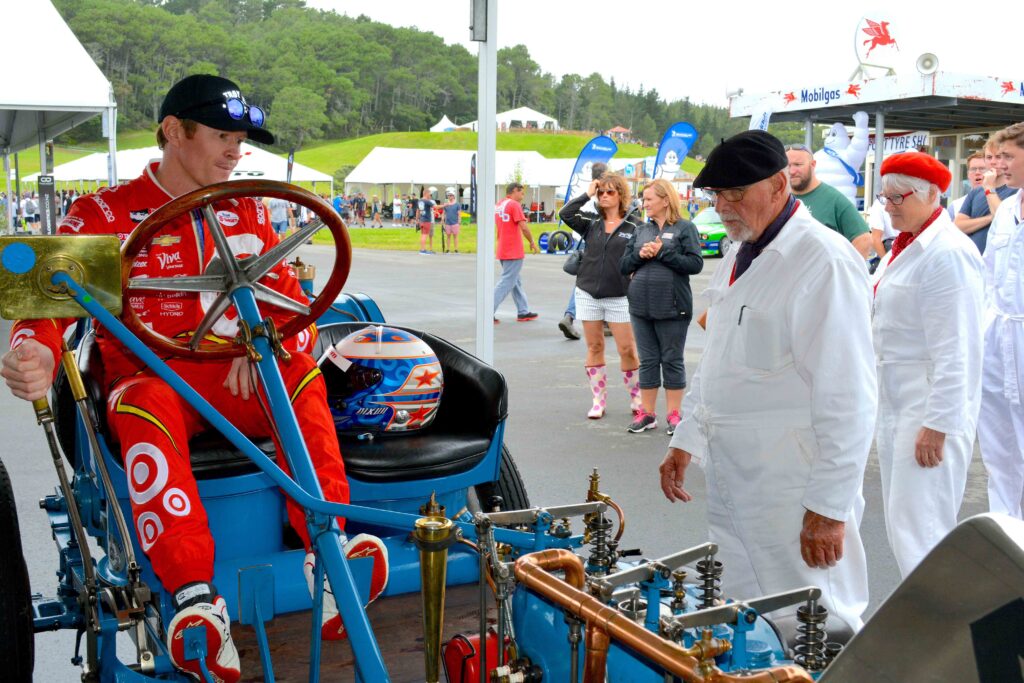
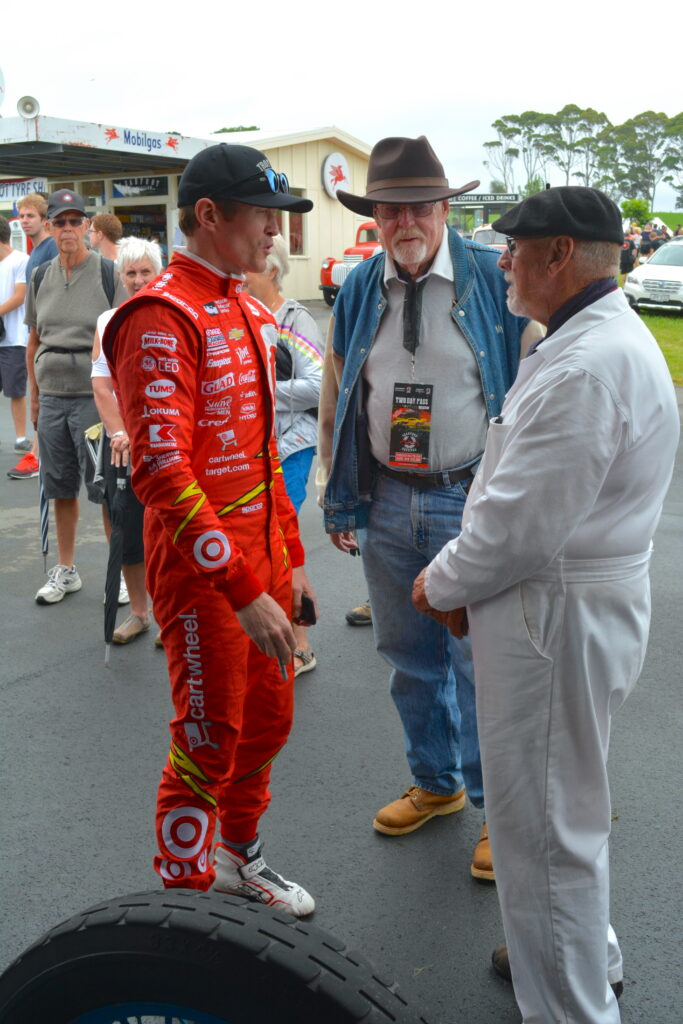
Scott Dixon learns about the brakes from Wallace McNair and Anne Thomson
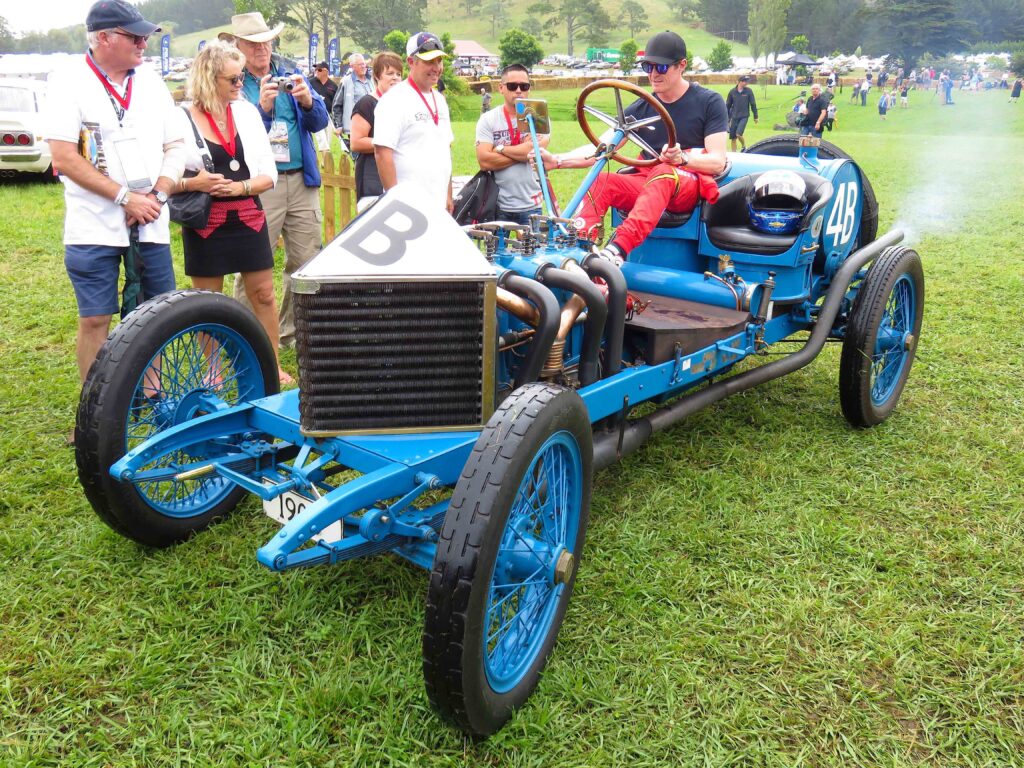
Dixon gets ready for a run up the hill
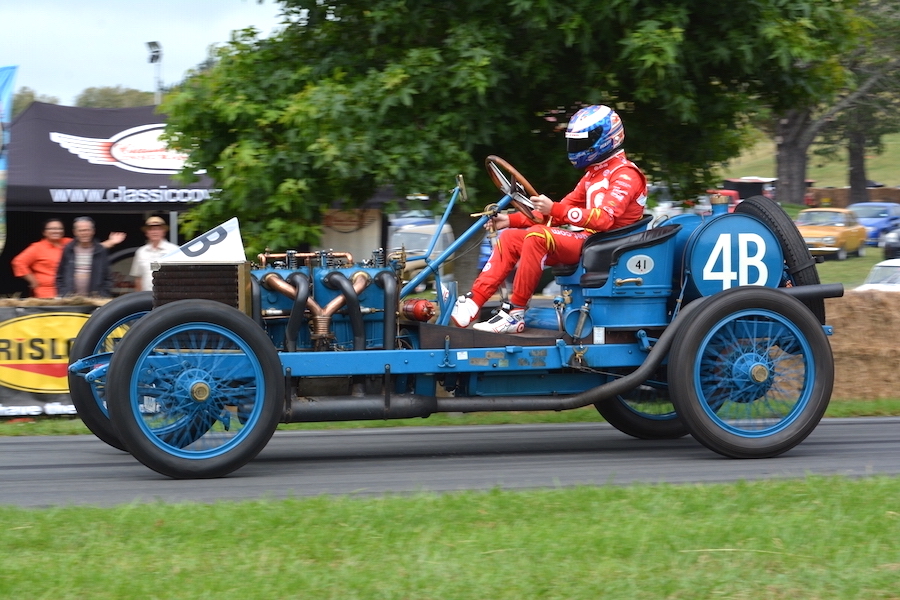
Dixon’s times came down as he wrestled the antique racer up Rod Millen’s driveway

The sporting Ms Thomson
When we were there for one of the inaugural shakedown spins around McNair’s neighbourhood back in 2004, he started the engine and car alarms in the area went off, causing a stir among the neighbours — even though they were fairly used to Wallace’s shenanigans because he also occasionally fired up a vintage Sunbeam land-speed-record car he restored that is equipped with an immense World War I Handley Page bomber engine. 
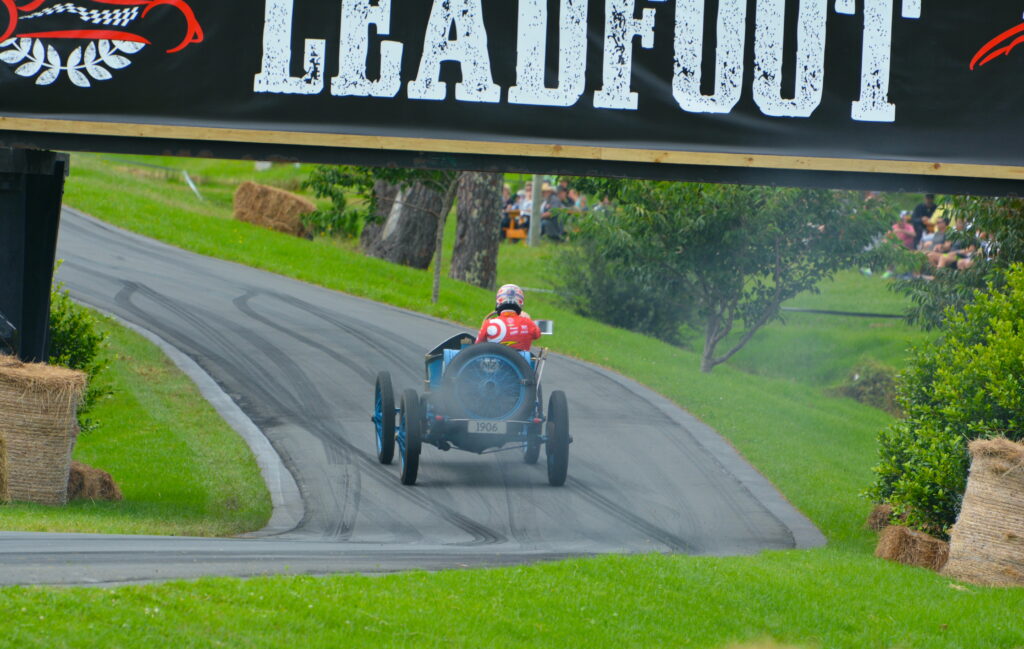
In recent years, Wallace’s wife, Anne Thomson, has exhibition-raced the car at the Leadfoot Festival and other famous tracks. When she took a fellow automotive journalist for a ride around the Hampton Downs course, all he could say was that it was, “Terrifying! There is no cowl, nor even a toe-board; there are no seatbelts, and the seats are no more than tiny buckets.”
This ancient Darracq did 108 miles an hour when it was built, and was clocked at over 100mph at Hampton Downs recently with Ms Thomson at the wheel. I have personally witnessed the car at full chat there several times over the years, and was amazed that such a primitive and basic early machine could be so fast.
Oil is fed to the engine via a small tank and a hand pump mounted in front of the seats. There is no protection from the heat, fumes, and splattering oil emanating from the motor, save the dusters worn by the driver and mechanic. Nor is there anything to keep the dirt, dust, and oil from clouding the driver’s goggles. We seem like sissies today with our helmets, roll bars, fireproof suits, paved tracks, and safety belts.
Water circulation in the cooling system is by thermosiphon, which relies on the fact that water rises as it gets warmer, causing it to flow through the large cooling system. Evaporation is also part of the cooling process, necessitating a large reservoir of water under the driver’s seat. The big engine gulps fuel and needs a barrel-sized 30-gallon gas tank behind the driver that is gravity-fed to the carburettor.
Wallace McNair and Anne Thomson sold their Darracq racer a few years ago to rally legend, Rod Millen, who hosts the Leadfoot Festival. No one knows what Millen paid for the car, but it was offered for a cool million dollars. In today’s market, that would certainly be a fair price for one of the very first Grand Prix racers, and the winner of — and last surviving car from — the 1906 Vanderbilt Cup.
In 2018, Scott Dixon, six-time world Indy Car champion, drove Millen’s 1906 Darracq in the festival at Millen’s Leadfoot Ranch on the Coromandel Peninsula. He had this to say about the experience: “It is much harder to drive than an Indy Car. You have to brake with the handbrake if you want to slow down at all. It is a real handful.”
Dixon’s contract would not normally allow him to drive other racing cars due to insurance problems, but a special dispensation was granted in this case. 
In the States, they call Dixon ‘The Iceman’ because of his cool demeanour, but when you see Dixon on the track, he is all pro, and all business. That was true of his spin in the 1906 Darracq, too. Over the course of the weekend, his times came steadily down. In the end, he was throwing this ancient racer around in a way Louis Wagner himself would appreciate. It was Scott’s chance to experience the actual ‘Formula 1’.

The thermosiphon and evaporation cooling system requires a water tank under the driver’s seat
Getting into her work uphill

Specifications: 1906 Darracq 120 Racer

Engine: 14-litre (854ci), overhead-valve four-cylinder, with cylinders cast in pairs
Oil system: Total loss
Cooling: Water-cooled by thermosiphon
Horsepower: 120hp (89.5kW)

Dimensions
Wheelbase: 2438mm
Track: 1346mm
Weight: 978kg

Performance
Top speed: 108mph (174kph)

Wallace McNair and yours truly give Dixon a few racing pointers
Total loss system’s oil tank and pump
No oil in the sight gauges? Pump more in

Dad will love this!

Subscribe or gift a subscription to NZ Classic Car magazine for one year this Father’s Day, and go into the draw to win one of two luxury car care packages worth $570 from Lovecars.
The prize: Adam’s Foam Cannon Kit includes a complete pressure-washer foam cannon setup; Michelle’s Car Wash Kit takes care of everything after the foam. It includes Autostolz Premium Auto Wash, Enhanced Ceramic Spray Wax, and loads more.
Together, you’ve got the setup to foam, wash, protect and dry your car properly – using some of NZ’s top-selling car detailing products.
A seriously good prize for anyone who loves keeping their car looking its best.
Motorsport Flashback: The Temple of Speed

On the banks of the Lambro River is Europe’s largest enclosed park, all 688 hectares of it. Parco di Monza was commissioned by the son of an Austrian empress as a summer retreat in the late 1700s, but it would be for another century and a half before ground was broken on what would become Italy’s famous theatre of speed at the park’s northern end. One hundred years ago on 3 September, less than four months after work started, Autodromo Nazionale di Monza was officially opened and the first race – appropriately, the Italian Grand Prix – was run a week later. Monza was the world’s third purpose-built circuit, after Brooklands and Indianapolis, and was the result of the Milan Automobile Club financing the 3500 workers who created the super-quick, and consequently dangerous, track that made the word ‘Monza’ synonymous for speed.