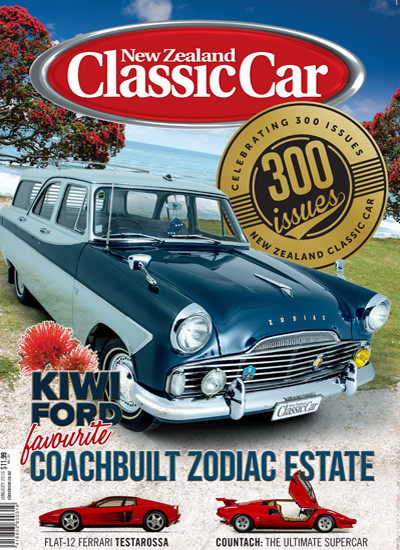
Celebrating 300 issues: the special edition of New Zealand Classic Car

31 December, 2015

With the January edition of New Zealand Classic Car now on sale, we celebrate our 300th issue with a special edition of New Zealand’s first and best classic car magazine. And, as a special bonus for our readers, every copy comes with a 2016 New Zealand Classic Car calendar and a terrific pack of classic car playing cards.

In what has now become something of a summertime tradition, our January cover car is a rare and rather splendid coach-built Ford Zodiac Estate — one of a number of bespoke vehicles built by Abbotts of Farnham.

Moving away from British Fords, we indulge ourselves and take a test drive in a pair of classic supercars — Ferrari’s fabled flat-12 Testarossa and Lamborghini’s totally over-the-top Countach.

Meanwhile, we also give readers an insight into what it takes to put together an eye-grabbing New Zealand Classic Car front cover — and reveal, for the first time, some of our more crazy ideas.

All your favourites are on board as well — Nationwide News, Behind the Garage Door, Motorsport Flashback, and, of course, Donn Anderson is Motor Man.

Pick up your copy of our 300th edition at your local supermarket or bookshop, or buy a print copy or a digital copy of the magazine below: 

Chrysler’s classy cruiser

I first saw our feature car, a 1970 V8-powered Regal 770 hardtop, towing a trailer carrying the tidy Ford Anglia classic racing saloon in Broadspeed racing colours that has featured in these pages. The coupe is comparatively rare here, which means anyone contemplating purchasing one of these big two-doors is sure to see prices continue to climb. The latter Charger has claimed much of the Aussie Chrysler limelight, but the simpler and classier lines of this car, which appeared dated soon after its introduction, now have a more timeless appeal.
Former owner, Balclutha motor engineer, Mike Verdoner, remembers the car well. He believes it came from Dunedin originally.
“I’m not sure about the car’s history, but I bought it off its owner at Kaitangata. Unusually, it was advertised in the local newspaper, the Clutha Leader, which was a surprise as these usually go for a lot more money on the internet. I had it for quite a few years. It needed a little bit of work to tidy it up, so I had to decide whether to spend the money on it to do it up, which could have been twenty grand. Its value at the time was not like it is now, so I sold it to Ewan. It’s probably now worth three or four times what I sold it for.”

The Pininfarina 230 SL

It’s October 1964, and imagine you’re an automotive journalist covering that year’s Paris Auto Show (Mondial de l’Automobile). As you approach the Pininfarina booth, you come across a car that looks a bit like the Mercedes-Benz 230 SL introduced the previous year at the Geneva Auto Show, a car then arriving at Mercedes-Benz dealerships around the world.
But looking closely, its styling and proportions seem to be a bit different. And it has a fixed roof, unlike the Pagoda-style greenhouse of the removable hardtop seen on the production 230 SL. While today, the styling of the W113, under the supervision of Head of Styling Friedrich Geiger, with lead designers Paul Bracq and Bela Barenyi, is considered a mid-century modern masterpiece, acceptance in-period was not universal. Some critics called out the concave design of its removable roof, which ultimately gave the car its “Pagoda” nickname.