
Porsche to restore one of the first-ever 911s

7 February, 2015

The Porsche 911 is nothing short of an icon. Its silhouette transcends countries and generations making it instantly recognizable from the first generation through to the current ‘991’ series. As one of history’s most revered sports cars, with hundreds of thousands sold since 1963, the second-hand market holds a 911 to suit nearly any budget. Rarities are common — the Carrera 2.7 RS comes readily to mind — and one of the first 911s manufactured would definitely fall under this category. However, that hasn’t stopped Porsche, who have come across one of the very first 911s ever built. Chassis number 57 sits within the Porsche Museum workshop in Stuttgart, ready to undergo a complete restoration.

Is there anyone better to undertake such a project? The 911 might not look like much now, but watch this space, and the video below — the meticulous restoration is guaranteed to be the best possible tribute to such a car’s history.

Breakfast of champions – Brink

Some older readers may recall the amusing late 60s advertisement for a breakfast drink using World Champion racing driver Graham Hill which was made while he was out here competing in the Tasman Series.
“Drink Brink” was the phrase, subtly altered by Graham’s characteristic lisp into “Dwink Bwinkl” which drew a grin or two.
Southland Mini racing enthusiast Howard Kingsford-Smith has preserved a little bit of Mini racing history when he re-created the “Brink Mini” some 25 years ago.
“I bought what remained of the original car and made a replica I suppose or look-a-like of the original Brink Mini from Cathy Henderson about 25 years ago,” Howard explained.

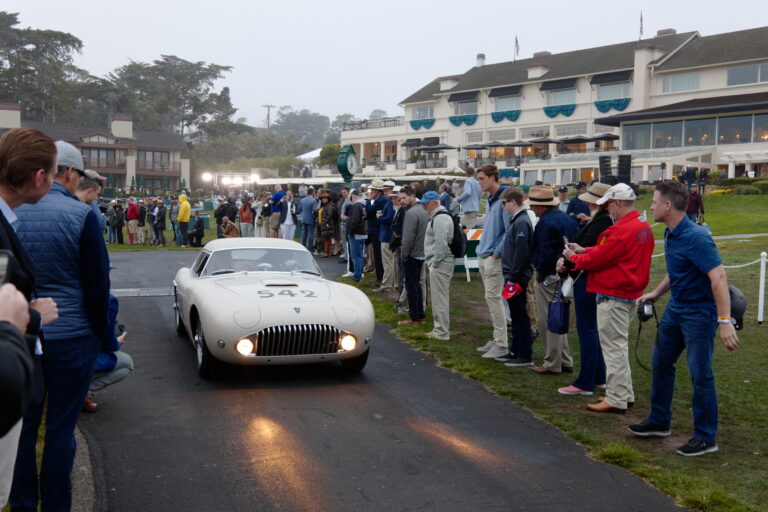
The motor car as an art form

We have certainly come a long way since the exhibition entitled 8 Automobiles, shown at the Museum of Modern Art in New York in the autumn of 1951, the first exhibition concerned with the aesthetics of motor car design.
It was here that the often-used term ‘rolling sculpture’ was coined by curator Philip C Johnson, director of the department of architecture and design, when he said, “An automobile is a familiar 20th century artefact, and is no less worthy of being judged for its visual appeal than a building or a chair. Automobiles are hollow, rolling sculptures, and their design refinements are fascinating. We have selected cars whose details and basic design suggest that automobiles, besides being America’s most useful objects, could be a source of visual experience more enjoyable than they now are.”