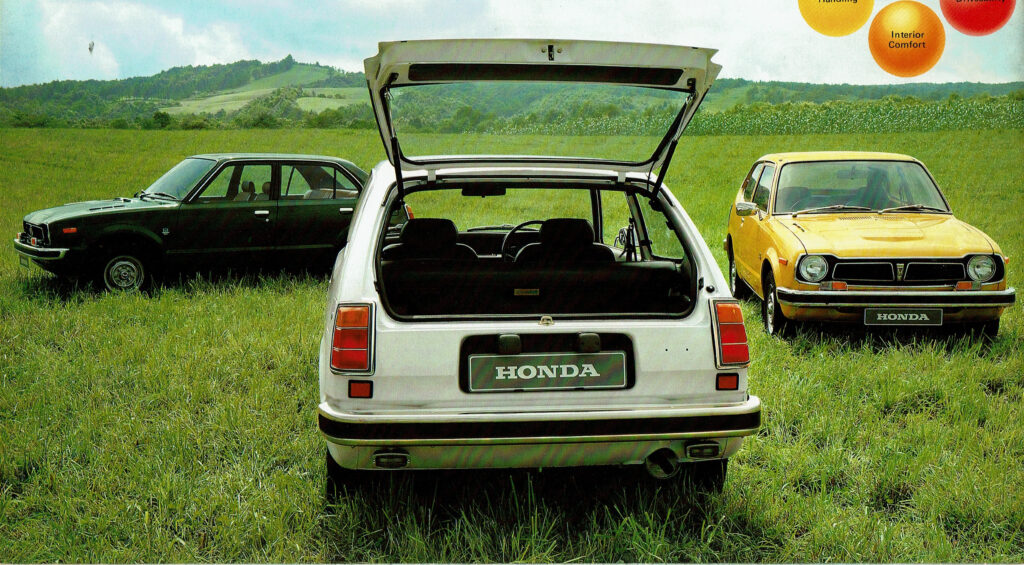
The original Civic broke the mould and set the Honda franchise in New Zealand on the road to popularity. The car, now surprisingly rare, celebrates a 50-year anniversary
By Donn Anderson
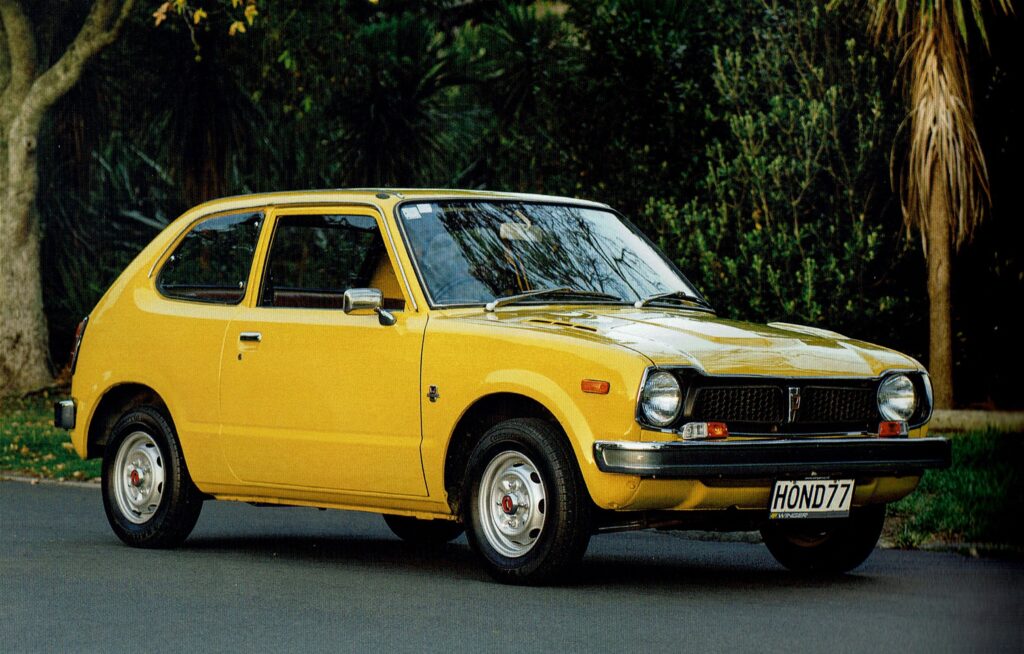
Japanese cars, and Hondas in particular, were about to flourish in New Zealand. This was the crux of the conversation I was having with Russell Moller, sitting in his Greenlane, Auckland, motor dealership early in 1973. Russell was particularly excited about the new Civic EB1 small car that had been unveiled in Japan the previous year.
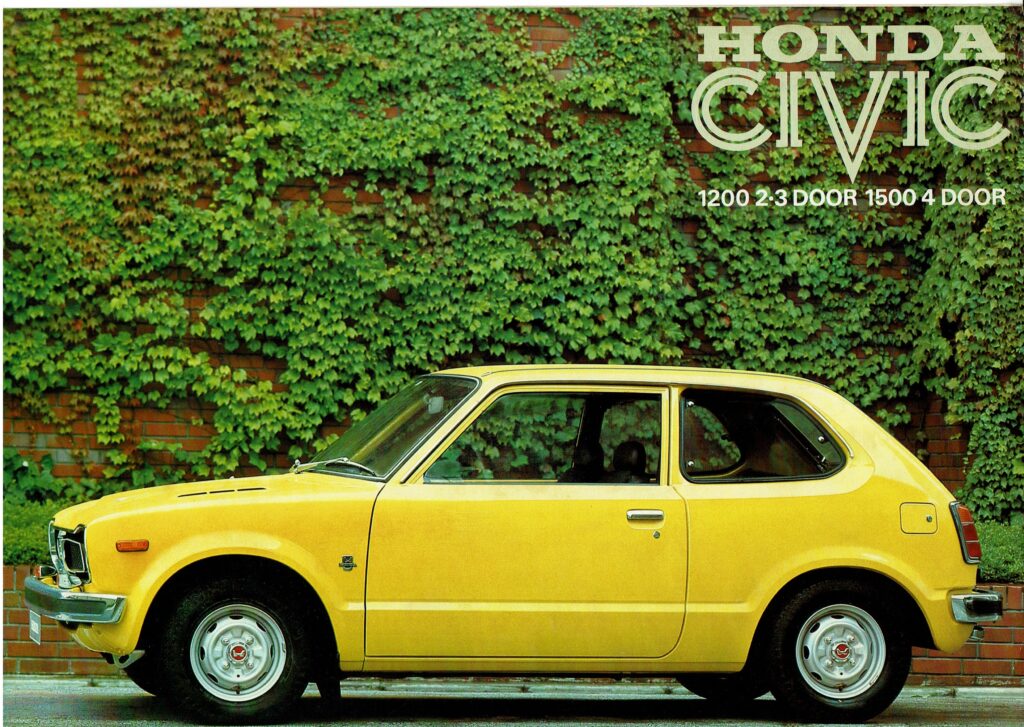
I was about to leave on an extended stay in Britain. When I returned more than two years later, it was apparent Russell had called it right. Norton and Russell Moller had gained the licence to import fully built-up Hondas, and formed Honda Pacific. A few highly prized Civics arrived before the New Zealand Motor Corporation (NZMC) assumed the franchise from the Moller Group. The corporation’s plans included building the EB1 at NZMC’s plant at Petone, near Wellington, and the first CKD (completely knocked down) Civic, a bright yellow example, rolled off the local assembly line in March 1976.
Honda was famous and well respected for its motorcycles, but late to the car and van business with its S600 sports car and slow-selling 1300 dry-sumped, air-cooled four-cylinder compact sedans in 1968. Founder Soichiro Honda had a particular interest in motorsport so it was somehow appropriate that the very first New Zealand importer of four-wheeled Hondas was Christchurch-based Pat Hoare. Hoare was an early Ferrari agent, a prominent racer, and winner of the 1962 New Zealand Gold Star open-wheeler championship. His Empisal Distributors company brought in limited numbers of S600s under licence. The Honda franchise was also held briefly by Auckland-based Richard J Kelly Ltd.
The marque has had a long and successful involvement in motorsport, including Formula 1, and, when chatting with Honda executives, their passion for all things motoring becomes apparent. I met Nobuhiko Kawamoto, president of Honda’s research and development department, on a visit to the company’s Japanese engineering centre in 1989. He spoke of his interest in older machinery, adding he could drive any car he wished, before disclosing that his personal garage included a Triumph TR3, a Porsche 356, and a 1935 Lagonda. Kawamoto, now aged 86, worked on Honda’s first Formula 1 project — and helped design the first-generation Civic.
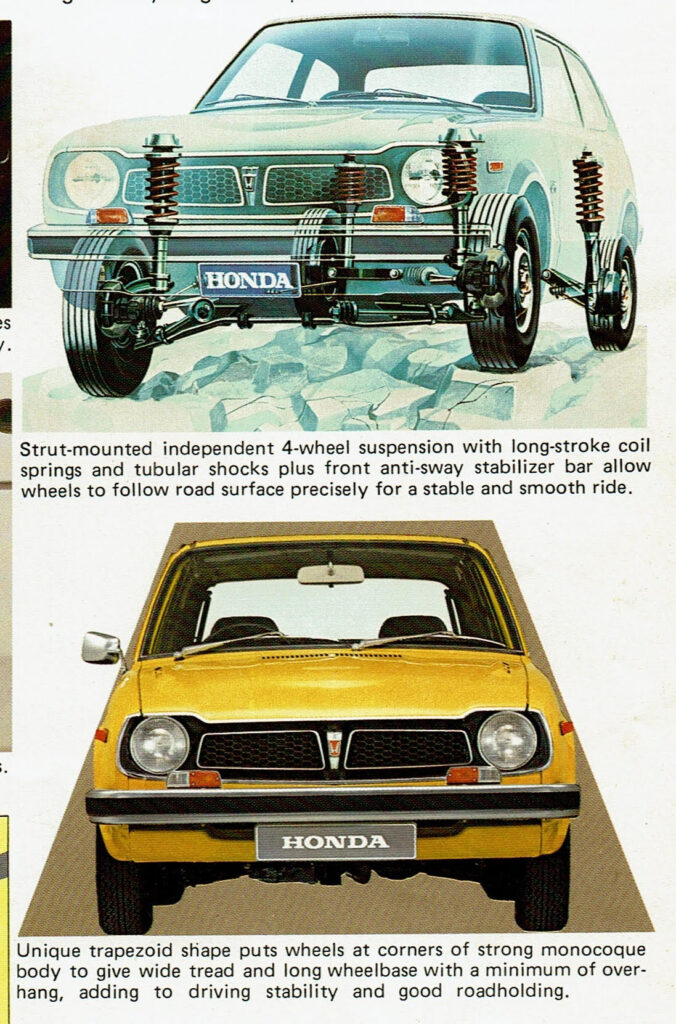
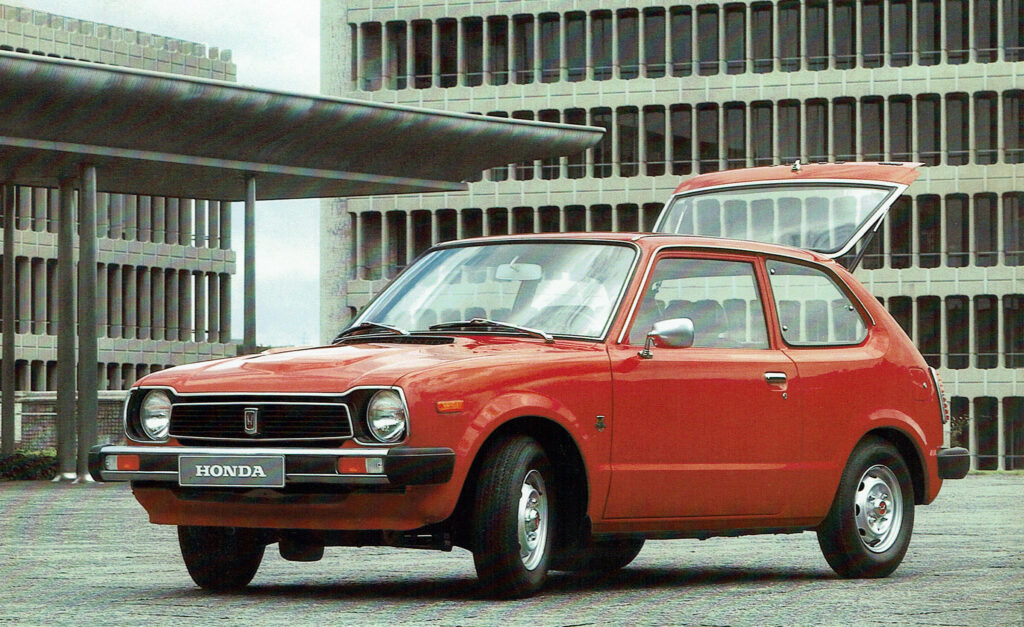
When the EB1 broke cover, most Japanese cars were conservative. The little Honda was a breath of fresh air, with its squat, trapezoidal style and small hatchback door; its transversely mounted overhead cam, cross-flow engine, and front wheel drive.
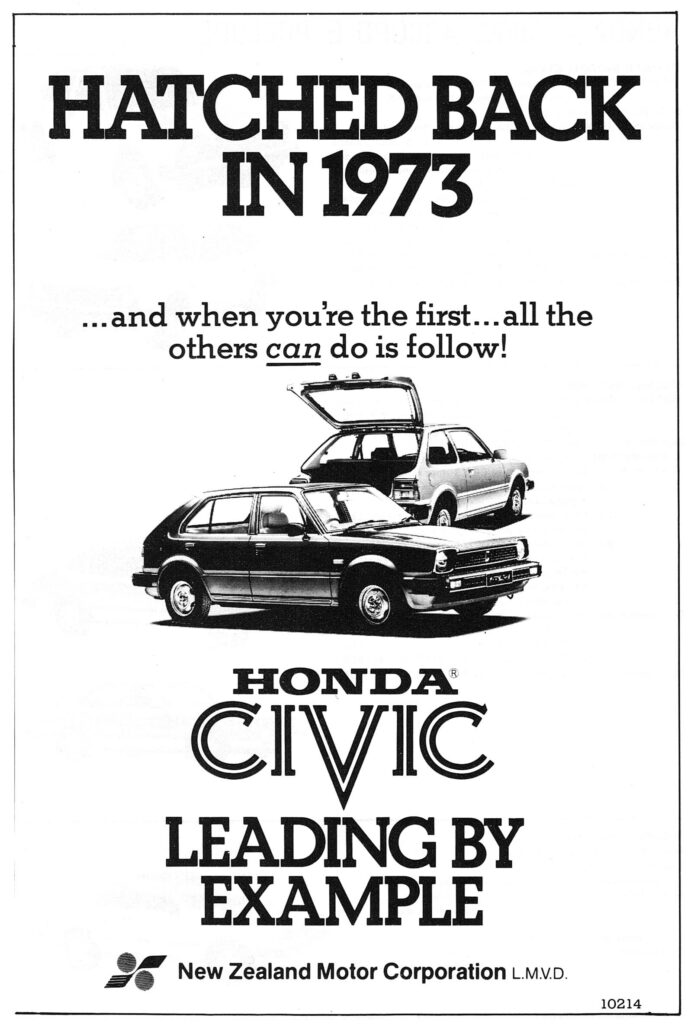
Rival brands were sceptical, or possibly jealous, of the hatchback concept. Nissan New Zealand even took a dig at the Civic by advertising the similarly sized but conventionally bodied Cherry as ‘no half-hatched idea’. The hatchback door on the early Civics opened above the number plate recess, which meant the sill was awkwardly high to load over, but it was still a significant advance for a small car.

FIRST HONDA CAR BUILT OVERSEAS
Significantly, the EB1 built in Petone in 1976 was the first Honda car to be assembled outside Japan, and the first locally assembled hatchback car in New Zealand. Just 28 years had passed since the founding of Honda Motor Company and 14 years since the first Honda car was made in Japan. For NZMC, the EB1 was a giant step away from a tradition of nearly three decades of assembling British motor vehicles.
When Motor Corp, as it was known, celebrated the first 10 years of Honda in New Zealand, gone from its locally assembled stable were Austins, Morrises, Leylands, and Triumphs. Land Rover was the only other brand assembled by the company. All the EB1s were assembled at Petone, which shut down in 1982, while the later second-generation Civics also came out of both Panmure and Nelson plants.
Small cars were not new to Honda; its early baby, two-cylinder, 354cc N360 sedan measured a mere 3025mm in length, fractionally less than a 1959 Austin Morris Mini. The front-drive N360 boasted good interior packaging and developed into the N600, with an all-alloy engine revving freely all the way to 10,000rpm redline. First imported in April 1969 in small numbers, the N360 cost $1608; in 1972, the N600 was $2180. A baby car before its time, the last N360, in 1973, was $2056, and the N600 was priced at $2571.
However, the larger, game-changing Civic was still small to European minds, with an overall length of 3405mm. Three decades later, an early BMW Mini R50 hatchback measured 3635mm and weighed almost twice as much as the Honda. Engineers sought an unladen weight target of just 600kg for the Civic, and, even though this proved impossible, the end result of 680kg was still remarkable. But if size matters, the 2200mm-wheelbase Civic would ultimately lose its way as a groundbreaking small car. Today, the model is in its 11th generation and is 4674mm long in sedan form and 4549mm as a hatchback.
Nevertheless, the historical aspect of the original EB1 is the timing of its launch; the Yom Kippur War was causing oil prices to rise sharply. A swing to fuel efficiency was a boon to small cars, which had hardly been doing well internationally. Rising inflation in the early ’70s played havoc with car prices. When the EB1 first arrived here, the built-up four-speed manual retailed for $2700 and the semi-automatic Hondamatic was $2890. Two years later, in 1975, the pricing was $3327 and $3483 respectively. The first New Zealand–made cars were $4789 and $4998. The last of the EB1s were assembled in March 1980, the manual priced at $7298 and the Hondamatic at $7583.
A WORLD-CLASS CAR
Two rival engineering companies within Honda were tasked with conceiving the first-generation Civic. One team was conservative and the other more innovative, yet both came up with a similar design. Honda wanted a world-class car that was light, quick, and compact. It had to be simple and unpretentious, offering maximum affordable practicality for buyers on a budget. There would be hatch and sedan configurations with the same two-box body design.
Instead of a cheaper beam design, the Civic was given an independent rear axle with coil springs front and rear. Initially, Mr Honda favoured a rigid axle because of simplicity and cost but the engineers preferred an independent design because of better interior space, stability, front/rear balance, and weight distribution. Four-wheel independent suspension was rare among front-drive models half a century ago, but would become mainstream among Honda’s compact and mid-size cars.
Although the rack and pinion steering was unassisted it was not heavy at parking speeds. Punted with enthusiasm, the steering tugs away in a classic front-drive manner, although both handling and roadholding are positive. The pedals are small and the footwell tight, but interior space is good considering the car’s external dimensions. Inside, there’s a preponderance of bare metal, including the door bottoms, which soon exhibit kick marks.
Rear seat legroom is limited once you have clambered past the static seat belts, which always seem to be in the way. Yet, headroom front and rear is good given the size of the car.
Unlike the Mini, the Honda’s clutch and gearbox ran in unit and in line with the crankshaft, using a separate oil supply. Slightly noisier than the manual, the Hondamatic proved highly popular among local buyers. This automatic has a simple helical gear train and a torque converter, the latter to drive the car in top gear alone. The planetary gear is eliminated, and there are two manually selected forward speeds for the compact transmission.
While the New Zealand industry average in the ’70s was 10 per cent automatic to 90 per cent manual transmission, the Civic achieved 40 per cent auto to 60 per cent manual and the model split in the Auckland region was a remarkable 50-50. There were never enough Civics to meet demand and, from 300 sales in 1973 and 900 sales the following year, new EB1 registrations romped to 3959 in 1976 with the arrival of local assembly. At times, the Civic was capturing 5 per cent of the local new car market and 12 per cent of the sub 1.3-litre class. In 1980, an almost fanatical following for the first-generation Civic meant some dealers reporting waiting lists of a year. That same year, the Civic was the sixth best-selling car in New Zealand, with sales of 4419 — up 42.7 per cent from the 3096 retailed in 1979. Civic sales increased by 50 per cent in 1981 to 6629, the fourth best-seller.
Geoff Wyn, group marketing manager for NZMC, said in April 1980: “Honda regards New Zealand as an important part of its overall marketing operation and as a weather vane for KD operations. Initially, Honda refused CKD because of concerns about quality problems. It said something for the ability of the engineering staff when the first locally assembled Civic was produced.”
Early EB1s had the 1159cc alloy engine developing a modest 37kW (50bhp) but this was upgraded in 1977 to the more acceptable 1238cc, 47kW (3bhp) flat torque power train. This long-stroke motor was an asset to low-speed flexibility that made the Civic easy to drive around town. While top speed rose marginally by 8kph to 138 kph, mid-range acceleration improved substantially with the larger engine, and performance further improved with the 1335cc motor.
MORE DERIVATIVES ADDED
A few minor facelifts were made, and the EB2 was born with an upmarket version, badged HL, and costing around $250 more. The HL had a cloth and vinyl interior, a trendy ’70s vinyl roof, and the 12-inch diameter black wheels were trimmed with chrome. Through 1978 and 1979, the Civics were known as EB3s and four derivatives were assembled. Some had their back seats replaced with wooden decks to be used as commercial vans.
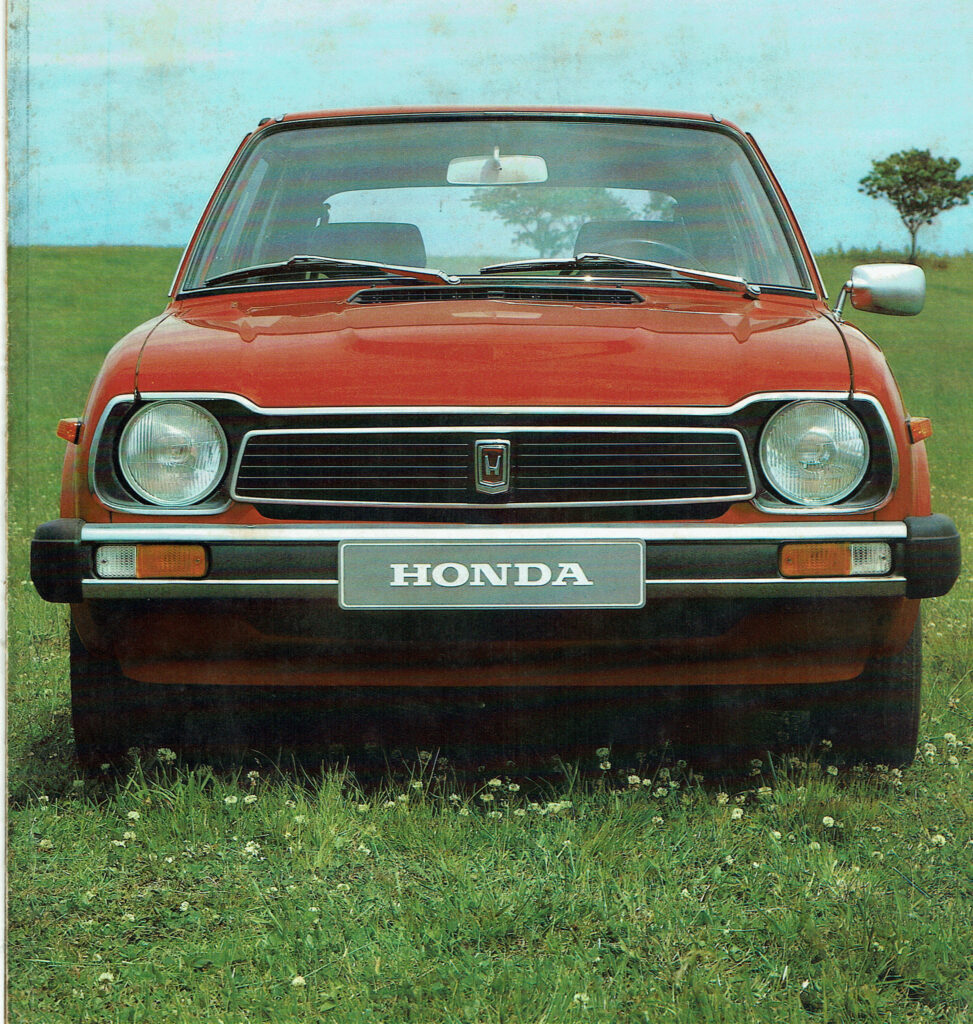
The 1979 facelift saw a plainer grille, with the indicator and parking lights now mounted within the bumpers rather than free-standing on top of the body protectors. Inside, there were only detail changes since the original layout and the clean dashboard design with simulated wood trim were too good to alter. Simplicity was the key, the speedo and second dial housing fuel and water temperature gauges separated by a strip of warning lights. Lift the front-hinged bonnet and the reasonably accessible mechanicals were packed into the engine bay.
In 1973, the first full year of production, a total of 80,000 EB1s were sold worldwide, and during the next few years, annual production was around 60,000. Civic’s New Zealand sales reached 50,000 by the time the model moved to the second-generation version — so where are they all today? A recent Trade Me search for 1973–1979 Civics revealed not a single car, and only five examples between 1979 and 1989. The majority, it seems, may have simply rusted away, yet apparently the second-generation model was even worse. Sadly, the EB1 was notoriously bad for rusting; the problem was so bad in North America that the National Highway Traffic Safety Administration issued a safety recall on the model. It cited corrosion on the lateral suspension arms, front crossbeam and strut coil spring lower support.
In April this year, at a Webb’s auction in Auckland, an immaculate, unrestored, four-owner Caroline Yellow EB1 with 77,000 recorded kilometres received a top offer of $16,675 — a good price, albeit less than the estimate of $25K–$30K. Honda New Zealand has purchased the first locally assembled EB1, which had done 61,000 kilometres, and this preserved example recently completed a tour of the country, celebrating the model’s half-century.
With the arrival of the second-generation car in 1980, the Civic became more practical, having a full rear opening hatch and larger dimensions, but it was the initial EB1 that was the first Japanese car set in the classic European small-car mould. The uncluttered, iconic shape of the 1972 Honda looks remarkably timeless, and the car’s complete specifications make the original Civic a memorable small car. It certainly deserves a hearty 50th birthday celebration.