
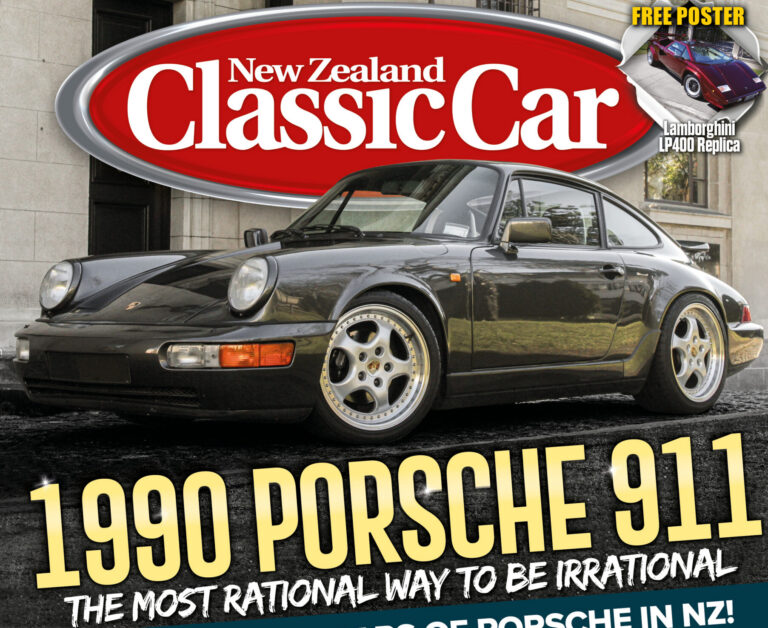
NZ Classic Car magazine, November/December 2026 issue 408, on sale now
Star status for classic Porsche
A long search ends: finding the right car
Unveiled at the Frankfurt Motor Show in 1963, the Porsche 911 heralded an iconic lineage of sports cars, known for their exceptional performance, remarkable racing reliability, and adaptability, second to none.
New Zealand Classic Car, in conjunction with Star Insure, recently conducted a photo competition to find 13 suitably impressive classics to grace the pages of the magazine’s 2027 calendar. A flood of entries showed that Kiwis recognise eye-catching designs and restorations. Many are handy with a camera, too, and have entered some outstanding results.
The choice was not straightforward, with multiple stunning entries, and Geoff Long’s immaculate 1990 Porsche 911 (964 Factory designation) took top honours. Fortunately, Geoff had Ethan Hanlon handy to take the accompanying photos while working in his office.
“I’ve got a young employee who is doing work experience in my office at the moment, and he’s a very avid photographer. So, I said, I’ll buy you breakfast and then why don’t we go and take some photos. He found the right spot, and he spent over an hour photographing.”
Originally sold new in Japan, hence the right-hand drive, the Porsche was resident there for four years before being exported to New Zealand, as Geoff recalls.
“I bought it two-and-a-half years ago, but I looked for it for over two years, because it’s just the colour scheme, interior and exterior I was after. The service file that came with it is extensive; I mean, it’s been beautifully looked after, which is what I wanted to continue, as it does get driven. It doesn’t sit in the garage.”
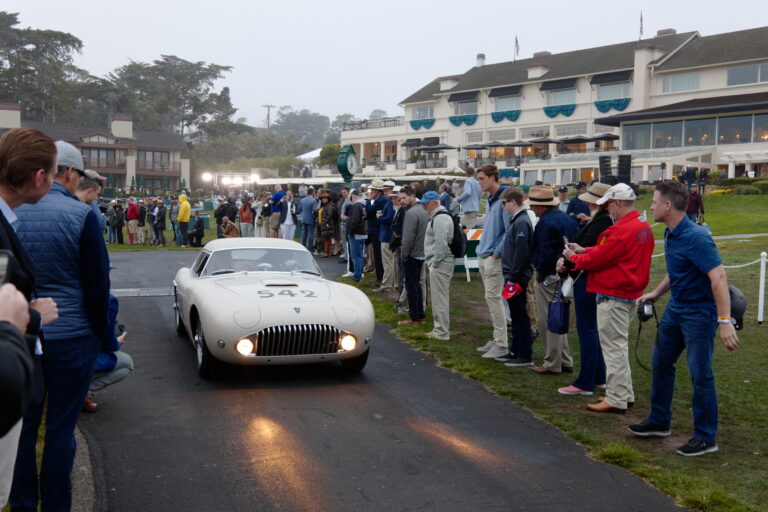
Classics on the green
Many pretenders vie for the title, but the Pebble Beach Concours d’Elegance gets my vote as the biggest thing since sliced bread.
The 71st edition of the world’s pre-eminent and best-known concours event featured 28 classes, judged by a 180-strong jury, which also chose the recipients of 26 special awards.
The size of the event, the number of visitors, and, most mind-numbingly, the sheer number of amazing cars, is almost overwhelming. There are so many quality cars to gaze upon, and so many people gazing at those cars, that it is almost impossible to cover everything.
Notable among the many attractions were the centenary celebrations of the 24 Hours of Le Mans, an elegant Talbot-Lago Grand Sport, Hermann Graber’s Swiss-bodied cabriolets and coupés, the jewels of Otto Vu Italian V8s, early Alfa Romeos, Lincoln and its centenary, and cars with unorthodox propulsion systems.
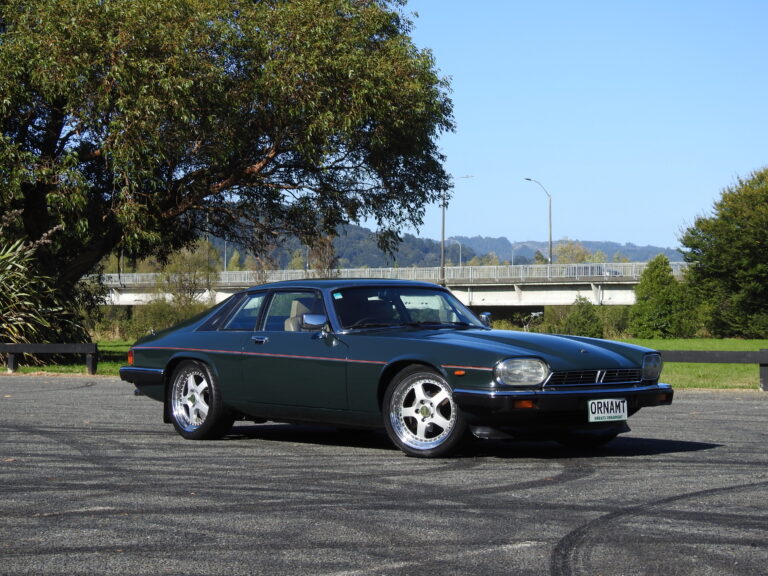
Janspeed recreates the Jaguar sports car
Thankfully, a few of these cars made it to New Zealand, the odd one being imported from the UK over the years. However, the 1988 British Racing Green example owned by Bill Slater in Upper Hutt was originally sold as a standard car but converted using the full Janspeed kit by the first owner within a couple of years of buying it.
Bill has owned a few other Jaguars. In fact, after he sold his Jaguar XJ12 in 2018, he found himself pining for another and, when the XJ-S came up for sale, he could not resist it. Having just sold the V12, he was not expecting much from the six-cylinder car other than more reliability and it being cheaper to keep on the road. Naturally, he had heard of the influence Janspeed had on the marque, but it was not until he took the car for a test drive that he became aware of just how superior it was to the car he had just sold. The price of a second-hand Janspeed XJ-S and that of a standard 3.6 XJ-S is quite comparable, making the Janspeed version an incredible bargain, even more so in comparison with other performance classic cars — or even modern cars, for that matter — which cost far more bucks for the bang.
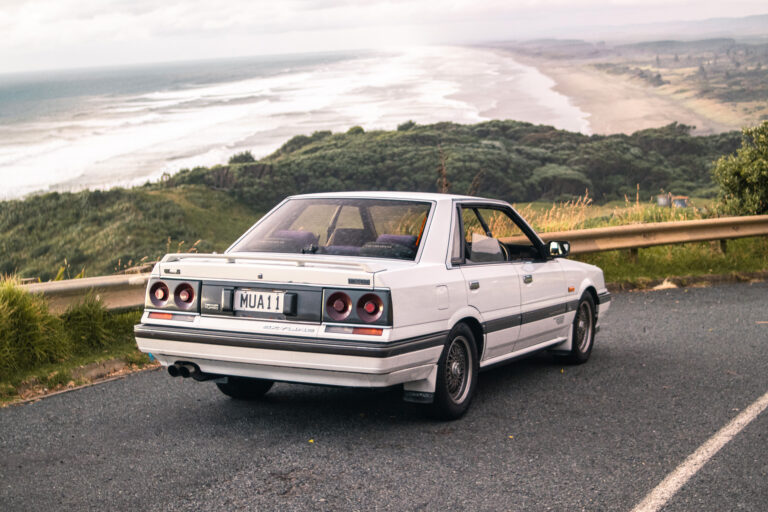
The writing on the wall
Deven, a digital content producer in his 20s, says it was the rear-drive Nissan and Toyota drift cars that fired his imagination in his not-so-distant youth and soon had him wanting one of his own. However, like most of us, he had to start in something less glamorous – in his case, a 1997 Mitsubishi Galant. After that, he bought a four-litre V8 1991 Toyota Soarer, a big change from the Mitsubishi.
“It was my daily driver, and it wasn’t that bad to run back when petrol was affordable,” he says.
When he got fed up with filling it up, Deven bought a 1989 Ford Laser sedan, a 1.3-litre five-speed manual, to be his daily driver. It’s in very good condition, bought from a careful older driver, and he still runs it – although he will occasionally also drive the latest in a series of Nissan Laurel sedans. His current one, from 1993, has done the lowest number of kilometres yet, at 183,000. It has the single-cam version of the engine in his Skyline.
“I’ve had four different versions of that car. It was just a car I always liked. It’s really comfortable, quite luxurious. I bought it from a 90-year-old in Hamilton. It’s in mint condition, and everything is standard.”
The actual Formula One
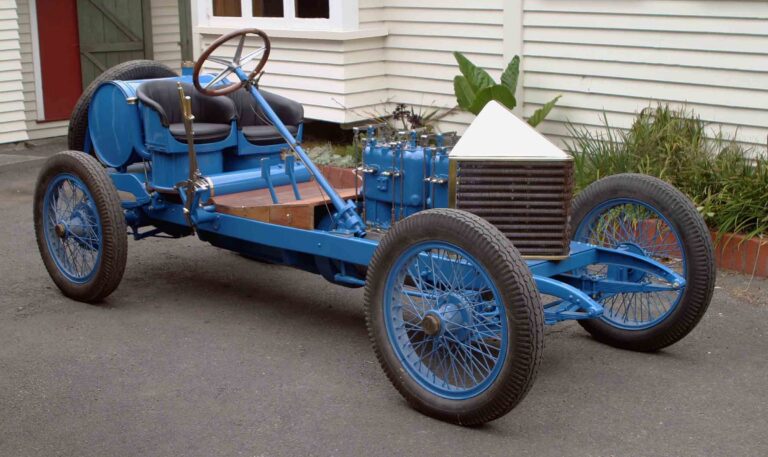
Seeing, in a shed in Hamilton, New Zealand, the Darracq 120 racer that Louis Wagner, also a pioneer aviator, drove to victory in the 1906 Vanderbilt Cup race felt a little like finding a Rembrandt at a garage sale.
For historical significance, I’d say this car ranks with Ray Harroun’s Marmon Wasp, the first Indianapolis 500 winner. Unlike Harroun’s Wasp, which has been lovingly cared for at the Indianapolis Motor Speedway Hall of Fame Museum over the years, this historically pivotal machine wound up half a world away from its home in France and, to most of the motoring world, largely forgotten. Sadly, so is the story of how the car got to Aotearoa in the first place.
More often than not, a racing car that is a few years old is regarded as obsolete and relegated to a shed somewhere. As far as racing drivers and team owners at the cutting edge of the sport are concerned, the cars are virtually worthless at that point. They can’t be driven on the street; at best they can be reconfigured for lower levels of the sport, so few people care about them until their historical significance becomes more apparent.
Dad will love this!
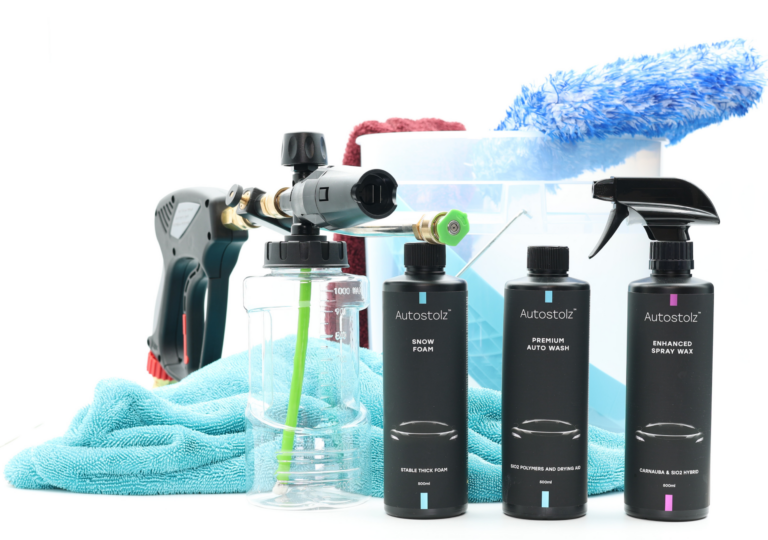
Subscribe or gift a subscription to NZ Classic Car magazine for one year this Father’s Day, and go into the draw to win one of two luxury car care packages worth $570 from Lovecars.
The prize: Adam’s Foam Cannon Kit includes a complete pressure-washer foam cannon setup; Michelle’s Car Wash Kit takes care of everything after the foam. It includes Autostolz Premium Auto Wash, Enhanced Ceramic Spray Wax, and loads more.
Together, you’ve got the setup to foam, wash, protect and dry your car properly – using some of NZ’s top-selling car detailing products.
A seriously good prize for anyone who loves keeping their car looking its best.
Motorsport Flashback: The Temple of Speed
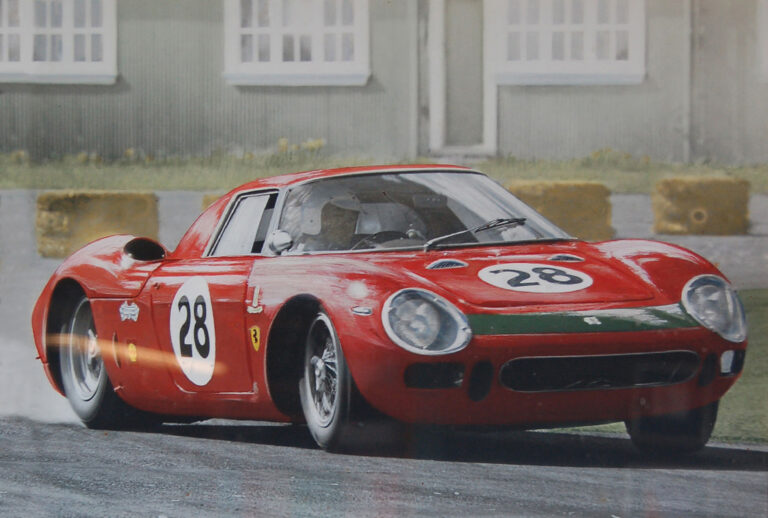
On the banks of the Lambro River is Europe’s largest enclosed park, all 688 hectares of it. Parco di Monza was commissioned by the son of an Austrian empress as a summer retreat in the late 1700s, but it would be for another century and a half before ground was broken on what would become Italy’s famous theatre of speed at the park’s northern end. One hundred years ago on 3 September, less than four months after work started, Autodromo Nazionale di Monza was officially opened and the first race – appropriately, the Italian Grand Prix – was run a week later. Monza was the world’s third purpose-built circuit, after Brooklands and Indianapolis, and was the result of the Milan Automobile Club financing the 3500 workers who created the super-quick, and consequently dangerous, track that made the word ‘Monza’ synonymous for speed.
Bronze treasure unearthed
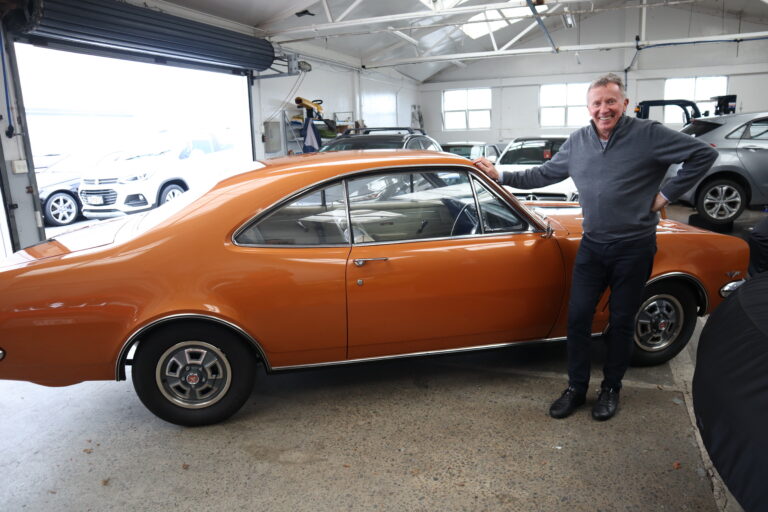
The car was put away in favour of something more practical, and when his father was unable to drive any more, Matt’s friend asked him to come and take a look at his dad’s old Holden. It turned out this was one of those phone calls that leads to that feeling of pure joy in the classic car world — the ‘barn find’ that turns out to be even better than expected. The HT Monaro had been put to bed some years before and had not seen the light of day since. Layers of dust and boxes of junk littered her undercarriage and bodywork and access points all around.
NZ Classic Car magazine, September/October 2026 issue 407, on sale now
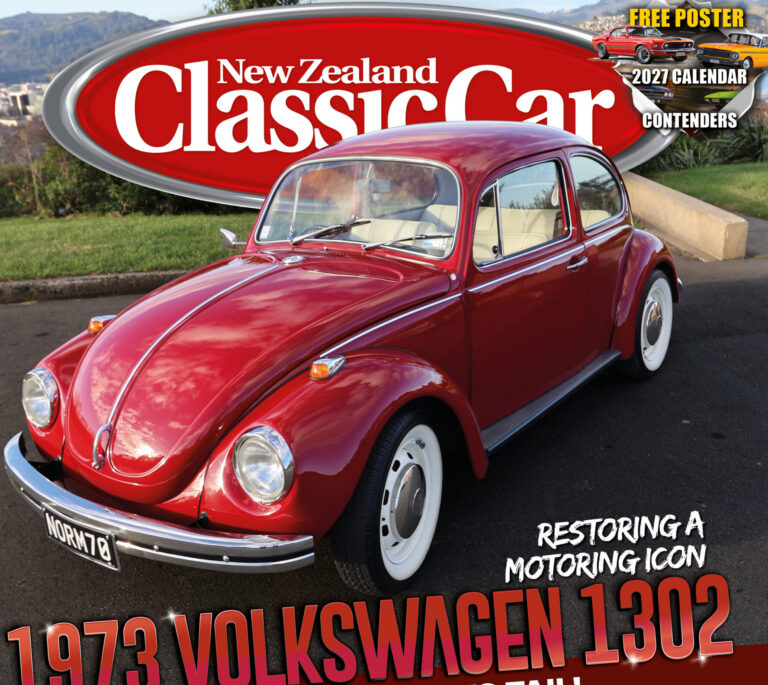
We love bugs!
A bit of TLC that became a major restoration
The 1302S, or ‘Super Beetle’ as it became known, was built for two years before it, too, was replaced by a further-enhanced Beetle, the 1303, continuing an amazing 65-year lineage for one of the World’s best-known shapes.
The world’s best-selling single-model vehicle, the VW Beetle, possibly established another record for the amount of controversy it has created since the inception of the Type 1.
In a meeting with Hitler in June 1934, Ferdinand Porsche was contracted to build a ‘People’s Car’ that could accommodate two adults and three children, was air-cooled and simple to maintain, and could cruise economically at moderate speed along Germany’s proposed new Autobahns.
Our feature car, a 1972 1302S ‘Super Beetle’, was found by Dave and Michelle Dickie in Mosgiel a few years back. It was a runner, but like most VWs of this age, it needed a little TLC. They were looking for a daily driver for Michelle when they first came upon the VW being sold locally on behalf of its owner.
“The owner offered it to his grandchildren, and they didn’t want it, so he got the guy out at Mosgiel in the Mobil petrol station to sell it for him, and he put it on Trade Me for them. We never met the owner, and we were always dealing with the guy at the petrol station. We put a bid on it, and we were the only people that bid on it.”
Their bid was eventually successful, eight years ago. Not knowing much of the history, in situations like that, it’s always a risk buying a car, but they were in for a bit of a surprise.
The other Q car
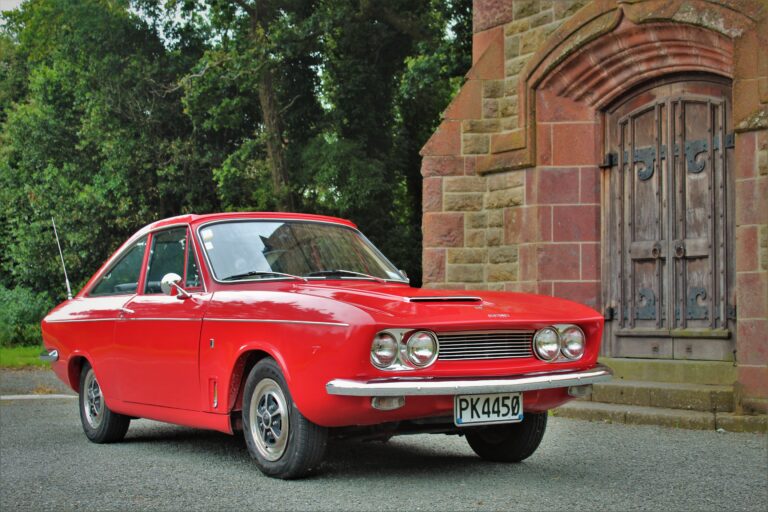
Say the word ‘bond’ to anyone in the street and around 80 per cent straight away think of pop culture’s least-secret secret agent. The other 20 per cent may think of the wad of cash required to secure a flat or hire equipment that one gets back providing the fixtures and fittings stay much as they were.
However, mention ‘bond’ in specialist classic car circles and people will spin a very different yarn. If you dig deep enough, you will find an eccentric British carmaker that, throughout its 23 years in business, spawned some quirky and charming little cars.
The company was founded by Paul Sharp in 1922 under the name of Sharp’s Commercials Limited. However, the company did not start producing cars until 1948. The first car to carry the Bond name was the Bond Minicar. A three-wheeled, soft-top, two-cylinder eco car, the Minicar was a big hit at the time as the desire for an economical urban runabout that didn’t attract four-wheel car tax was strong in post-war Britain. All in all, 34,285 Minicars were produced over 26 years in a variety of variants.
Lunch with Bill Leckie: An Imp’s tale
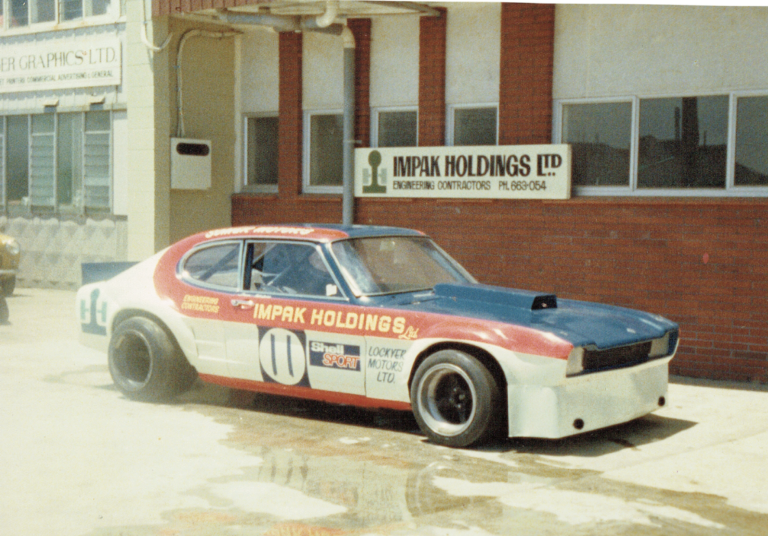
Seeking limelight is part of Bill Leckie’s DNA, but when I asked him if anyone had written about his career and the cars he created, he didn’t think so. Even so, I was delighted when he agreed to sit down with me over a pie and coffee to reminisce. I started by asking how it is that someone who is so fanatical about F1 only ever raced saloon cars? Well, we’ll get to that, but where did things start? “I went to Cornwall Park Primary School and then to Remuera Intermediate where I became good mates with Geoff Perry, son of the legendary motorcycle racing legend Len.” Geoff Perry was 23 and on the edge of stardom when he was killed in a mystery air disaster over the Pacific in 1973. “We used to race around his backyard on a cutdown motorbike. It was friendly competition that I suppose helped hone our racing instincts. There was never much between us and so, by 11 or 12, I had a definite leaning towards speed.”
Mitsubishi’s secret weapon
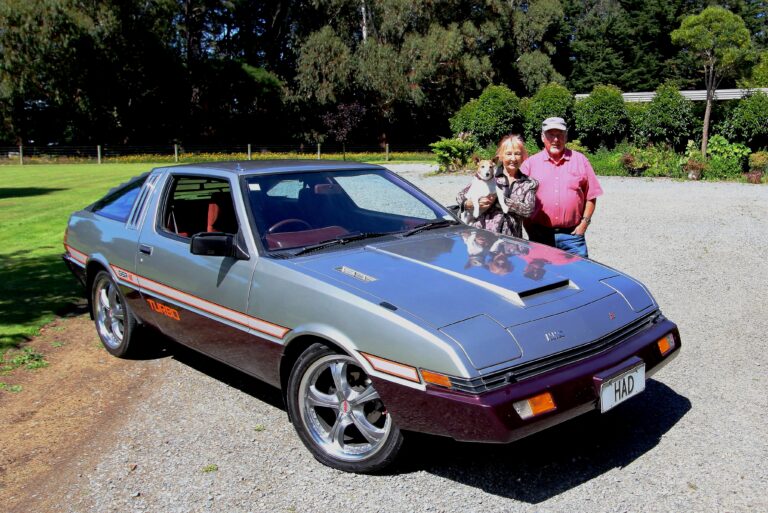
Ewen’s Starion is a little different and special. He saved this one – literally ‘found in a paddock’ — just in time, as he relates.
“Mine is a 1983 Starion. I’ve had it about five years. I first saw it in a paddock at Ryal Bush [north of Invercargill], and I went past it three times. The third time I went back and knocked at the door, but the owner didn’t want to sell. He rang up a year later, and put a price on it, which we accepted. Only thing wrong was the motor was totally dismantled.”
Ewen then set about getting the car back to its current state.
“It took me six months to find somebody suitable to refurbish it back then. Simon Bradley at Midas in Invercargill offered to do it and he did a great job on it. The head was badly damaged around the valves, and Simon said you could get generic cylinder heads now, so he installed one, and it cost $800. It’s made such a difference to the car. Mine is an intercooled, fuel-injected turbo model, fitted with a five-speed manual gearbox. It’s a great car to drive too.”
Except for a small patch of surface rust, Ewen’s car was in surprisingly good condition despite its paddock life.
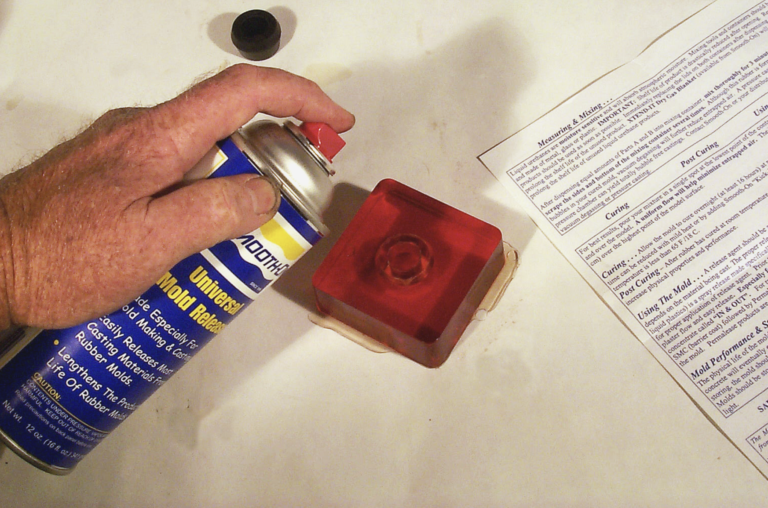
Coaching from the bench: Casting plastic knobs and rubber parts
Casting rubber items is simple if you have a good original to work with. The item doesn’t have to be perfect. You can use plasticine to smooth out cracks, and you can even make whole prototypes out of low-fire modelling clay available from craft stores if you need to. Prototypes can also be made of wood or metal.
You will need mould dams to contain the liquid urethane moulding solution until it cures. You can build boxes out of strips of wood, but I have found that small plastic boxes and bowls such as those you would use for leftovers in your fridge work well if you spray them with a mould release agent.
Temperature is important to the chemical processes involved, so work in an area that can be maintained at around 20 degrees. You will also need adequate ventilation because the fumes can be dangerous to breathe. And you will want to wear latex gloves to protect your hands.
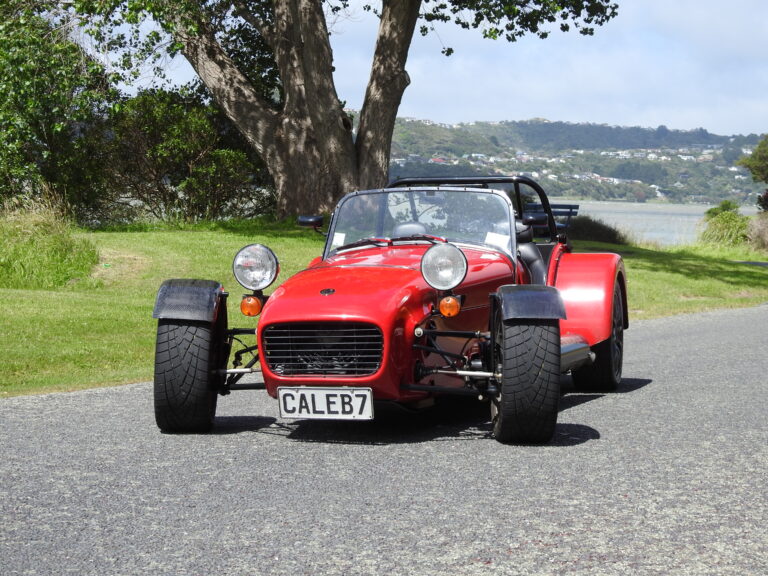
Fraser Cars – low flying into the fourth decade
With almost three and a half decades under its belt, Fraser Cars is one of New Zealand’s longest-surviving car manufacturers. The company first opened its doors for business in 1988, during the boom time for kit manufacturers. During the ’80s, around 40 different companies were building kits and turnkey cars for this niche market. Of those, only Fraser and Almac Cars (established 1981) are still in business today.
Most of the new kit car companies were killed off in the cradle by the threat of new legislation that never eventuated and definitively by the sudden availability of high-performance Japanese cars when the floodgates to second-hand imports were opened. The now long-retired founder of the company, Neil Fraser, first came across Lotus Seven replicas while racing Lotus Cortinas in the early ’80s. He regularly found himself racing against a little Caterham, a Lotus Seven–styled car built in England. He was very impressed by its simplicity and handling. In 1986 Fraser built his own Lotus Seven–type car, using the knowledge he had gained from several close looks at the Caterham.

2027 Star Insure Calendar Competition Terms and Conditions
2027 Star Insure Calendar Competition
We’ve partnered up with Star Insure in search for 13 outstanding classic cars to feature across the 2027 Star Insure Calendar and the December issue of NZ Classic Car Magazine. One standout entry wins the ultimate honour: cover placement on both the calendar and the magazine, with the remaining 12 featured across the monthly pages.
Email your photo to [email protected] and include your full name, postal address, phone number and vehicle details (year, make and model). Entries close Friday, 31 July 2026. *T’s & C’s apply.
Read more to find out the full details >>
NZ Classic Car magazine, July/August 2026 issue 406, on sale now
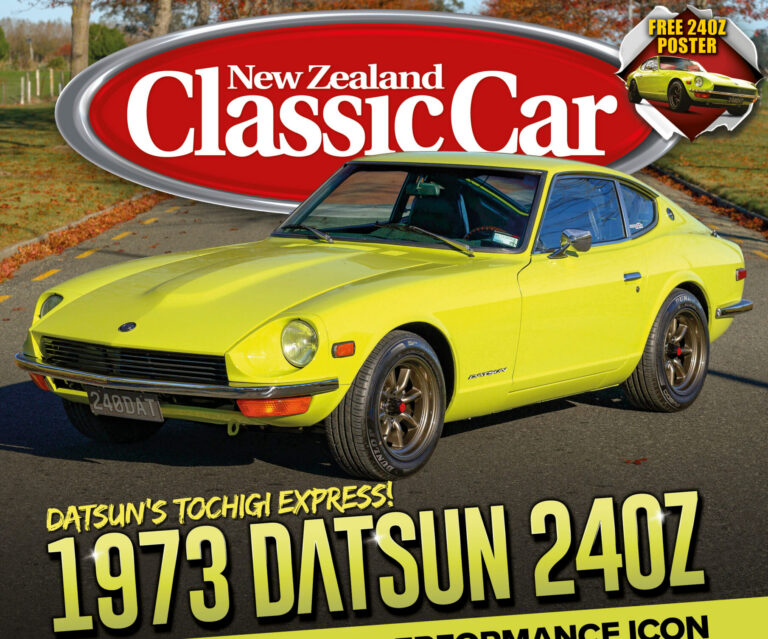
Rebirth of a brilliant Grand Tourer –1973 Datsun 240Z
How often do we long for that ultimate dream sports car, and that dream comes true? This is about one of the most influential Japanese cars of all time, a car that changed the sports car market.
This is about much more than the restoration of an iconic classic sports car, the 240Z. It’s about the culmination of a dream over many years and the friendships made. It’s about the people who helped and the professionals whose approach ensured that the dream became a reality, an attitude typical of the industry we call ‘classic restoration experts’.
It is no surprise that the outcome after a lengthy search by Conrad Van der Geest for the right Datsun 240Z culminated in a trophy for the best Japanese car at this year’s Caroline Bay Beach, Rock N’ Hop at Timaru.
Originally a roadworthy car in running order, it was left-hand-drive and had been driven for several years by its Timaru owner, as Conrad explains.
“A neighbour, Dave Barron, knew I was looking for one and introduced me to the owner. I had seen the car being driven around Timaru. It was unusual for one of these coming originally from California, so it was a really clean car instead of rusty, as they are prone to rust. The story goes that the grandfather passed it onto his grandson, who decided to sell it, and that’s when it came over here.”
Every issue comes with our FREE huge wall poster; this issue, it’s our cover car for this edition, a 1973 Datsun 240Z
The butterfly effect
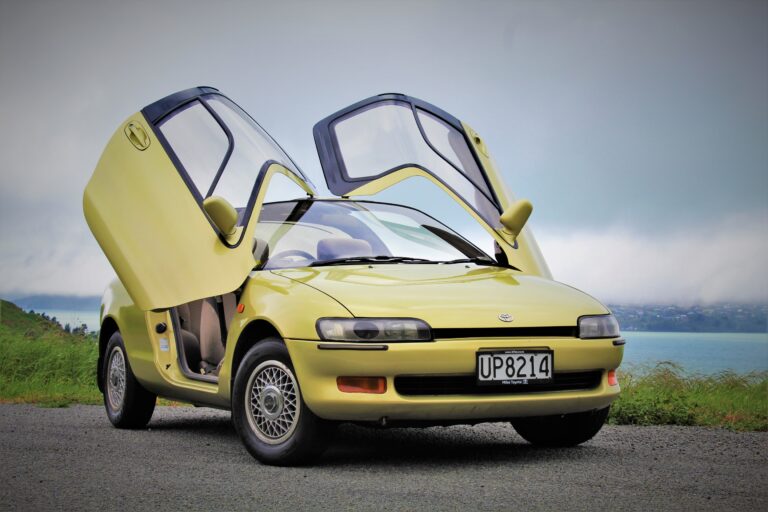
The man on the mountain bike pedalled over, taking it all in. Gazing in wonderment at this small Japanese coupe with butterfly doors, he said, “Wow, I have never seen one of these before. What is it?” When I told him it was a Toyota, he nearly fell off his bike.
The Toyota Sera is unique amongst ’90s Japanese coupes. The Sera, which is Italian for ‘evening’, can trace its roots back to Toyota’s AXV-II concept car. Launched as part of a trio of Toyota concept cars at the 1987 Tokyo Motor Show, it shared its underpinnings with the P70 Toyota Starlet. The similarities ended there, thanks to the AXV-II’s low-slung and rounded coupe styling with butterfly doors. These doors were held upright by gas struts when fully open. Glass covered the upper section of the doors and the rear hatchback.
These features, much to everyone’s surprise, were carried over to the production Sera in 1990. Toyota marketed the Sera, which means ‘will be’ in Spanish and ‘princess’ in Hebrew, as a funky alternative to the much-loved MR2.
Racing Mazdas
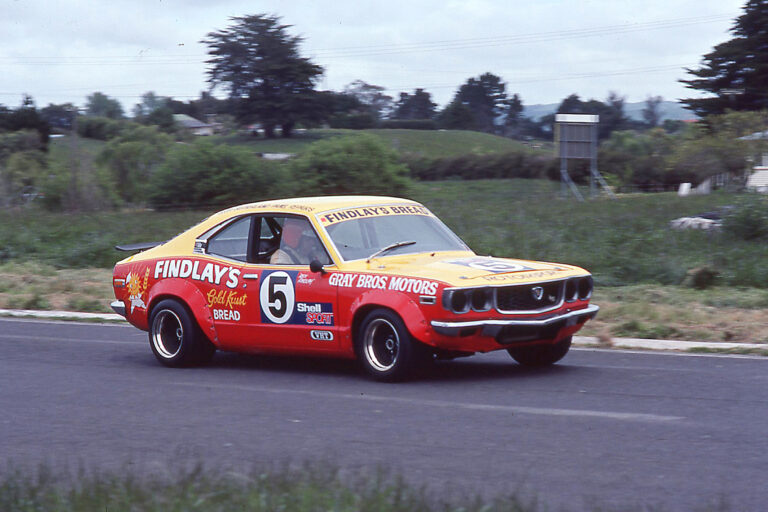
Both Rod Millen and Ron Kendall were rotary racing kings, emanating from the North Shore of Auckland, where I grew up. And the ultimate rotary techno guru was Bill Shiells, who developed the engine into a rocket ship while working out of Gulf Mazda in Takapuna from 1969, and later in his own business, Rotorsport. He began to extract some phenomenal horsepower from the enigmatic rotary engine. Bill was one of the first to race the Mazda RX-2 Coupe in 1971 and achieved immediate success, causing others to sit up and take notice, particularly the North Shore’s racing elite. They included Robbie Francevic, Rod Millen, Ron Kendall, John Woolf, John Le Feuvre, and Rex Findlay.
Range Rover CSK — the original SUV
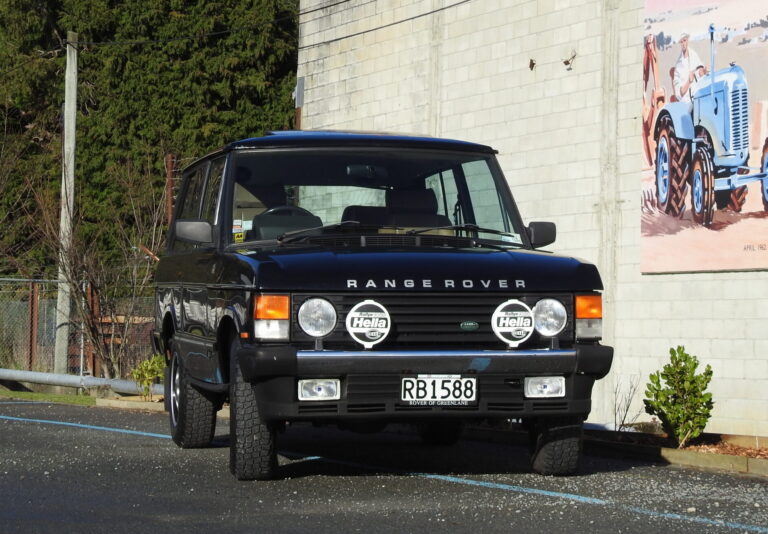
The Range Rover, thanks to Charles Spencer King, went into production in 1970 boasting an iconic shape that would last until 1996. The vehicle that would create the SUV moniker came about because Rover decided it was time to add a bigger four-wheel-drive vehicle, one with a 100-inch wheelbase, to the model range. Land Rover made a 109-inch wheelbase model but the standard vehicle had a 88-inch wheelbase.
The new model would be more suitable for road use than the existing Land Rover, which was considered to be predominantly for rural use. To make sure it could cope on any road it came standard with the Rover 3.5-litre V8 engine. The body design was originally sketched by King and went into production with only a few minor touch-ups by the Rover styling team.
According to King, “The idea was to combine the comfort and on-road ability of a Rover saloon with the off-road ability of a Land Rover. Nobody was doing it.”
Ford’s Mustang – the endlessly hip American dream machine
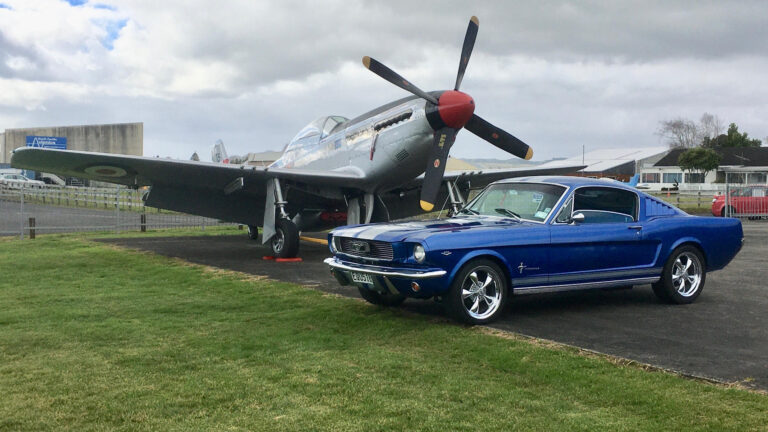
Fifty or so years ago, the only place in New Zealand to see a Ford Mustang was on the racetrack. In a local market severely constrained by a lack of new motor vehicles, the new North American Ford was a dreamy icon boosted by considerable motorsport success.
Import licences for cars were limited, and if Kiwis travelled abroad, the amount of currency they could take with them was restricted. What’s more, those funds could not be used to buy a car for importation back home. Yet it was OK to spend the money on heavy drinking at a London pub, Gucci shoes, sable fur coats, and excessive stays at the Hôtel Martinez at Cannes in France.
However, any rare Mustang that landed on our shores would not be destined to pose around Auckland’s then trendy Queen Street on a Friday night but would more likely be found in the care of well-known racing drivers on the starting grid at local motor racing tracks.
Chrysler’s classy cruiser
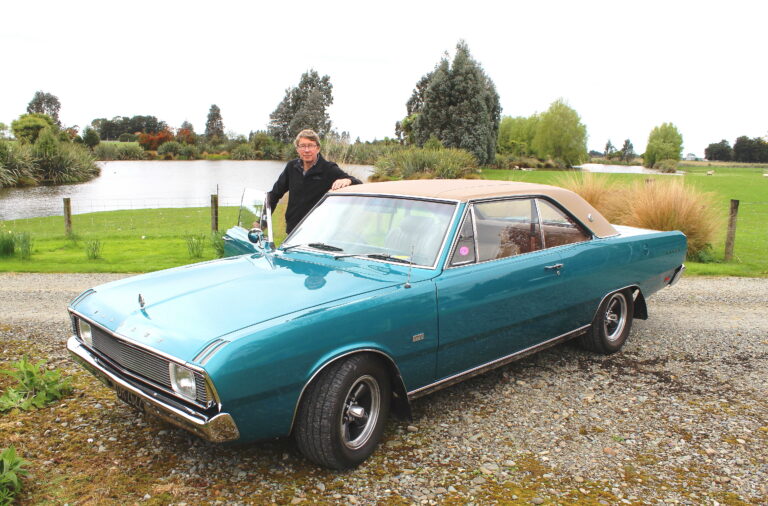
I first saw our feature car, a 1970 V8-powered Regal 770 hardtop, towing a trailer carrying the tidy Ford Anglia classic racing saloon in Broadspeed racing colours that has featured in these pages. The coupe is comparatively rare here, which means anyone contemplating purchasing one of these big two-doors is sure to see prices continue to climb. The latter Charger has claimed much of the Aussie Chrysler limelight, but the simpler and classier lines of this car, which appeared dated soon after its introduction, now have a more timeless appeal.
Former owner, Balclutha motor engineer, Mike Verdoner, remembers the car well. He believes it came from Dunedin originally.
“I’m not sure about the car’s history, but I bought it off its owner at Kaitangata. Unusually, it was advertised in the local newspaper, the Clutha Leader, which was a surprise as these usually go for a lot more money on the internet. I had it for quite a few years. It needed a little bit of work to tidy it up, so I had to decide whether to spend the money on it to do it up, which could have been twenty grand. Its value at the time was not like it is now, so I sold it to Ewan. It’s probably now worth three or four times what I sold it for.”
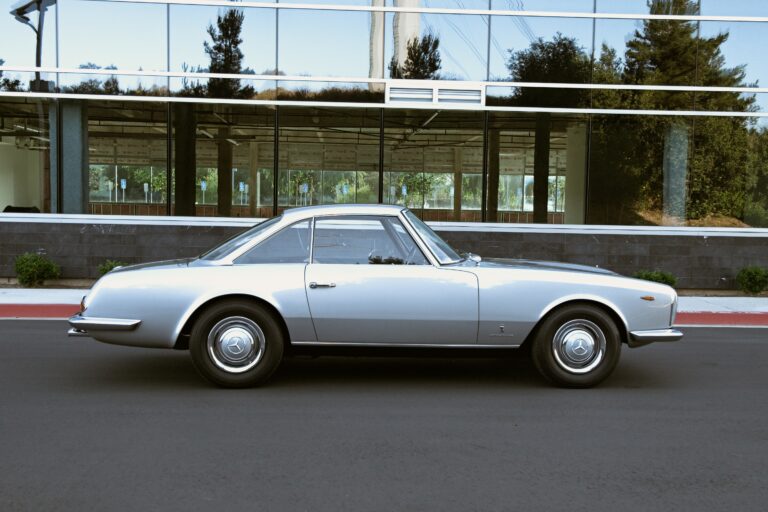
The Pininfarina 230 SL
It’s October 1964, and imagine you’re an automotive journalist covering that year’s Paris Auto Show (Mondial de l’Automobile). As you approach the Pininfarina booth, you come across a car that looks a bit like the Mercedes-Benz 230 SL introduced the previous year at the Geneva Auto Show, a car then arriving at Mercedes-Benz dealerships around the world.
But looking closely, its styling and proportions seem to be a bit different. And it has a fixed roof, unlike the Pagoda-style greenhouse of the removable hardtop seen on the production 230 SL. While today, the styling of the W113, under the supervision of Head of Styling Friedrich Geiger, with lead designers Paul Bracq and Bela Barenyi, is considered a mid-century modern masterpiece, acceptance in-period was not universal. Some critics called out the concave design of its removable roof, which ultimately gave the car its “Pagoda” nickname.
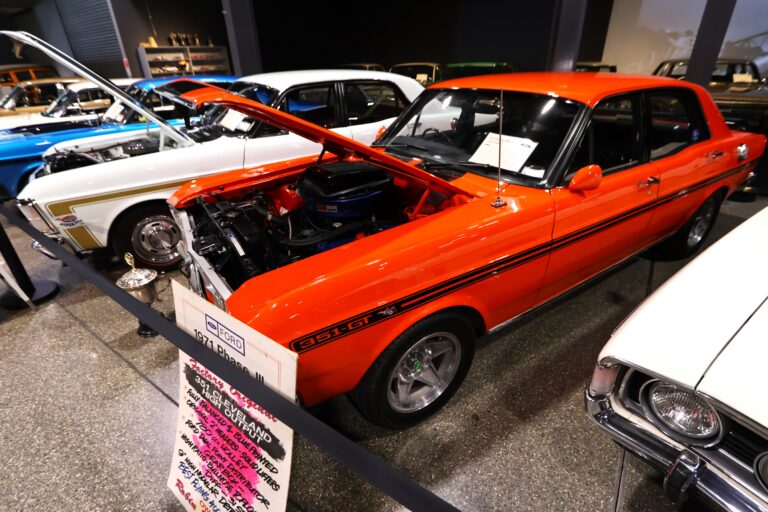
Ford Falcon display: Bill Richardson Transport World
Ford Falcon enthusiasts from around Southland have made their pride and joy, Australian Ford Falcons, available for the extensive display now on at Bill Richardson Transport World in Invercargill.
Avid local Ford Falcon GT collectors, Roger and Diane Whyte have made a number of their cars available for display, while a
real rarity is Robin MacDonald’s factory original 1971 Ford Falcon Phase II GTHO.
From the very first to the very last Ford Falcon, this is a great opportunity to view these Australian icons under one roof.
The exhibition is on until early June. Don’t miss it!
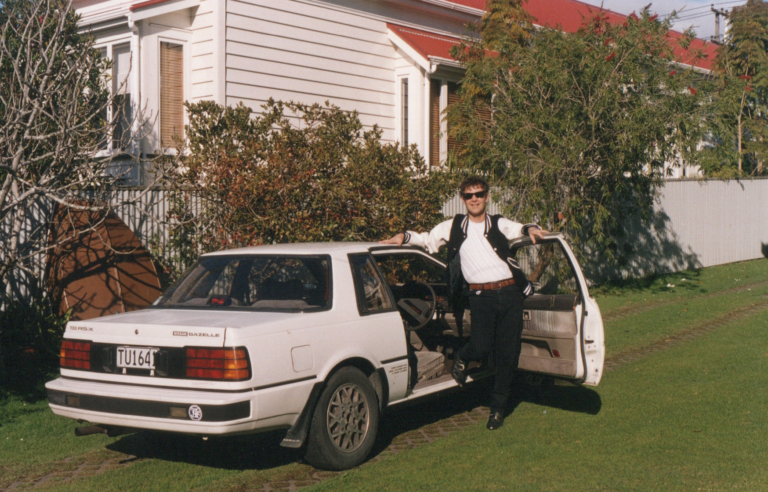
“Gotcha!’’ The continuing tale of a Nissan/Datsun tragic – part two
In 1996, I was on a mission to buy a suitable pavement scorcher and visited the now-defunct Manukau City Car Fair. Unbelievably, among the sea of four-door utilitarian Japanese compacts was the absolute jewel in the crown, my automobile wet dream — a 1985 two-door R30 RS Nissan Skyline FJ20 Turbo five-speed manual in nice condition. The owner wanted $10,000 — a great deal.
But what did I do? I bailed out, paralysed by indecision. The money would have been a stretch, but it was the worst automotive choice I ever made. Instead, I went for a rusty Toyota Sprinter 8 Valve Twin Cam Coupé, which was pretty terminal from the get-go. I know. We’ve all done it, but there was really no excuse for passing up the Skyline, and I was haunted by that for years.
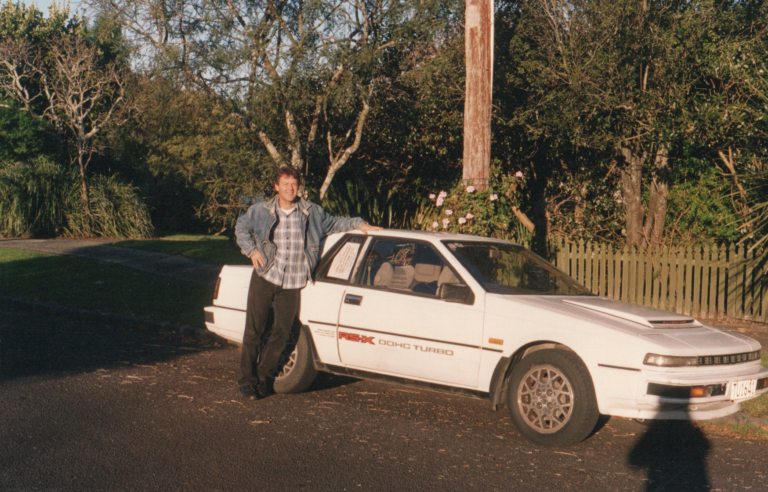
Last Tango in the Fast Lane
In the mid ’80s, I locked into a serious Nissan/Datsun performance obsession. It could have kicked off with my ’82 Datsun Sunny, though this would have been a bit of a stretch of the imagination, given its normally aspirated 1.2-litre motor — not the sort of thing to unleash radical road warrior dreams. But it did plant a seed, and it was a sweet little machine and surprisingly quick, in contrast to all the diabolical English offerings I had endured.
I was living in South Auckland at the time and was an unrepentant petrolhead. Motor racing was my drug of choice, and I followed the scene slavishly. Saloon car racing, with the arrival of the international Group A formula, was having a serious renaissance here and in Australia and Europe. There was suddenly an exotic air in local racing that had been absent for 15 years.
I was transfixed by this new frontier of motor racing that had hit our tracks in 1985–87 and the new array of machinery on display. In 1986, the Nissan Skyline RS DR30 made a blinding impression on me. The Australian Fred Gibson-run, Peter Jackson-sponsored team of George Fury and Glenn Seton were the fastest crew of the 1986 Australian Touring Car Championship. But Kiwi legend Robbie Francevic snuck through to win the Aussie Championship in his Volvo 240T after a strong start and consistent finishes.
NZ Classic Car magazine, May/June 2026 issue 405, on sale now
Reincarnation of the snake
We are captivated by a top-quality sports car
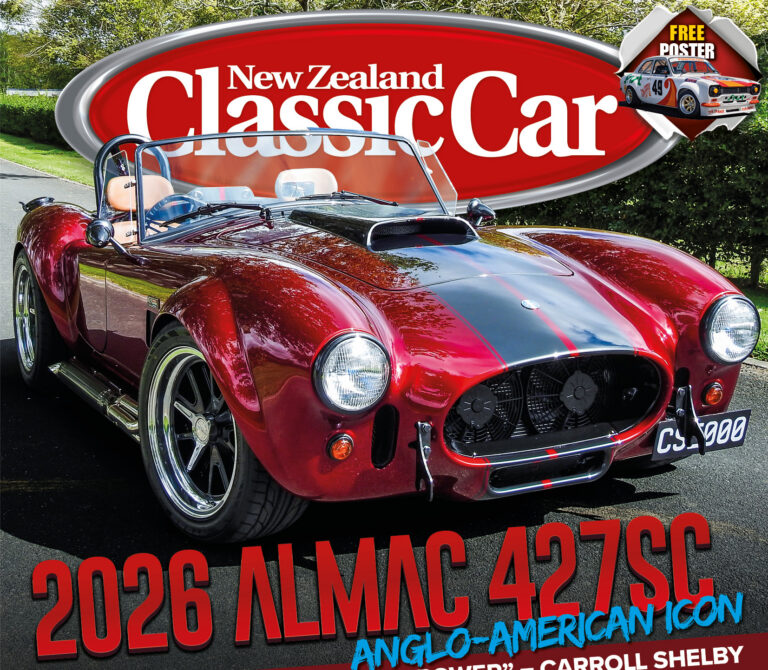
The Shelby NZ build team at Matamata Panelworks has endured a long and challenging journey, culminating with the highly anticipated public unveiling of the 427SC and firing up of its sonorous V8 at the 2026 Ayrburn Classic Festival of Motoring in Queenstown on February 20. This is a New Zealand-built car with loads of character and potential.
The car is now back in Matamata, and I finally have an opportunity to get up close and personal with it. But before then, the question that must be asked is, “Why would ya?”
The first answer is easy, as mentioned in the last issue of New Zealand Classic Car (#404). It was a great way to use up all the surplus Mustang parts acquired while converting brand-new Mustangs into Shelbys. The unused new Mustang parts would be great in any kit car, but the 427SC in front of me cannot be classified as one.
This is not a kit car. The reality is that it is a high-quality, factory-made production car.
Possibly the second answer is because the CEO of Matamata Panelworks, Malcolm Sankey, wanted to build a replica of the car that is a distant relation to the Shelby Mustangs scattered around his showroom floor, a car created long before the first Mustang was even thought of, and the brainchild of Carroll Shelby back in the early ‘60s.
A tradesman’s estate — the Cortina GT Estate
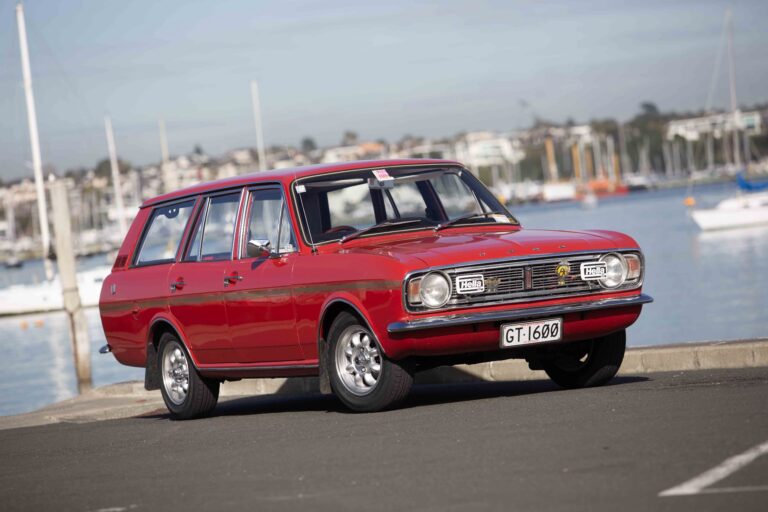
The owner of our featured car, Rod Peat, used to rally a Cortina GT back when the words ‘rally’ and ‘trial’ were interchangeable. In times after that he could also be seen beside Mal Clark in various Targa NZ rallies, getting the famous Rover V8 or Lotus Cortina in spirited fashion around and over the various special stages that make up those events. After children, houses, and career, Rod decided it was time to own a GT again.
A search on the various systems available turned up a car Rod and probably most of us didn’t even know existed: a genuine Ford factory Cortina Estate GT.
For the love of cars
Passion, Pride & Joy:
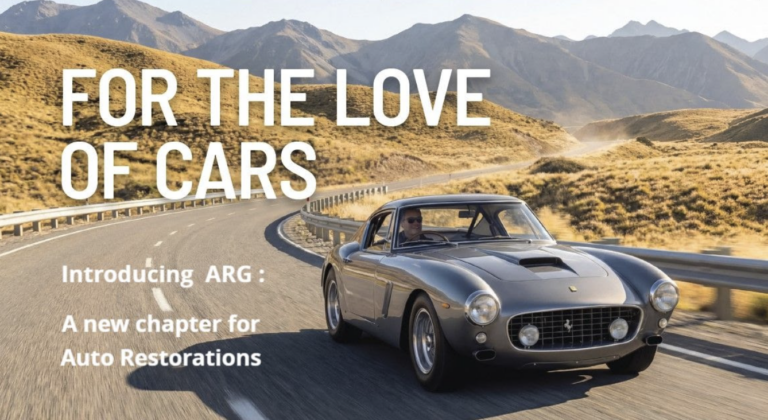
A new chapter for New Zealand’s classic car custodians
In the world of classic and collector cars, continuity matters. Not just of ownership or
provenance, but of care shaped by skilled hands, patience, and deep respect for the machines themselves.
Since 1973, Auto Restorations has existed for this purpose: to ensure these cars live
on, not as relics, but as working expressions of design and engineering. Over more than five decades, we have restored and returned countless vehicles to the road and racetrack, and in recent years expanded our service offering to keep them
performing at their best.
Today, we are proud to introduce the next step in that journey: This is not a reinvention, but a natural evolution. A name that reflects the full scope of what we now offer, while staying true to the standards and values that have always defined us.
Super affordable supercar
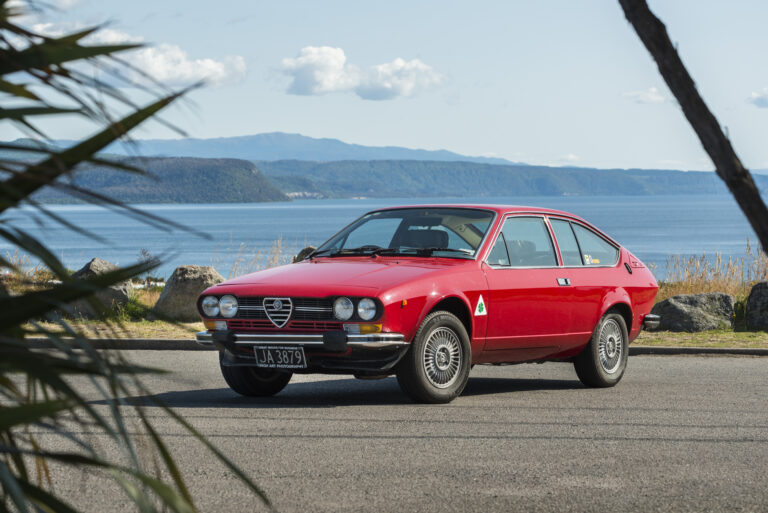
The owner of this 1978 GTV, Stephen Perry, with only a skerrick of wishful thinking, says through half-closed eyes, “It is not dissimilar to the Maserati Khamsin”.
The nose is particularly trim and elegant from all angles, featuring cut-outs for the headlights echoing Alfa’s own exotic Montreal. The body is unfussy, lean with lots of glass, and the roofline shows a faint family resemblance — although on a much more angular car — to the curved waistline of the earlier 105s. The slightly hunched rear means there’s much more space in the rear seats than in the cramped rear of 105s — very much a 2+2 — and a generous boot. These more severe lines are not quite as endearing as the 105’s but they are still classy and clearly European.
Motorman – advancing the skills
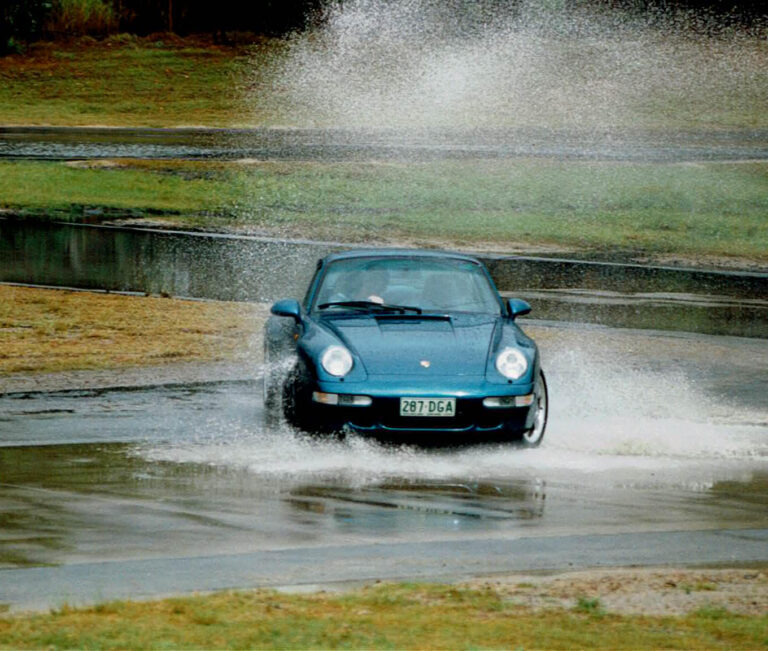
Of course we are all great drivers — definitely above average — until we find out we aren’t. And finding out in a safe way is clearly the major benefit of driver training and why almost all of us who use motor vehicles should experience it.
Driver training applies to all types of cars and commercial vehicles and logically it is even more applicable to high-performance specialist machines — at least for their drivers and passengers — and, of course, if you are not exploiting or understanding the abilities of your car you are not making the most of it.
When I attended the Porsche Experience Driving Centre in Australia more than 20 years ago, one participant told me, “I’ve had my Porsche parked in the garage for several years and have never known how to use it properly — until now.”
Job opportunity – upholster needed urgently!
HELP!
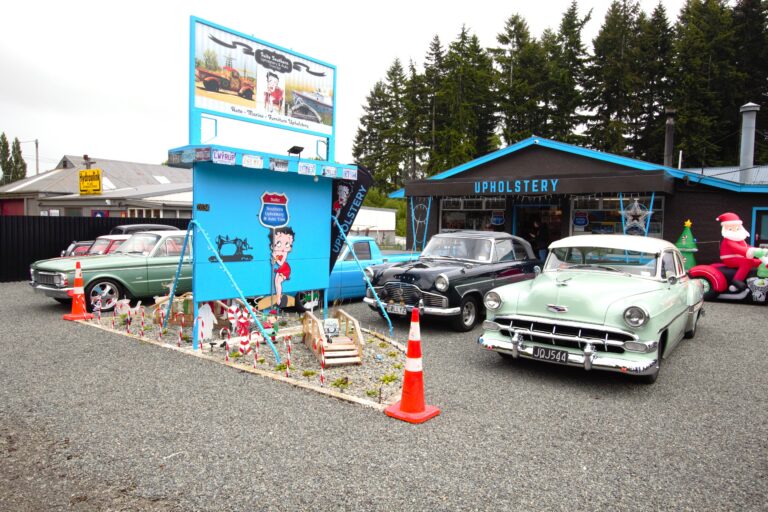
Bren Mathers and Scott Flynn from Suite Southern Upholstery and Auto Trim urgently require assistance from someone with a knack for upholstery.
“We would prefer someone who is already trained in upholstery skills or has the skills to do the work,” Bren said.
Based in Dipton, in rural Northern Southland, the on-the-go business is expanding with a new sample room and extra sheds.
Suite Southern Upholstery carries out a range of upholstery work, from automotive and household furniture and craftwork to marine work.
They currently have eight cars booked in for work, so expect to be busy!
The business has a great reputation for the quality of its work throughout the classic car network, and as far away as Auckland.
If you want to work for a great firm full-time or hours to suit, in a peaceful country work environment, give Bren or Scott a call on 021 685 157
or 03 214 0523.
Check them out on Facebook!
Breakfast of champions – Brink
Some older readers may recall the amusing late 60s advertisement for a breakfast drink using World Champion racing driver Graham Hill which was made while he was out here competing in the Tasman Series.
“Drink Brink” was the phrase, subtly altered by Graham’s characteristic lisp into “Dwink Bwinkl” which drew a grin or two.
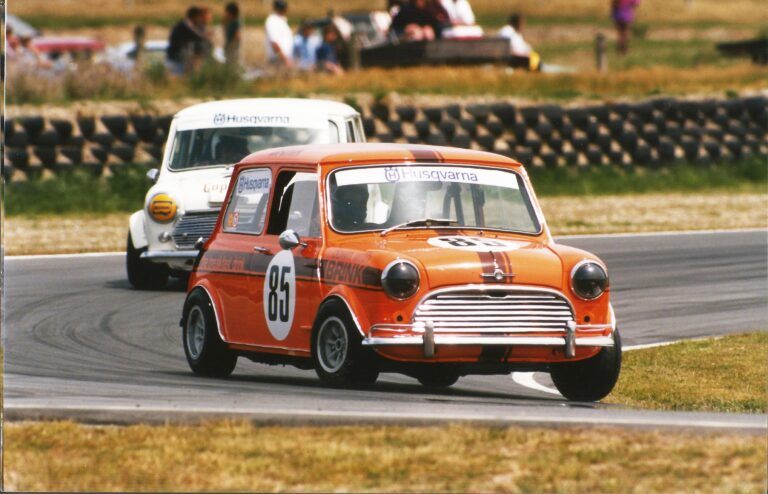
Southland Mini racing enthusiast Howard Kingsford-Smith has preserved a little bit of Mini racing history when he re-created the “Brink Mini” some 25 years ago.
“I bought what remained of the original car and made a replica I suppose or look-a-like of the original Brink Mini from Cathy Henderson about 25 years ago,” Howard explained.
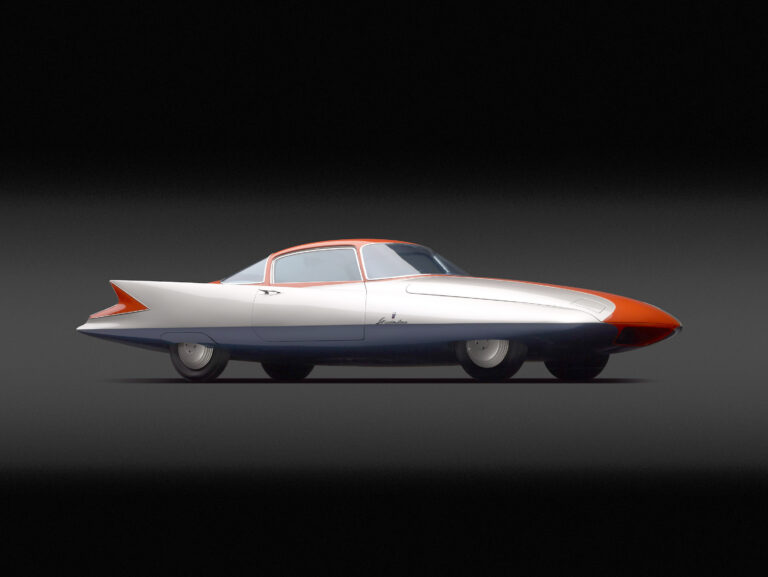
The motor car as an art form
We have certainly come a long way since the exhibition entitled 8 Automobiles, shown at the Museum of Modern Art in New York in the autumn of 1951, the first exhibition concerned with the aesthetics of motor car design.
It was here that the often-used term ‘rolling sculpture’ was coined by curator Philip C Johnson, director of the department of architecture and design, when he said, “An automobile is a familiar 20th century artefact, and is no less worthy of being judged for its visual appeal than a building or a chair. Automobiles are hollow, rolling sculptures, and their design refinements are fascinating. We have selected cars whose details and basic design suggest that automobiles, besides being America’s most useful objects, could be a source of visual experience more enjoyable than they now are.”
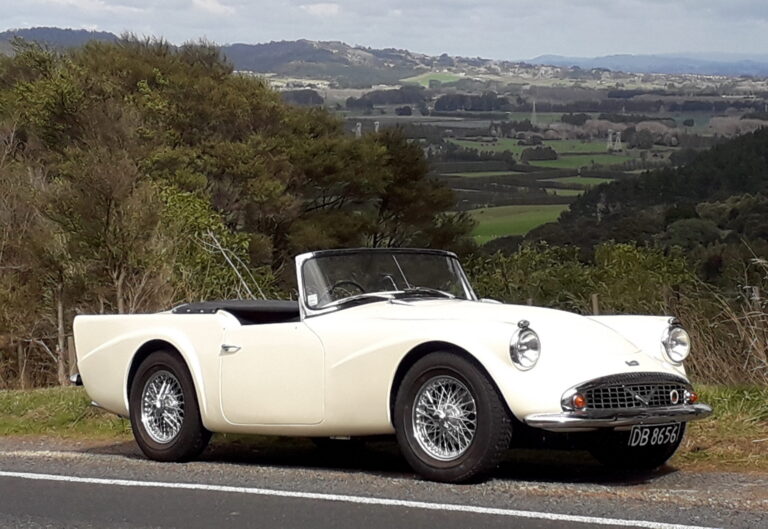
More to the point
This Daimler SP252 is so rare, few people know it exists. It’s one of a kind. It’s the only surviving, in fact the only SP252 ever completed; the would-be successor to the SP250 Daimler Dart. It is also the last sports car to have been designed by Jaguar’s legendary founder, Sir William Lyons.
Perhaps one of the original Dart’s biggest problems was it’s somewhat-divisive looks. It certainly went well enough to win fans, although Sir William wasn’t among them. It crushed the opposition in the Bathurst six-hour race, finishing five laps ahead of anyone else, and it was snapped up by police forces in Britain, Australia, and New Zealand, as it was the fastest thing on the road.
So you’d think a stunning new body with the magic Lyons touch would have been a surefire success. Why this car never made it into production is still something of a mystery, as the official explanations barely stack up.
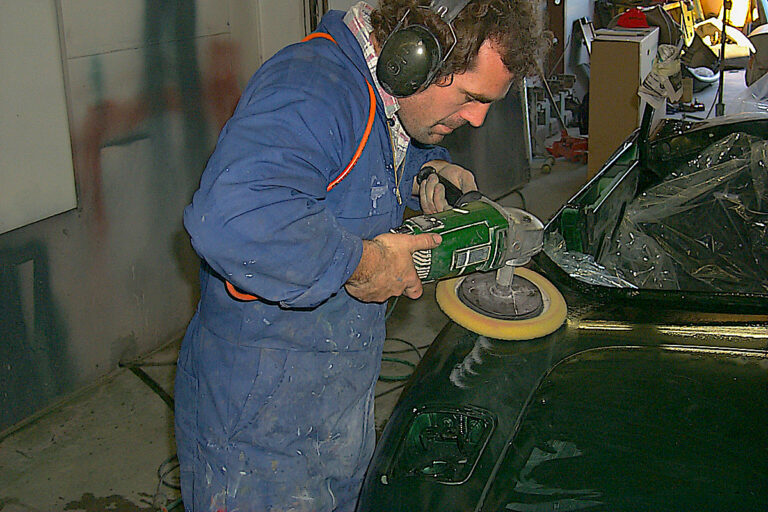
Polishing to perfection
The secret to a show-stopping finish is colour sanding, no matter which paint system you use. Even a good painter, no matter how experienced or talented — like my mate Bruce Haye, CEO at Ace Panel and Paint in Whitianga — can’t shoot to a perfect mirror finish. To get that level of perfection, you need to colour sand.
It used to be called ‘rubbing out’ or ‘cutting’, and it was done with pastes that came in cans. They worked — sort of — but the compounds really just rounded off imperfections instead of eliminating them, and they removed a lot of paint in the process. But now your new finish can be made flawless, thanks to microfine sandpapers that come in 1000, 1500, 2000, and even 2500 grit ranges, and Farecla G3 polish — available from automotive paint suppliers.
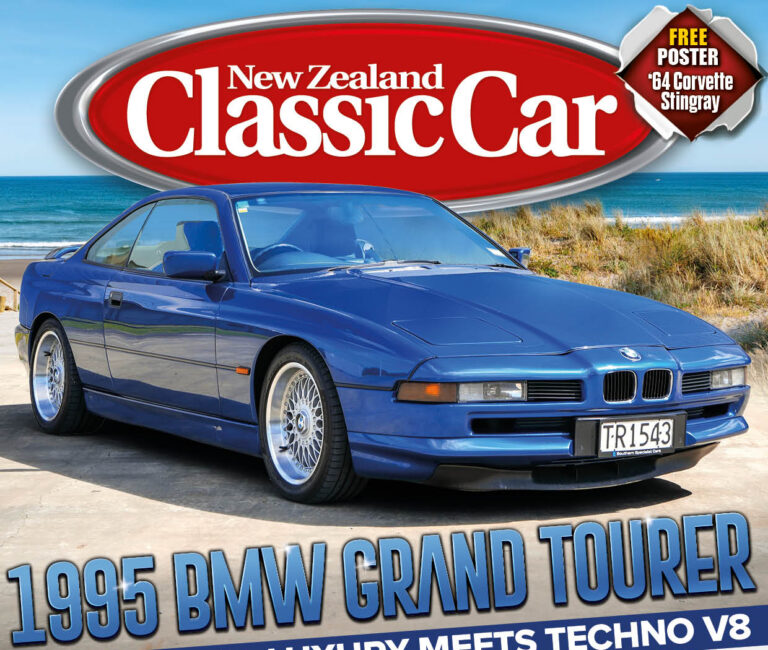
NZ Classic Car magazine, March/April 2026 issue 404, on sale now
BMW’s flagship techno showcase
The supermodel 1995 BMW 840Ci is simply elegant and perfectly engineered.
BMW’s 840 Ci flagship Coupe provides superb comfort and equipment packaged in a stylish body, with grand-touring performance and surprisingly competent handling for its size.
It’s the kind of machine that stands apart from the start. When BMW first unveiled its flagship Grand Tourer at the 1989 Frankfurt Motor Show, the automotive world blinked twice. Sleek, low, and impossibly modern for its era, it combined drama with a sort of purposeful understatement. This silhouette still looks striking today, long after its peers have faded into obscurity.
Initially offered with a range of engines, the model you’re reading about is the V8 iteration, featuring a 4.0-litre eight-cylinder heart under its long bonnet and a smooth five-speed automatic at the back. It wasn’t about blistering sprint times so much as effortless velocity. There was power on tap, sure, but the way it delivered thrust felt unhurried and measured – the automotive equivalent of a deep exhale on a long drive.
Poster 1964 Chevrolet Corvette Stingray, C2
Family pet
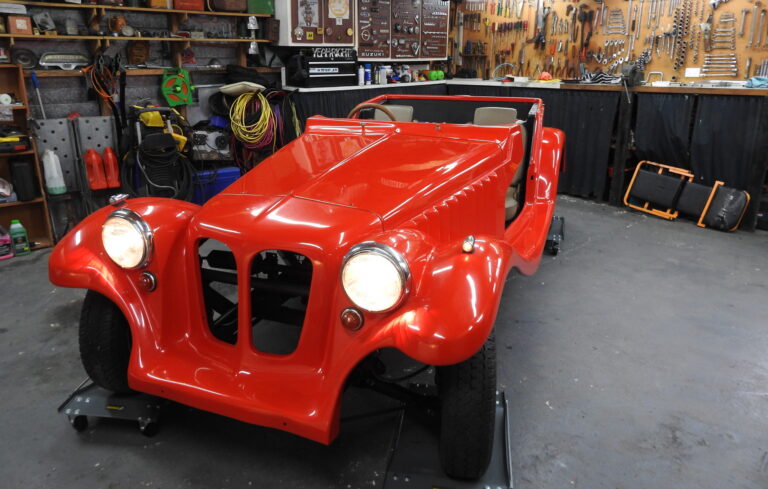
Diana and Fred Vermeulen from Manurewa, Auckland, have been involved with cars and car clubs for most of their married life. In the early days, it was all about Vauxhalls. At one stage they were president and secretary of the Vauxhall Owners Club. They have lost track of how many Vauxhalls have passed through their hands. Now, their garage contains a classic ’62 Oldsmobile and an ’80s Ford panel van, behind which is a kit car that few in this country will have heard of. It’s a Bulldog — the squat, flat-nosed dog with short legs beloved of the political cartoonists of last century as a symbol of the British spirit. For its automotive equivalent, most will think of the Austin Allegro.
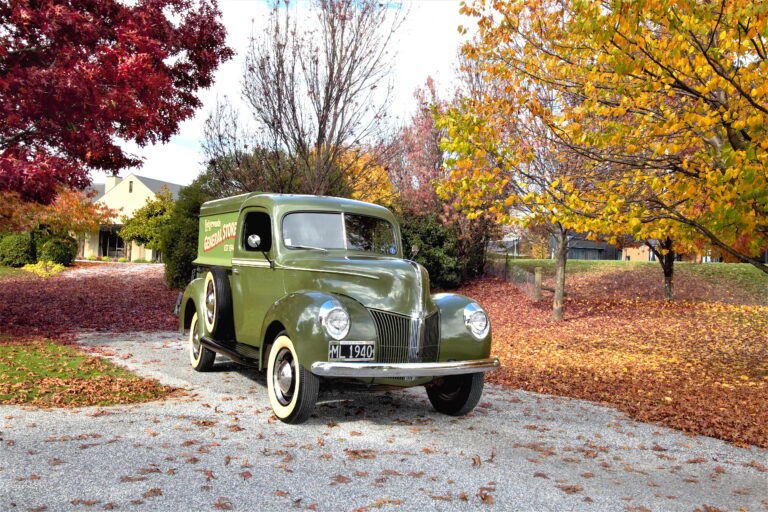
Picking over the past – 1940 Ford V8 ½-Ton Pickup
Jim and Daphne Ledgerwood have been around Fords most of their lives. They love their Ford coupés and two door hardtops, while also making room for an occasional Chevrolet. Their Wanaka based ‘Originals’ collection, featured in New Zealand Classic Car’s July 2022 issue is headed by an outstanding time-warp black 1940 Ford Coupé, its original factory assembly markings and documents offering something of a nostalgia trip.
Jim’s early days in hotrodding in Dunedin were spent building up a number of early Ford pickups and he became a prolific builder of modified pickups.
“I had lots of early Ford V8s in those days and once I had finished them I often sold them on. I would run out of garage space. I had up to a dozen restored Fords at most times then.”